

occur. Flavonoids are often hydroxylated in positions 3, 5, 7, 2, 3′, 4′, and 5′. When
glycosides are formed, the glycosidic linkage is normally placed in positions 3 or 7
and the carbohydrate can be glucorhamnose, galactose, L-rhamnose, D-glucose, or
arabinose (Narayana et al. 2001).
The presence of bioactive natural compounds (phenolic compounds) in plant
products like vegetables, fruits and legumes offer protection afforded by their
consumption. Phenolic compounds are well-known phytochemicals found in all
plants. Phenolic compounds are manufactured by plants as a result of reaction to
physiological or ecological pressures such as pests and diseases attack, wounding
and UV radiation (Ali et al. 2013; Kennedy and Wightman 2011) The aromatic ring
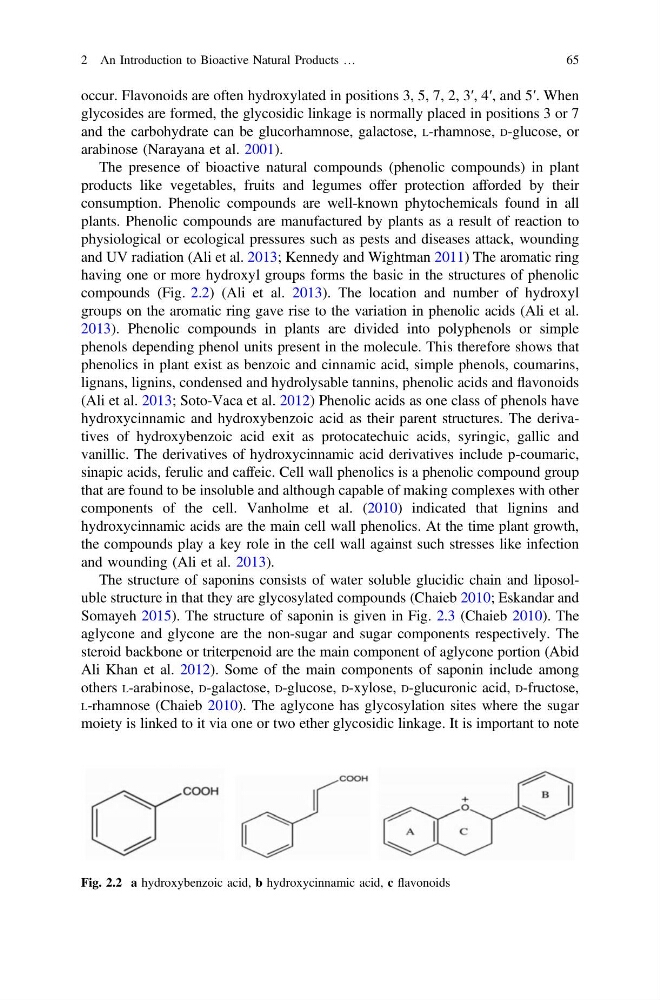
having one or more hydroxyl groups forms the basic in the structures of phenolic
compounds (Fig. 2.2) (Ali et al. 2013). The location and number of hydroxyl
groups on the aromatic ring gave rise to the variation in phenolic acids (Ali et al.
2013). Phenolic compounds in plants are divided into polyphenols or simple
phenols depending phenol units present in the molecule. This therefore shows that
phenolics in plant exist as benzoic and cinnamic acid, simple phenols, coumarins,
lignans, lignins, condensed and hydrolysable tannins, phenolic acids and flavonoids
(Ali et al. 2013; Soto-Vaca et al. 2012) Phenolic acids as one class of phenols have
hydroxycinnamic and hydroxybenzoic acid as their parent structures. The derivatives of hydroxybenzoic acid exit as protocatechuic acids, syringic, gallic and
vanillic. The derivatives of hydroxycinnamic acid derivatives include p-coumaric,
sinapic acids, ferulic and caffeic. Cell wall phenolics is a phenolic compound group
that are found to be insoluble and although capable of making complexes with other
components of the cell. Vanholme et al. (2010) indicated that lignins and
hydroxycinnamic acids are the main cell wall phenolics. At the time plant growth,
the compounds play a key role in the cell wall against such stresses like infection
and wounding (Ali et al. 2013).
The structure of saponins consists of water soluble glucidic chain and liposoluble structure in that they are glycosylated compounds (Chaieb 2010; Eskandar and
Somayeh 2015). The structure of saponin is given in Fig. 2.3 (Chaieb 2010). The
aglycone and glycone are the non-sugar and sugar components respectively. The
steroid backbone or triterpenoid are the main component of aglycone portion (Abid
Ali Khan et al. 2012). Some of the main components of saponin include among
others L-arabinose, D-galactose, D-glucose, D-xylose, D-glucuronic acid, D-fructose,
L-rhamnose (Chaieb 2010). The aglycone has glycosylation sites where the sugar
moiety is linked to it via one or two ether glycosidic linkage. It is important to note
Fig. 2.2 a hydroxybenzoic acid, b hydroxycinnamic acid, c flavonoids
2 An Introduction to Bioactive Natural Products …
65
glycosides are formed, the glycosidic linkage is normally placed in positions 3 or 7
and the carbohydrate can be glucorhamnose, galactose, L-rhamnose, D-glucose, or
arabinose (Narayana et al. 2001).
The presence of bioactive natural compounds (phenolic compounds) in plant
products like vegetables, fruits and legumes offer protection afforded by their
consumption. Phenolic compounds are well-known phytochemicals found in all
plants. Phenolic compounds are manufactured by plants as a result of reaction to
physiological or ecological pressures such as pests and diseases attack, wounding
and UV radiation (Ali et al. 2013; Kennedy and Wightman 2011) The aromatic ring
having one or more hydroxyl groups forms the basic in the structures of phenolic
compounds (Fig. 2.2) (Ali et al. 2013). The location and number of hydroxyl
groups on the aromatic ring gave rise to the variation in phenolic acids (Ali et al.
2013). Phenolic compounds in plants are divided into polyphenols or simple
phenols depending phenol units present in the molecule. This therefore shows that
phenolics in plant exist as benzoic and cinnamic acid, simple phenols, coumarins,
lignans, lignins, condensed and hydrolysable tannins, phenolic acids and flavonoids
(Ali et al. 2013; Soto-Vaca et al. 2012) Phenolic acids as one class of phenols have
hydroxycinnamic and hydroxybenzoic acid as their parent structures. The derivatives of hydroxybenzoic acid exit as protocatechuic acids, syringic, gallic and
vanillic. The derivatives of hydroxycinnamic acid derivatives include p-coumaric,
sinapic acids, ferulic and caffeic. Cell wall phenolics is a phenolic compound group
that are found to be insoluble and although capable of making complexes with other
components of the cell. Vanholme et al. (2010) indicated that lignins and
hydroxycinnamic acids are the main cell wall phenolics. At the time plant growth,
the compounds play a key role in the cell wall against such stresses like infection
and wounding (Ali et al. 2013).
The structure of saponins consists of water soluble glucidic chain and liposoluble structure in that they are glycosylated compounds (Chaieb 2010; Eskandar and
Somayeh 2015). The structure of saponin is given in Fig. 2.3 (Chaieb 2010). The
aglycone and glycone are the non-sugar and sugar components respectively. The
steroid backbone or triterpenoid are the main component of aglycone portion (Abid
Ali Khan et al. 2012). Some of the main components of saponin include among
others L-arabinose, D-galactose, D-glucose, D-xylose, D-glucuronic acid, D-fructose,
L-rhamnose (Chaieb 2010). The aglycone has glycosylation sites where the sugar
moiety is linked to it via one or two ether glycosidic linkage. It is important to note
Fig. 2.2 a hydroxybenzoic acid, b hydroxycinnamic acid, c flavonoids
2 An Introduction to Bioactive Natural Products …
65