

that the aglycone may consist in it one or more unsaturated carbon to carbon (C–C)
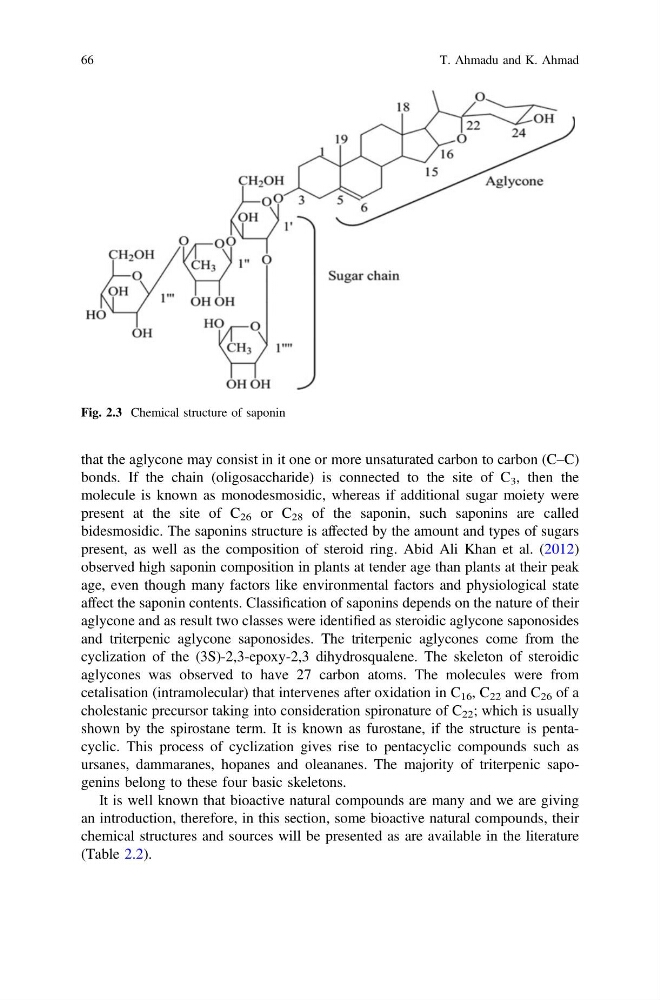
bonds. If the chain (oligosaccharide) is connected to the site of C 3 , then the
molecule is known as monodesmosidic, whereas if additional sugar moiety were
present at the site of C 26 or C 28 of the saponin, such saponins are called
bidesmosidic. The saponins structure is affected by the amount and types of sugars
present, as well as the composition of steroid ring. Abid Ali Khan et al. (2012)
observed high saponin composition in plants at tender age than plants at their peak
age, even though many factors like environmental factors and physiological state
affect the saponin contents. Classification of saponins depends on the nature of their
aglycone and as result two classes were identified as steroidic aglycone saponosides
and triterpenic aglycone saponosides. The triterpenic aglycones come from the
cyclization of the (3S)-2,3-epoxy-2,3 dihydrosqualene. The skeleton of steroidic
aglycones was observed to have 27 carbon atoms. The molecules were from
cetalisation (intramolecular) that intervenes after oxidation in C 16 , C 22 and C 26 of a
cholestanic precursor taking into consideration spironature of C 22 ; which is usually
shown by the spirostane term. It is known as furostane, if the structure is pentacyclic. This process of cyclization gives rise to pentacyclic compounds such as
ursanes, dammaranes, hopanes and oleananes. The majority of triterpenic sapogenins belong to these four basic skeletons.
It is well known that bioactive natural compounds are many and we are giving
an introduction, therefore, in this section, some bioactive natural compounds, their
chemical structures and sources will be presented as are available in the literature
(Table 2.2).
Fig. 2.3 Chemical structure of saponin
66
T. Ahmadu and K. Ahmad
bonds. If the chain (oligosaccharide) is connected to the site of C 3 , then the
molecule is known as monodesmosidic, whereas if additional sugar moiety were
present at the site of C 26 or C 28 of the saponin, such saponins are called
bidesmosidic. The saponins structure is affected by the amount and types of sugars
present, as well as the composition of steroid ring. Abid Ali Khan et al. (2012)
observed high saponin composition in plants at tender age than plants at their peak
age, even though many factors like environmental factors and physiological state
affect the saponin contents. Classification of saponins depends on the nature of their
aglycone and as result two classes were identified as steroidic aglycone saponosides
and triterpenic aglycone saponosides. The triterpenic aglycones come from the
cyclization of the (3S)-2,3-epoxy-2,3 dihydrosqualene. The skeleton of steroidic
aglycones was observed to have 27 carbon atoms. The molecules were from
cetalisation (intramolecular) that intervenes after oxidation in C 16 , C 22 and C 26 of a
cholestanic precursor taking into consideration spironature of C 22 ; which is usually
shown by the spirostane term. It is known as furostane, if the structure is pentacyclic. This process of cyclization gives rise to pentacyclic compounds such as
ursanes, dammaranes, hopanes and oleananes. The majority of triterpenic sapogenins belong to these four basic skeletons.
It is well known that bioactive natural compounds are many and we are giving
an introduction, therefore, in this section, some bioactive natural compounds, their
chemical structures and sources will be presented as are available in the literature
(Table 2.2).
Fig. 2.3 Chemical structure of saponin
66
T. Ahmadu and K. Ahmad