

F. racemosa have shown excellent biological activity with different modes of action
and are reported as candidates for controlling diabetes disease (Deepa et al. 2018).
2.3 Phytochemistry of Bioactive Natural Compounds
The leaves, roots, stem bark, flowers, seeds, pulp, rhizomes and the essential oils of
medicinal plants are known to possess various bioactive natural compounds
(Bahare et al. 2019; Baliga et al. 2011). Essentially, these phytochemicals could be
produced by these plants as flavonoids, saponins, phenolic acids, alkaloids, tannin,
glycosides, terpenoids, polysaccharides and stilbenes which are investigated
intensively for their chemical constituents. Flavonoids are a group of natural
bioactive compounds with more than 4000 varieties that have been identified
(Shashank and Abhay 2013). Flavonoids are chemically a structure with a skeleton
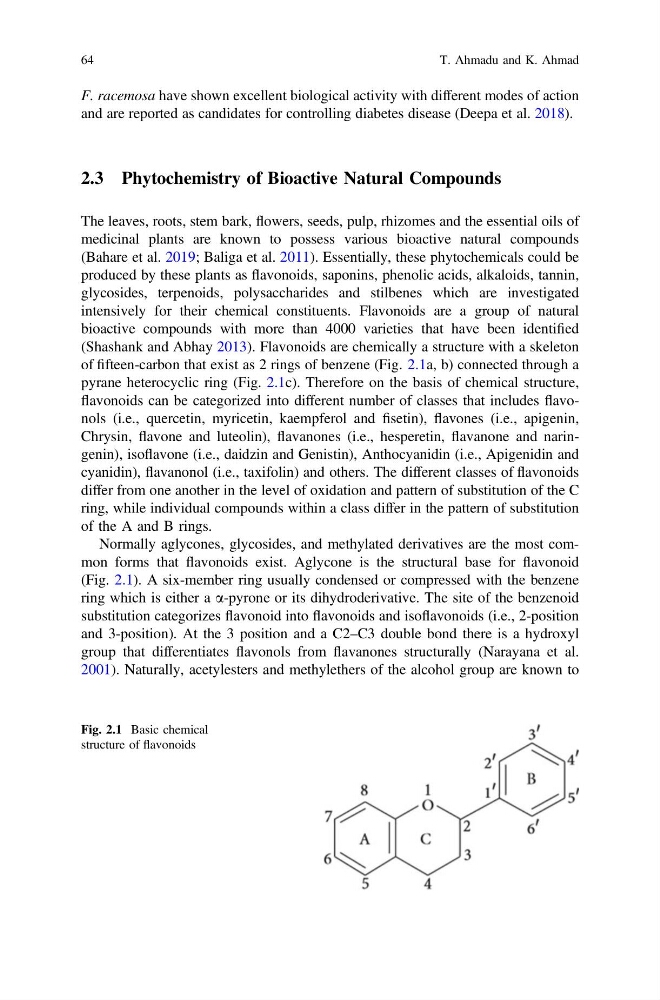
of fifteen-carbon that exist as 2 rings of benzene (Fig. 2.1a, b) connected through a
pyrane heterocyclic ring (Fig. 2.1c). Therefore on the basis of chemical structure,
flavonoids can be categorized into different number of classes that includes flavonols (i.e., quercetin, myricetin, kaempferol and fisetin), flavones (i.e., apigenin,
Chrysin, flavone and luteolin), flavanones (i.e., hesperetin, flavanone and naringenin), isoflavone (i.e., daidzin and Genistin), Anthocyanidin (i.e., Apigenidin and
cyanidin), flavanonol (i.e., taxifolin) and others. The different classes of flavonoids
differ from one another in the level of oxidation and pattern of substitution of the C
ring, while individual compounds within a class differ in the pattern of substitution
of the A and B rings.
Normally aglycones, glycosides, and methylated derivatives are the most common forms that flavonoids exist. Aglycone is the structural base for flavonoid
(Fig. 2.1). A six-member ring usually condensed or compressed with the benzene
ring which is either a a-pyrone or its dihydroderivative. The site of the benzenoid
substitution categorizes flavonoid into flavonoids and isoflavonoids (i.e., 2-position
and 3-position). At the 3 position and a C2–C3 double bond there is a hydroxyl
group that differentiates flavonols from flavanones structurally (Narayana et al.
2001). Naturally, acetylesters and methylethers of the alcohol group are known to
Fig. 2.1 Basic chemical
structure of flavonoids
64
T. Ahmadu and K. Ahmad
and are reported as candidates for controlling diabetes disease (Deepa et al. 2018).
2.3 Phytochemistry of Bioactive Natural Compounds
The leaves, roots, stem bark, flowers, seeds, pulp, rhizomes and the essential oils of
medicinal plants are known to possess various bioactive natural compounds
(Bahare et al. 2019; Baliga et al. 2011). Essentially, these phytochemicals could be
produced by these plants as flavonoids, saponins, phenolic acids, alkaloids, tannin,
glycosides, terpenoids, polysaccharides and stilbenes which are investigated
intensively for their chemical constituents. Flavonoids are a group of natural
bioactive compounds with more than 4000 varieties that have been identified
(Shashank and Abhay 2013). Flavonoids are chemically a structure with a skeleton
of fifteen-carbon that exist as 2 rings of benzene (Fig. 2.1a, b) connected through a
pyrane heterocyclic ring (Fig. 2.1c). Therefore on the basis of chemical structure,
flavonoids can be categorized into different number of classes that includes flavonols (i.e., quercetin, myricetin, kaempferol and fisetin), flavones (i.e., apigenin,
Chrysin, flavone and luteolin), flavanones (i.e., hesperetin, flavanone and naringenin), isoflavone (i.e., daidzin and Genistin), Anthocyanidin (i.e., Apigenidin and
cyanidin), flavanonol (i.e., taxifolin) and others. The different classes of flavonoids
differ from one another in the level of oxidation and pattern of substitution of the C
ring, while individual compounds within a class differ in the pattern of substitution
of the A and B rings.
Normally aglycones, glycosides, and methylated derivatives are the most common forms that flavonoids exist. Aglycone is the structural base for flavonoid
(Fig. 2.1). A six-member ring usually condensed or compressed with the benzene
ring which is either a a-pyrone or its dihydroderivative. The site of the benzenoid
substitution categorizes flavonoid into flavonoids and isoflavonoids (i.e., 2-position
and 3-position). At the 3 position and a C2–C3 double bond there is a hydroxyl
group that differentiates flavonols from flavanones structurally (Narayana et al.
2001). Naturally, acetylesters and methylethers of the alcohol group are known to
Fig. 2.1 Basic chemical
structure of flavonoids
64
T. Ahmadu and K. Ahmad