

LPS/TLR4 axis. Furthermore, this finding suggests that piperine modulates signaling
pathways associated with the TLR adaptor molecule Toll/IL-1R domain-containing
adaptor inducing interferon (TRIF) and the TLR adaptor protein MyD88, since TLR3
agonists such as poly I:C act via TRIF, TLR9 agonists such as CpG act via MyD88,
and TLR4 agonists such as LPS activate both TRIF and MyD88 signaling pathways
(Trinchieri and Sher 2007). It, therefore, seems likely that piperine acts downstream
of TRIF and MyD88 by targeting NF-jB, which stimulates the production of genes
participating in the inflammatory response (Gasparini and Feldmann 2012). Other
investigators have also reported piperine-mediated suppression of the NF-jB route.
For instance, nuclear aggregation of the NF-jB subunits p65, p50, and cRel is
repressed in piperine-medicated B16-F10 melanoma cells (Pradeep and Kuttan
2004), while piperine interferes with NF-jB transcriptional activation in HT-1080
fibrosarcoma cells (Hwang et al. 2011). Piperine also inhibits the degradation of IjBa
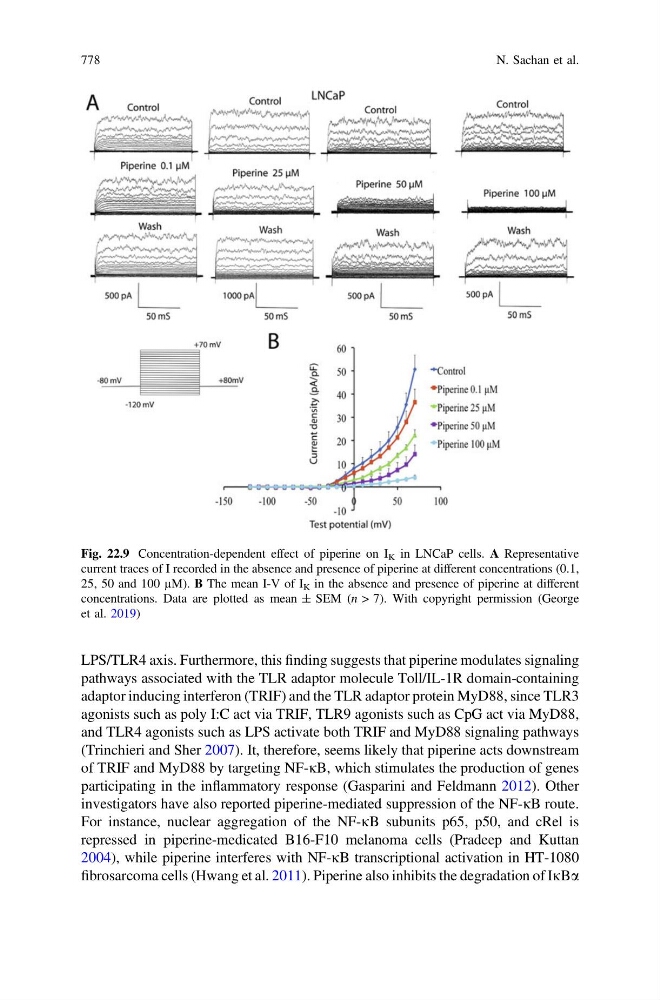
Fig. 22.9 Concentration-dependent effect of piperine on I K in LNCaP cells. A Representative
current traces of I recorded in the absence and presence of piperine at different concentrations (0.1,
25, 50 and 100 µM). B The mean I-V of I K in the absence and presence of piperine at different
concentrations. Data are plotted as mean ± SEM (n > 7). With copyright permission (George
et al. 2019)
778
N. Sachan et al.