

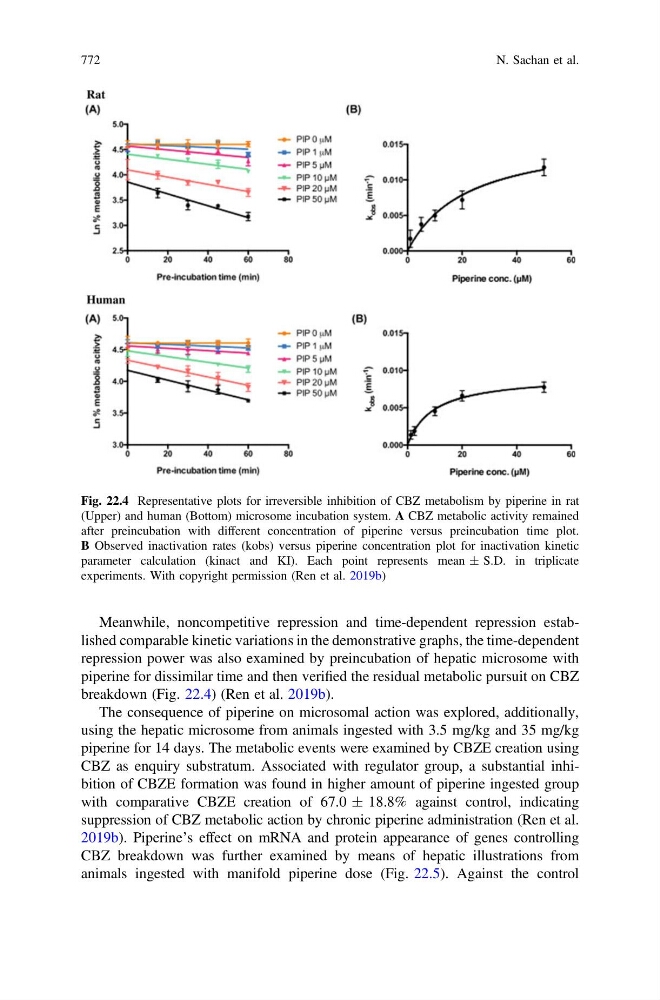
Meanwhile, noncompetitive repression and time-dependent repression established comparable kinetic variations in the demonstrative graphs, the time-dependent
repression power was also examined by preincubation of hepatic microsome with
piperine for dissimilar time and then verified the residual metabolic pursuit on CBZ
breakdown (Fig. 22.4) (Ren et al. 2019b).
The consequence of piperine on microsomal action was explored, additionally,
using the hepatic microsome from animals ingested with 3.5 mg/kg and 35 mg/kg
piperine for 14 days. The metabolic events were examined by CBZE creation using
CBZ as enquiry substratum. Associated with regulator group, a substantial inhibition of CBZE formation was found in higher amount of piperine ingested group
with comparative CBZE creation of 67.0 ± 18.8% against control, indicating
suppression of CBZ metabolic action by chronic piperine administration (Ren et al.
2019b). Piperine’s effect on mRNA and protein appearance of genes controlling
CBZ breakdown was further examined by means of hepatic illustrations from
animals ingested with manifold piperine dose (Fig. 22.5). Against the control
Fig. 22.4 Representative plots for irreversible inhibition of CBZ metabolism by piperine in rat
(Upper) and human (Bottom) microsome incubation system. A CBZ metabolic activity remained
after preincubation with different concentration of piperine versus preincubation time plot.
B Observed inactivation rates (kobs) versus piperine concentration plot for inactivation kinetic
parameter calculation (kinact and KI). Each point represents mean ± S.D. in triplicate
experiments. With copyright permission (Ren et al. 2019b)
772
N. Sachan et al.