

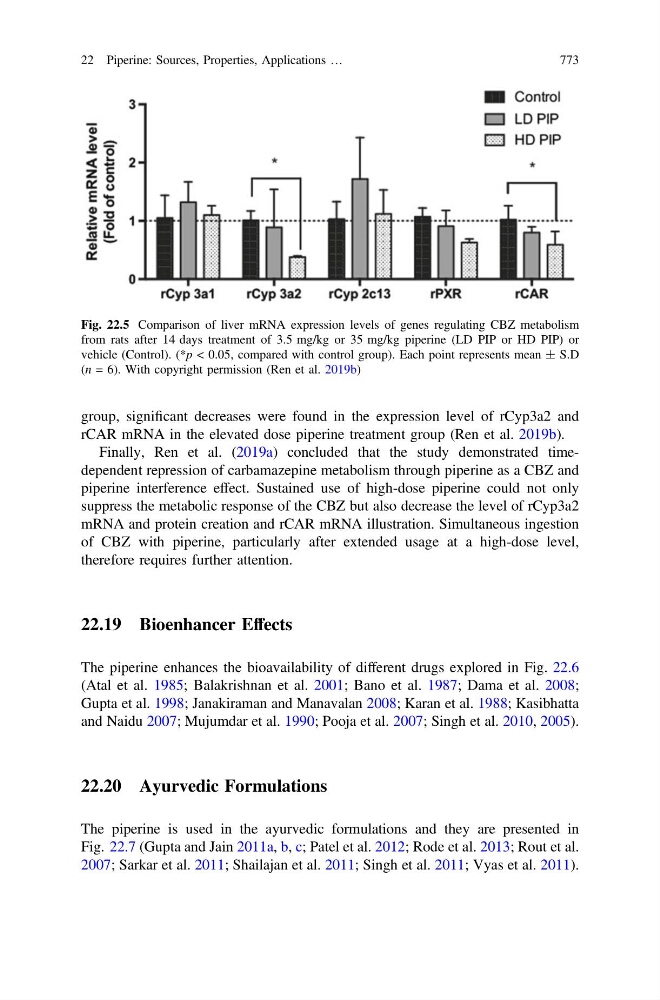
group, significant decreases were found in the expression level of rCyp3a2 and
rCAR mRNA in the elevated dose piperine treatment group (Ren et al. 2019b).
Finally, Ren et al. (2019a) concluded that the study demonstrated timedependent repression of carbamazepine metabolism through piperine as a CBZ and
piperine interference effect. Sustained use of high-dose piperine could not only
suppress the metabolic response of the CBZ but also decrease the level of rCyp3a2
mRNA and protein creation and rCAR mRNA illustration. Simultaneous ingestion
of CBZ with piperine, particularly after extended usage at a high-dose level,
therefore requires further attention.
22.19 Bioenhancer Effects
The piperine enhances the bioavailability of different drugs explored in Fig. 22.6
(Atal et al. 1985; Balakrishnan et al. 2001; Bano et al. 1987; Dama et al. 2008;
Gupta et al. 1998; Janakiraman and Manavalan 2008; Karan et al. 1988; Kasibhatta
and Naidu 2007; Mujumdar et al. 1990; Pooja et al. 2007; Singh et al. 2010, 2005).
22.20 Ayurvedic Formulations
The piperine is used in the ayurvedic formulations and they are presented in
Fig. 22.7 (Gupta and Jain 2011a, b, c; Patel et al. 2012; Rode et al. 2013; Rout et al.
2007; Sarkar et al. 2011; Shailajan et al. 2011; Singh et al. 2011; Vyas et al. 2011).
Fig. 22.5 Comparison of liver mRNA expression levels of genes regulating CBZ metabolism
from rats after 14 days treatment of 3.5 mg/kg or 35 mg/kg piperine (LD PIP or HD PIP) or
vehicle (Control). (*p < 0.05, compared with control group). Each point represents mean ± S.D
(n = 6). With copyright permission (Ren et al. 2019b)
22 Piperine: Sources, Properties, Applications …
773