

product of Carbamazepine in liver by CYP3A4 with lesser concern of CYP2C8
(Kerr et al. 1994) and contributes to seizure control and toxicity (Tomson et al.
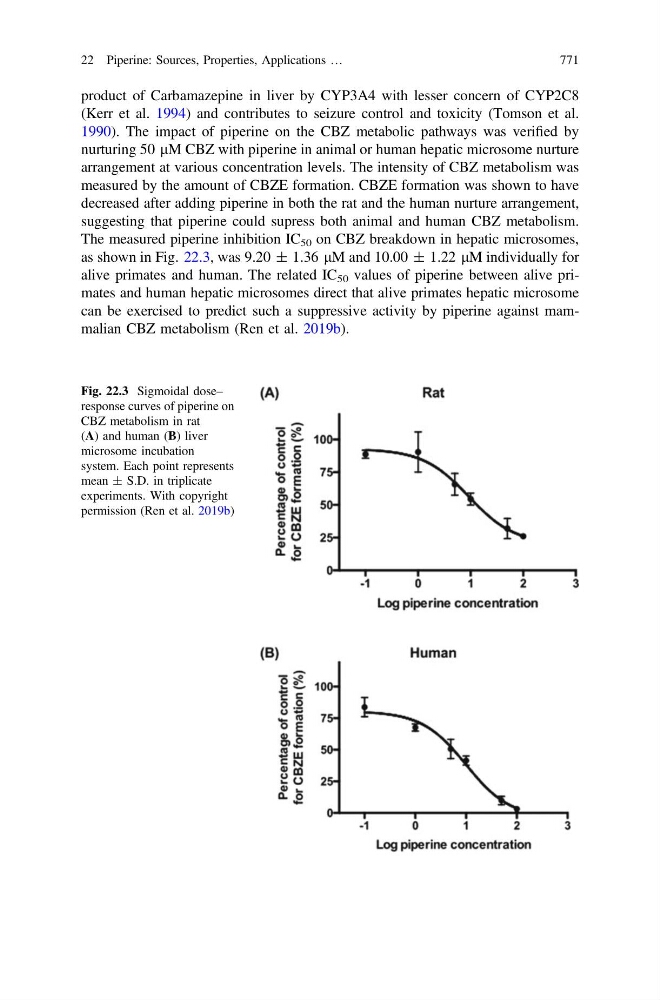
1990). The impact of piperine on the CBZ metabolic pathways was verified by
nurturing 50 lM CBZ with piperine in animal or human hepatic microsome nurture
arrangement at various concentration levels. The intensity of CBZ metabolism was
measured by the amount of CBZE formation. CBZE formation was shown to have
decreased after adding piperine in both the rat and the human nurture arrangement,
suggesting that piperine could supress both animal and human CBZ metabolism.
The measured piperine inhibition IC 50 on CBZ breakdown in hepatic microsomes,
as shown in Fig. 22.3, was 9.20 ± 1.36 lM and 10.00 ± 1.22 lM individually for
alive primates and human. The related IC 50 values of piperine between alive primates and human hepatic microsomes direct that alive primates hepatic microsome
can be exercised to predict such a suppressive activity by piperine against mammalian CBZ metabolism (Ren et al. 2019b).
Fig. 22.3 Sigmoidal dose–
response curves of piperine on
CBZ metabolism in rat
(A) and human (B) liver
microsome incubation
system. Each point represents
mean ± S.D. in triplicate
experiments. With copyright
permission (Ren et al. 2019b)
22 Piperine: Sources, Properties, Applications …
771