

21.9.5 Anti-obesity Action
It is believed that polyphenol-rich diets may relate to anti-obesity action as tannins
possess the ability to interact with adipose tissues like pre-adipocytes, adipose stem
cells, and immune cells directly or indirectly (Sieniawska and Baj 2017)
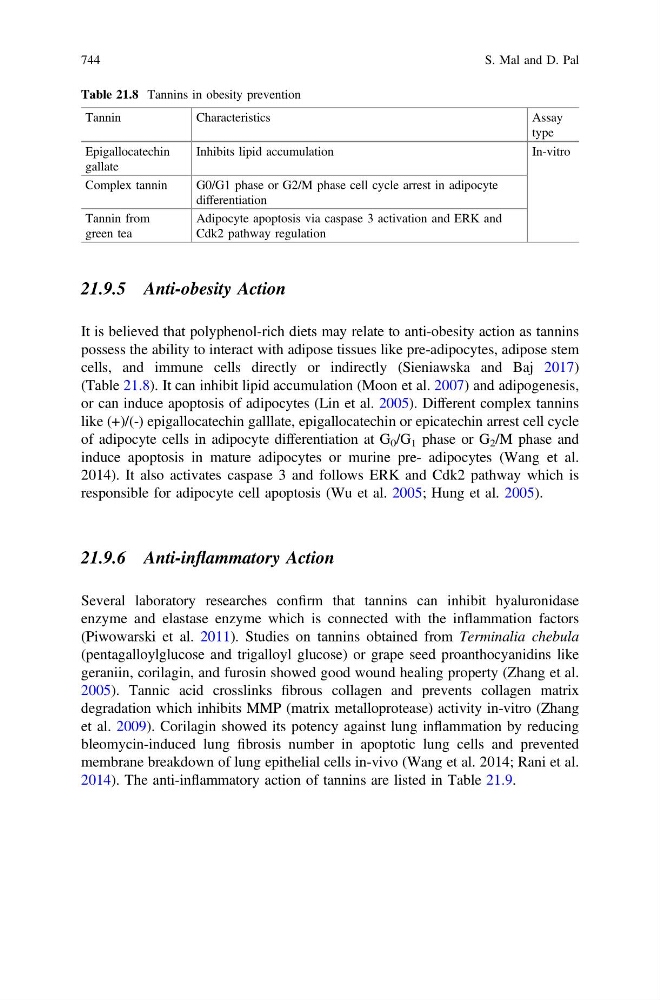
(Table 21.8). It can inhibit lipid accumulation (Moon et al. 2007) and adipogenesis,
or can induce apoptosis of adipocytes (Lin et al. 2005). Different complex tannins
like (+)/(-) epigallocatechin galllate, epigallocatechin or epicatechin arrest cell cycle
of adipocyte cells in adipocyte differentiation at G 0 /G 1 phase or G 2 /M phase and
induce apoptosis in mature adipocytes or murine pre- adipocytes (Wang et al.
2014). It also activates caspase 3 and follows ERK and Cdk2 pathway which is
responsible for adipocyte cell apoptosis (Wu et al. 2005; Hung et al. 2005).
21.9.6 Anti-inflammatory Action
Several laboratory researches confirm that tannins can inhibit hyaluronidase
enzyme and elastase enzyme which is connected with the inflammation factors
(Piwowarski et al. 2011). Studies on tannins obtained from Terminalia chebula
(pentagalloylglucose and trigalloyl glucose) or grape seed proanthocyanidins like
geraniin, corilagin, and furosin showed good wound healing property (Zhang et al.
2005). Tannic acid crosslinks fibrous collagen and prevents collagen matrix
degradation which inhibits MMP (matrix metalloprotease) activity in-vitro (Zhang
et al. 2009). Corilagin showed its potency against lung inflammation by reducing
bleomycin-induced lung fibrosis number in apoptotic lung cells and prevented
membrane breakdown of lung epithelial cells in-vivo (Wang et al. 2014; Rani et al.
2014). The anti-inflammatory action of tannins are listed in Table 21.9.
Table 21.8 Tannins in obesity prevention
Tannin
Characteristics
Assay
type
Epigallocatechin
gallate
Inhibits lipid accumulation
In-vitro
Complex tannin
G0/G1 phase or G2/M phase cell cycle arrest in adipocyte
differentiation
Tannin from
green tea
Adipocyte apoptosis via caspase 3 activation and ERK and
Cdk2 pathway regulation
744
S. Mal and D. Pal