

increasing vascular cyclic guanosin monophosphate (cGMP) levels (Flesch et al.
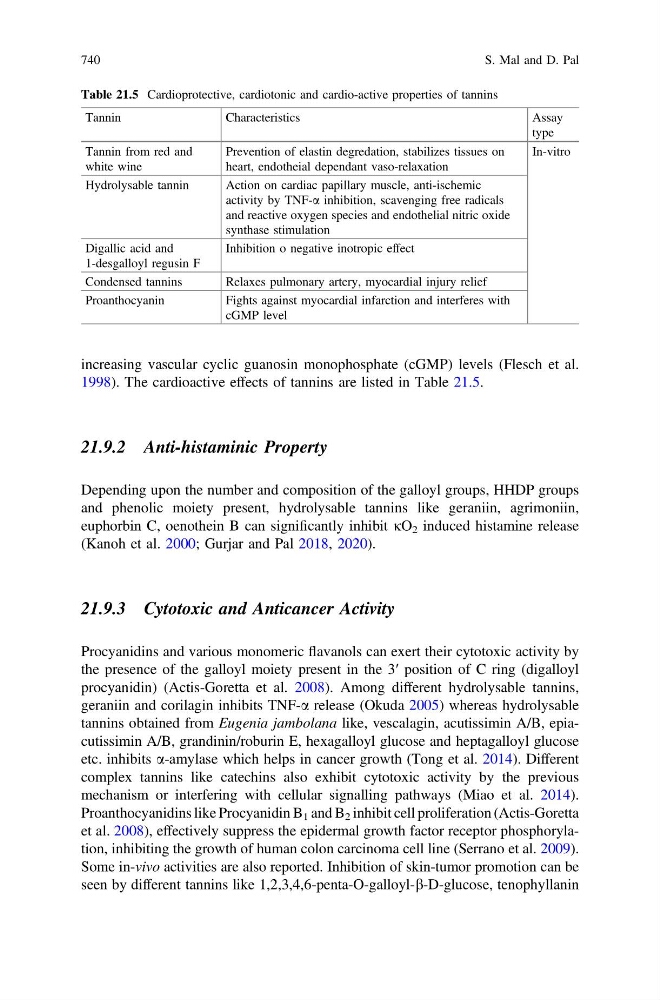
1998). The cardioactive effects of tannins are listed in Table 21.5.
21.9.2 Anti-histaminic Property
Depending upon the number and composition of the galloyl groups, HHDP groups
and phenolic moiety present, hydrolysable tannins like geraniin, agrimoniin,
euphorbin C, oenothein B can significantly inhibit jO 2 induced histamine release
(Kanoh et al. 2000; Gurjar and Pal 2018, 2020).
21.9.3 Cytotoxic and Anticancer Activity
Procyanidins and various monomeric flavanols can exert their cytotoxic activity by
the presence of the galloyl moiety present in the 3′ position of C ring (digalloyl
procyanidin) (Actis-Goretta et al. 2008). Among different hydrolysable tannins,
geraniin and corilagin inhibits TNF-a release (Okuda 2005) whereas hydrolysable
tannins obtained from Eugenia jambolana like, vescalagin, acutissimin A/B, epiacutissimin A/B, grandinin/roburin E, hexagalloyl glucose and heptagalloyl glucose
etc. inhibits a-amylase which helps in cancer growth (Tong et al. 2014). Different
complex tannins like catechins also exhibit cytotoxic activity by the previous
mechanism or interfering with cellular signalling pathways (Miao et al. 2014).
Proanthocyanidins like Procyanidin B 1 and B 2 inhibit cell proliferation (Actis-Goretta
et al. 2008), effectively suppress the epidermal growth factor receptor phosphorylation, inhibiting the growth of human colon carcinoma cell line (Serrano et al. 2009).
Some in-vivo activities are also reported. Inhibition of skin-tumor promotion can be
seen by different tannins like 1,2,3,4,6-penta-O-galloyl-b-D-glucose, tenophyllanin
Table 21.5 Cardioprotective, cardiotonic and cardio-active properties of tannins
Tannin
Characteristics
Assay
type
Tannin from red and
white wine
Prevention of elastin degredation, stabilizes tissues on
heart, endotheial dependant vaso-relaxation
In-vitro
Hydrolysable tannin
Action on cardiac papillary muscle, anti-ischemic
activity by TNF-a inhibition, scavenging free radicals
and reactive oxygen species and endothelial nitric oxide
synthase stimulation
Digallic acid and
1-desgalloyl regusin F
Inhibition o negative inotropic effect
Condensed tannins
Relaxes pulmonary artery, myocardial injury relief
Proanthocyanin
Fights against myocardial infarction and interferes with
cGMP level
740
S. Mal and D. Pal