

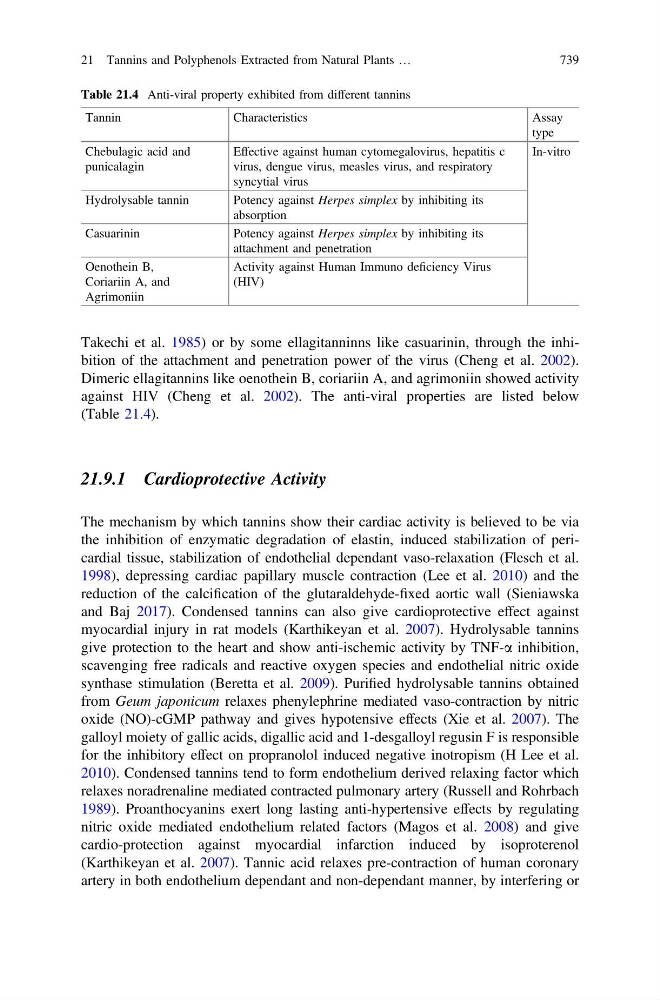
Takechi et al. 1985) or by some ellagitanninns like casuarinin, through the inhibition of the attachment and penetration power of the virus (Cheng et al. 2002).
Dimeric ellagitannins like oenothein B, coriariin A, and agrimoniin showed activity
against HIV (Cheng et al. 2002). The anti-viral properties are listed below
(Table 21.4).
21.9.1 Cardioprotective Activity
The mechanism by which tannins show their cardiac activity is believed to be via
the inhibition of enzymatic degradation of elastin, induced stabilization of pericardial tissue, stabilization of endothelial dependant vaso-relaxation (Flesch et al.
1998), depressing cardiac papillary muscle contraction (Lee et al. 2010) and the
reduction of the calcification of the glutaraldehyde-fixed aortic wall (Sieniawska
and Baj 2017). Condensed tannins can also give cardioprotective effect against
myocardial injury in rat models (Karthikeyan et al. 2007). Hydrolysable tannins
give protection to the heart and show anti-ischemic activity by TNF-a inhibition,
scavenging free radicals and reactive oxygen species and endothelial nitric oxide
synthase stimulation (Beretta et al. 2009). Purified hydrolysable tannins obtained
from Geum japonicum relaxes phenylephrine mediated vaso-contraction by nitric
oxide (NO)-cGMP pathway and gives hypotensive effects (Xie et al. 2007). The
galloyl moiety of gallic acids, digallic acid and 1-desgalloyl regusin F is responsible
for the inhibitory effect on propranolol induced negative inotropism (H Lee et al.
2010). Condensed tannins tend to form endothelium derived relaxing factor which
relaxes noradrenaline mediated contracted pulmonary artery (Russell and Rohrbach
1989). Proanthocyanins exert long lasting anti-hypertensive effects by regulating
nitric oxide mediated endothelium related factors (Magos et al. 2008) and give
cardio-protection against myocardial infarction induced by isoproterenol
(Karthikeyan et al. 2007). Tannic acid relaxes pre-contraction of human coronary
artery in both endothelium dependant and non-dependant manner, by interfering or
Table 21.4 Anti-viral property exhibited from different tannins
Tannin
Characteristics
Assay
type
Chebulagic acid and
punicalagin
Effective against human cytomegalovirus, hepatitis c
virus, dengue virus, measles virus, and respiratory
syncytial virus
In-vitro
Hydrolysable tannin
Potency against Herpes simplex by inhibiting its
absorption
Casuarinin
Potency against Herpes simplex by inhibiting its
attachment and penetration
Oenothein B,
Coriariin A, and
Agrimoniin
Activity against Human Immuno deficiency Virus
(HIV)
21 Tannins and Polyphenols Extracted from Natural Plants …
739