

21.8.2 Anti-microbial Properties
The anti-microbial properties of tannins also have been a field of interest for different researchers. Tannins can show their anti-microbial activity in direct way or
indirect way. The direct way comprises of the action of tannin in microbial
metabolism by affecting oxidative phosphorylation, whereas by inhibiting extracellular microbial enzymes and depriving the substrate required for microbial
growth, tannins exert their indirect way of anti-microbial action (Cardona et al.
2013; Mohanta et al. 2007; Gurjar and Pal 2020; Howell 2001). Gallotannins can
exert bacteriocidal activity on Streptococcus mutans, S. Salivarius, and
Actinomyces viscosus by inhibiting the synthesis of water insoluble glucan
(Wu-Yuan et al. 1988). Different complex tannins like catechins and epigallocatechin gallate showed in-vitro anti-bacterial potency against Helicobacterium pylori,
Escherichia coli (Díaz-Gómez et al. 2014) (Díaz-Gómez et al. 2013). Different
hydrolysable tannins like Tellimagrandin I, rugosin B, corilagin and theasinensin A
(complex tannin) and procyanidin B 3 and B 4 can remarkably reduce the MIC
(minimum inhibitory concentration) of antibiotics like oxacillin, penicillin G,
aminoglycosides and ampicillin in the treatment of methicillin resistant
Staphylococcus aureus (MRSA) (Hatano et al. 2005). Catechins are shown to have
inhibitory property towards Clostridium histolyticum (Cardona et al. 2013). The
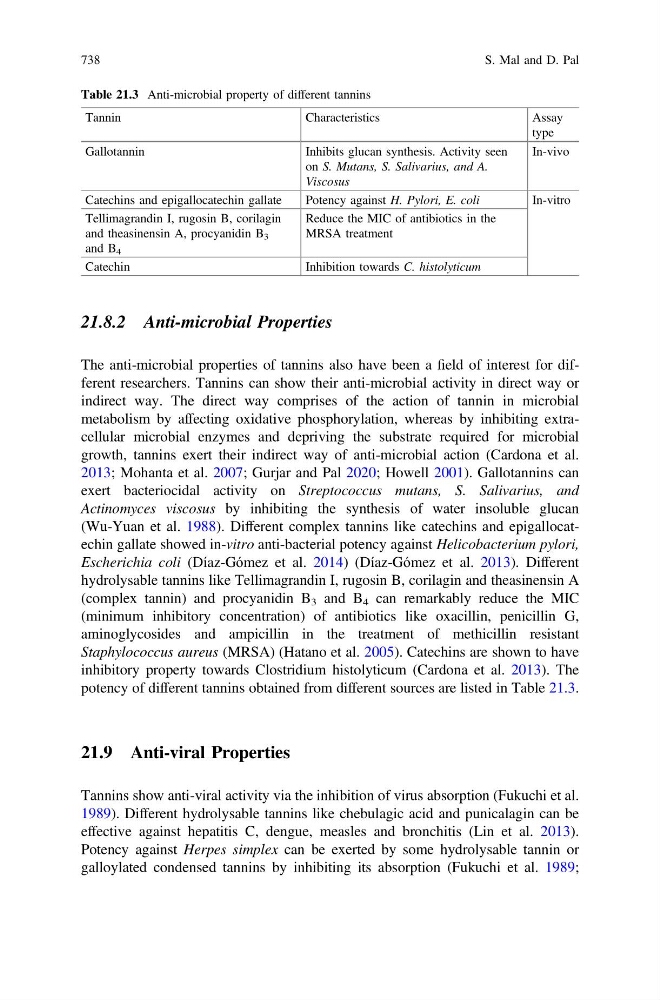
potency of different tannins obtained from different sources are listed in Table 21.3.
21.9 Anti-viral Properties
Tannins show anti-viral activity via the inhibition of virus absorption (Fukuchi et al.
1989). Different hydrolysable tannins like chebulagic acid and punicalagin can be
effective against hepatitis C, dengue, measles and bronchitis (Lin et al. 2013).
Potency against Herpes simplex can be exerted by some hydrolysable tannin or
galloylated condensed tannins by inhibiting its absorption (Fukuchi et al. 1989;
Table 21.3 Anti-microbial property of different tannins
Tannin
Characteristics
Assay
type
Gallotannin
Inhibits glucan synthesis. Activity seen
on S. Mutans, S. Salivarius, and A.
Viscosus
In-vivo
Catechins and epigallocatechin gallate
Potency against H. Pylori, E. coli
In-vitro
Tellimagrandin I, rugosin B, corilagin
and theasinensin A, procyanidin B 3
and B 4
Reduce the MIC of antibiotics in the
MRSA treatment
Catechin
Inhibition towards C. histolyticum
738
S. Mal and D. Pal