

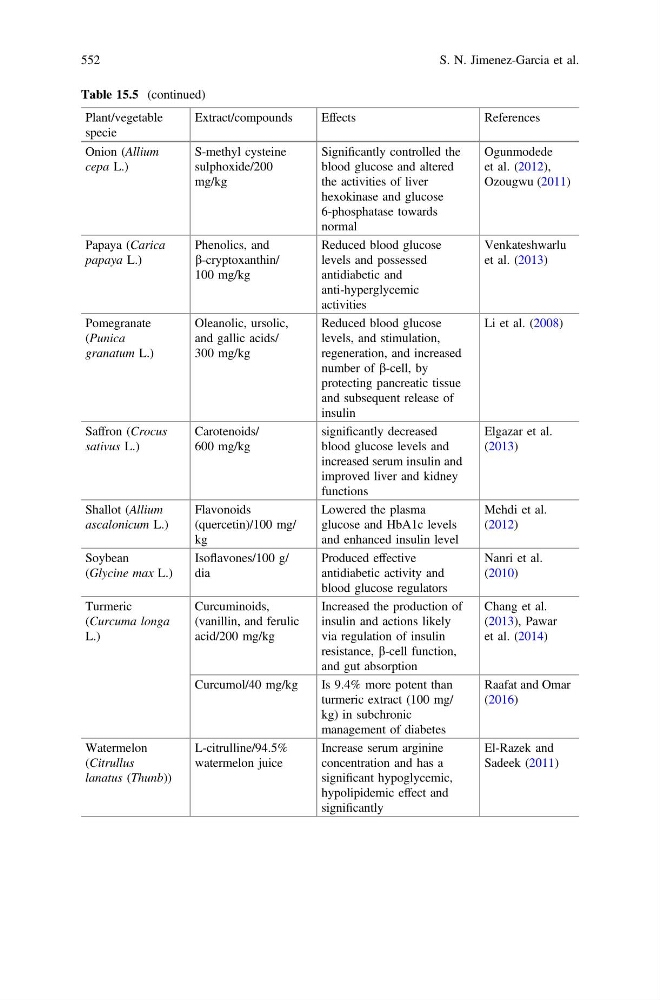
Table 15.5 (continued)
Plant/vegetable
specie
Extract/compounds
Effects
References
Onion (Allium
cepa L.)
S-methyl cysteine
sulphoxide/200
mg/kg
Significantly controlled the
blood glucose and altered
the activities of liver
hexokinase and glucose
6-phosphatase towards
normal
Ogunmodede
et al. (2012),
Ozougwu (2011)
Papaya (Carica
papaya L.)
Phenolics, and
b-cryptoxanthin/
100 mg/kg
Reduced blood glucose
levels and possessed
antidiabetic and
anti-hyperglycemic
activities
Venkateshwarlu
et al. (2013)
Pomegranate
(Punica
granatum L.)
Oleanolic, ursolic,
and gallic acids/
300 mg/kg
Reduced blood glucose
levels, and stimulation,
regeneration, and increased
number of b-cell, by
protecting pancreatic tissue
and subsequent release of
insulin
Li et al. (2008)
Saffron (Crocus
sativus L.)
Carotenoids/
600 mg/kg
significantly decreased
blood glucose levels and
increased serum insulin and
improved liver and kidney
functions
Elgazar et al.
(2013)
Shallot (Allium
ascalonicum L.)
Flavonoids
(quercetin)/100 mg/
kg
Lowered the plasma
glucose and HbA1c levels
and enhanced insulin level
Mehdi et al.
(2012)
Soybean
(Glycine max L.)
Isoflavones/100 g/
dia
Produced effective
antidiabetic activity and
blood glucose regulators
Nanri et al.
(2010)
Turmeric
(Curcuma longa
L.)
Curcuminoids,
(vanillin, and ferulic
acid/200 mg/kg
Increased the production of
insulin and actions likely
via regulation of insulin
resistance, b-cell function,
and gut absorption
Chang et al.
(2013), Pawar
et al. (2014)
Curcumol/40 mg/kg
Is 9.4% more potent than
turmeric extract (100 mg/
kg) in subchronic
management of diabetes
Raafat and Omar
(2016)
Watermelon
(Citrullus
lanatus (Thunb))
L-citrulline/94.5%
watermelon juice
Increase serum arginine
concentration and has a
significant hypoglycemic,
hypolipidemic effect and
significantly
El-Razek and
Sadeek (2011)
552
S. N. Jimenez-Garcia et al.
Plant/vegetable
specie
Extract/compounds
Effects
References
Onion (Allium
cepa L.)
S-methyl cysteine
sulphoxide/200
mg/kg
Significantly controlled the
blood glucose and altered
the activities of liver
hexokinase and glucose
6-phosphatase towards
normal
Ogunmodede
et al. (2012),
Ozougwu (2011)
Papaya (Carica
papaya L.)
Phenolics, and
b-cryptoxanthin/
100 mg/kg
Reduced blood glucose
levels and possessed
antidiabetic and
anti-hyperglycemic
activities
Venkateshwarlu
et al. (2013)
Pomegranate
(Punica
granatum L.)
Oleanolic, ursolic,
and gallic acids/
300 mg/kg
Reduced blood glucose
levels, and stimulation,
regeneration, and increased
number of b-cell, by
protecting pancreatic tissue
and subsequent release of
insulin
Li et al. (2008)
Saffron (Crocus
sativus L.)
Carotenoids/
600 mg/kg
significantly decreased
blood glucose levels and
increased serum insulin and
improved liver and kidney
functions
Elgazar et al.
(2013)
Shallot (Allium
ascalonicum L.)
Flavonoids
(quercetin)/100 mg/
kg
Lowered the plasma
glucose and HbA1c levels
and enhanced insulin level
Mehdi et al.
(2012)
Soybean
(Glycine max L.)
Isoflavones/100 g/
dia
Produced effective
antidiabetic activity and
blood glucose regulators
Nanri et al.
(2010)
Turmeric
(Curcuma longa
L.)
Curcuminoids,
(vanillin, and ferulic
acid/200 mg/kg
Increased the production of
insulin and actions likely
via regulation of insulin
resistance, b-cell function,
and gut absorption
Chang et al.
(2013), Pawar
et al. (2014)
Curcumol/40 mg/kg
Is 9.4% more potent than
turmeric extract (100 mg/
kg) in subchronic
management of diabetes
Raafat and Omar
(2016)
Watermelon
(Citrullus
lanatus (Thunb))
L-citrulline/94.5%
watermelon juice
Increase serum arginine
concentration and has a
significant hypoglycemic,
hypolipidemic effect and
significantly
El-Razek and
Sadeek (2011)
552
S. N. Jimenez-Garcia et al.