

1.4.3.8 Effects of Phenylalanine, Salicylic Acid and Chitosan
on Secondary Metabolites of Coleus aromaticus Benth
Govindaraju et al. experimentally confirmed the importance of phenylalanine,
salicylic acid and chitosan as dual abiotic-biotic elicitor on the accumulation of
alkaloid, flavonoid, saponin, terpenoids, total phenolic content followed by
expression of phenylalanine messenger ribonucleic acid in the root/shoot culture
and regenerated Coleus aromaticus Benth plant. The experiment was started from
the induction of shoot followed by development of explants in the MS medium with
activated charcoal and ascorbic acid as carbon and antioxidant source. The effect of
BA and kinetin were also tested. The outcomes revealed that healthy explants were
maximized with (7.5 g/l) activated charcoal and (1.0 mg/l) ascorbic acid. The
percent induction of explants and number of shoots were maximum with a combination of (1 mg/l) of BA and kinetin. Different concentration of phenylalanine
(0.5, 1.0, 1.5, 2.0, and 2.5) mg/l, salicylic acid (0.2, 0.4, 0.6, 0.8, and 1.0) mg/l and
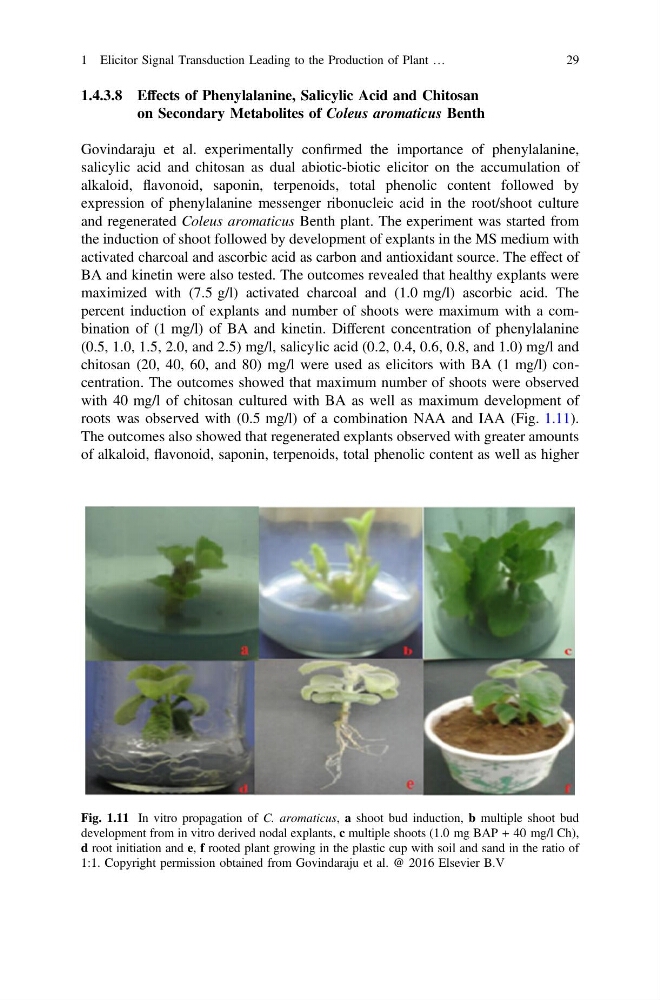
chitosan (20, 40, 60, and 80) mg/l were used as elicitors with BA (1 mg/l) concentration. The outcomes showed that maximum number of shoots were observed
with 40 mg/l of chitosan cultured with BA as well as maximum development of
roots was observed with (0.5 mg/l) of a combination NAA and IAA (Fig. 1.11).
The outcomes also showed that regenerated explants observed with greater amounts
of alkaloid, flavonoid, saponin, terpenoids, total phenolic content as well as higher
Fig. 1.11 In vitro propagation of C. aromaticus, a shoot bud induction, b multiple shoot bud
development from in vitro derived nodal explants, c multiple shoots (1.0 mg BAP + 40 mg/l Ch),
d root initiation and e, f rooted plant growing in the plastic cup with soil and sand in the ratio of
1:1. Copyright permission obtained from Govindaraju et al. @ 2016 Elsevier B.V
1 Elicitor Signal Transduction Leading to the Production of Plant …
29
on Secondary Metabolites of Coleus aromaticus Benth
Govindaraju et al. experimentally confirmed the importance of phenylalanine,
salicylic acid and chitosan as dual abiotic-biotic elicitor on the accumulation of
alkaloid, flavonoid, saponin, terpenoids, total phenolic content followed by
expression of phenylalanine messenger ribonucleic acid in the root/shoot culture
and regenerated Coleus aromaticus Benth plant. The experiment was started from
the induction of shoot followed by development of explants in the MS medium with
activated charcoal and ascorbic acid as carbon and antioxidant source. The effect of
BA and kinetin were also tested. The outcomes revealed that healthy explants were
maximized with (7.5 g/l) activated charcoal and (1.0 mg/l) ascorbic acid. The
percent induction of explants and number of shoots were maximum with a combination of (1 mg/l) of BA and kinetin. Different concentration of phenylalanine
(0.5, 1.0, 1.5, 2.0, and 2.5) mg/l, salicylic acid (0.2, 0.4, 0.6, 0.8, and 1.0) mg/l and
chitosan (20, 40, 60, and 80) mg/l were used as elicitors with BA (1 mg/l) concentration. The outcomes showed that maximum number of shoots were observed
with 40 mg/l of chitosan cultured with BA as well as maximum development of
roots was observed with (0.5 mg/l) of a combination NAA and IAA (Fig. 1.11).
The outcomes also showed that regenerated explants observed with greater amounts
of alkaloid, flavonoid, saponin, terpenoids, total phenolic content as well as higher
Fig. 1.11 In vitro propagation of C. aromaticus, a shoot bud induction, b multiple shoot bud
development from in vitro derived nodal explants, c multiple shoots (1.0 mg BAP + 40 mg/l Ch),
d root initiation and e, f rooted plant growing in the plastic cup with soil and sand in the ratio of
1:1. Copyright permission obtained from Govindaraju et al. @ 2016 Elsevier B.V
1 Elicitor Signal Transduction Leading to the Production of Plant …
29