

(Agada et al. 2020). In the same sense, hexane extract of the roots of Paramignya
trimera (Rutaceae), a woody shrub endemic from the south of Vietnam, exhibited
a-glucosidase inhibitory activity presumably related to new compound found in
there, comprising two coumarins, pyranocoumarins A and B, and an acridone
alkaloid, paramiacridone (Trinh et al. 2020). Methanolic, aqueous, petroleum, and
hexane extracts from seeds, barks, and leaves of S. mahogany have shown
antidiabetics activities by different mechanisms, among them, inhibition of glucosidase. The compounds implicated in such activity are phenolics (flavonoids
(swietemacrophyllanin, catechin, and epicatechin) and tannins), triterpenoids,
tetranortriterpenoid (limonoid: mahonin, secomahoganin, swietmanins, swiemahogins, swietenine, and swietenolide), saponins, and alkaloids (Ervina 2020).
Alkaloids isolated from the mushroom Hericium erinaceus exhibited IC 50 values
for the inhibition of a-glucosidase in the range of 12.7–23.3 lM (Wang et al. 2015).
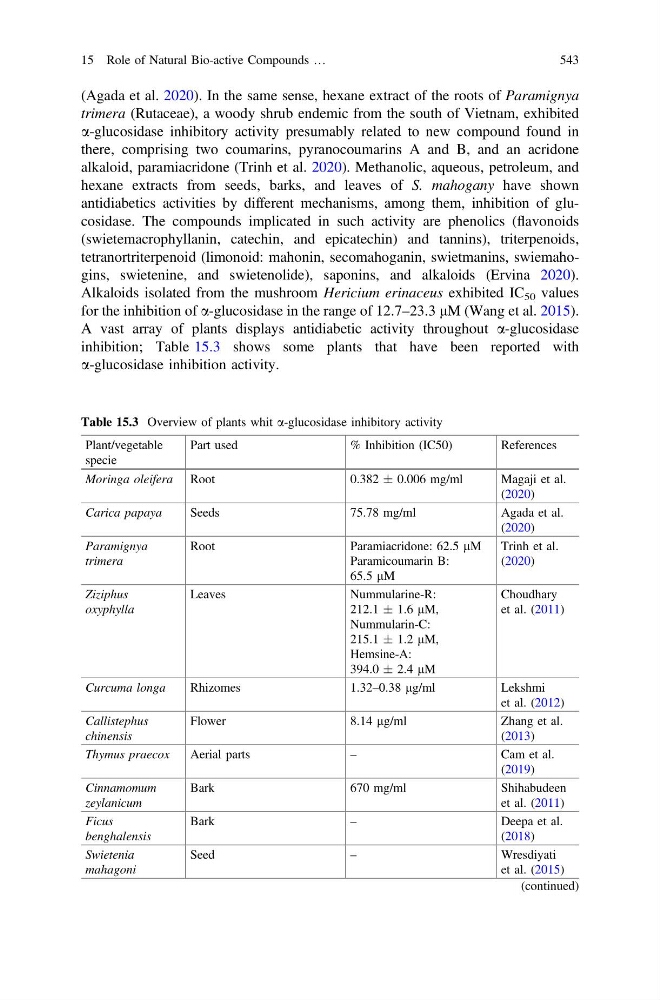
A vast array of plants displays antidiabetic activity throughout a-glucosidase
inhibition; Table 15.3 shows some plants that have been reported with
a-glucosidase inhibition activity.
Table 15.3 Overview of plants whit a-glucosidase inhibitory activity
Plant/vegetable
specie
Part used
% Inhibition (IC50)
References
Moringa oleifera Root
0.382 ± 0.006 mg/ml
Magaji et al.
(2020)
Carica papaya
Seeds
75.78 mg/ml
Agada et al.
(2020)
Paramignya
trimera
Root
Paramiacridone: 62.5 lM
Paramicoumarin B:
65.5 lM
Trinh et al.
(2020)
Ziziphus
oxyphylla
Leaves
Nummularine-R:
212.1 ± 1.6 lM,
Nummularin-C:
215.1 ± 1.2 lM,
Hemsine-A:
394.0 ± 2.4 lM
Choudhary
et al. (2011)
Curcuma longa
Rhizomes
1.32–0.38 lg/ml
Lekshmi
et al. (2012)
Callistephus
chinensis
Flower
8.14 lg/ml
Zhang et al.
(2013)
Thymus praecox
Aerial parts
–
Cam et al.
(2019)
Cinnamomum
zeylanicum
Bark
670 mg/ml
Shihabudeen
et al. (2011)
Ficus
benghalensis
Bark
–
Deepa et al.
(2018)
Swietenia
mahagoni
Seed
–
Wresdiyati
et al. (2015)
(continued)
15 Role of Natural Bio-active Compounds …
543
trimera (Rutaceae), a woody shrub endemic from the south of Vietnam, exhibited
a-glucosidase inhibitory activity presumably related to new compound found in
there, comprising two coumarins, pyranocoumarins A and B, and an acridone
alkaloid, paramiacridone (Trinh et al. 2020). Methanolic, aqueous, petroleum, and
hexane extracts from seeds, barks, and leaves of S. mahogany have shown
antidiabetics activities by different mechanisms, among them, inhibition of glucosidase. The compounds implicated in such activity are phenolics (flavonoids
(swietemacrophyllanin, catechin, and epicatechin) and tannins), triterpenoids,
tetranortriterpenoid (limonoid: mahonin, secomahoganin, swietmanins, swiemahogins, swietenine, and swietenolide), saponins, and alkaloids (Ervina 2020).
Alkaloids isolated from the mushroom Hericium erinaceus exhibited IC 50 values
for the inhibition of a-glucosidase in the range of 12.7–23.3 lM (Wang et al. 2015).
A vast array of plants displays antidiabetic activity throughout a-glucosidase
inhibition; Table 15.3 shows some plants that have been reported with
a-glucosidase inhibition activity.
Table 15.3 Overview of plants whit a-glucosidase inhibitory activity
Plant/vegetable
specie
Part used
% Inhibition (IC50)
References
Moringa oleifera Root
0.382 ± 0.006 mg/ml
Magaji et al.
(2020)
Carica papaya
Seeds
75.78 mg/ml
Agada et al.
(2020)
Paramignya
trimera
Root
Paramiacridone: 62.5 lM
Paramicoumarin B:
65.5 lM
Trinh et al.
(2020)
Ziziphus
oxyphylla
Leaves
Nummularine-R:
212.1 ± 1.6 lM,
Nummularin-C:
215.1 ± 1.2 lM,
Hemsine-A:
394.0 ± 2.4 lM
Choudhary
et al. (2011)
Curcuma longa
Rhizomes
1.32–0.38 lg/ml
Lekshmi
et al. (2012)
Callistephus
chinensis
Flower
8.14 lg/ml
Zhang et al.
(2013)
Thymus praecox
Aerial parts
–
Cam et al.
(2019)
Cinnamomum
zeylanicum
Bark
670 mg/ml
Shihabudeen
et al. (2011)
Ficus
benghalensis
Bark
–
Deepa et al.
(2018)
Swietenia
mahagoni
Seed
–
Wresdiyati
et al. (2015)
(continued)
15 Role of Natural Bio-active Compounds …
543