

15.4 a-Glucosidase Inhibition
Among the therapeutic options in the treatment of type-2 diabetes mellitus (T2DM)
a-glucosidase enzyme inhibition is an effective one. One strategy that has been used
for the treatment of type-2 diabetes is the inhibition of the activity of
alpha-glucosidases using synthetic drugs. a-glucosidase inhibitors are known to
exist for clinical use (e.g.,voglibose, acarbose, and miglitol); nevertheless, these
inhibitors are habitually connected with gastrointestinal side effects as well as long
synthetic routes. For this reason, the development of inhibitors from natural
products could be an alternative option for the management of postprandial
hyperglycemic condition in T2DM (Dhameja and Gupta 2019). Several studies
have been directed to identify a-glucosidases inhibitors from natural sources, and
many candidates have resulted to be secondary metabolites (alkaloids, flavonoids,
phenols, and terpenoids) (Assefa et al. 2020; Choudhury et al. 2018; Di Stefano
et al. 2018).
a-glucosidase, located in the brush border of the small intestine, catalyzes the
liberation of a-glucose from the non-reducing end of the substrate. By the inhibition
of a-glucosidase in the intestine, the process of carbohydrate digestion spreads to
the lower part of small intestine delaying the absorption rate of glucose into the
blood. Several phytochemicals have shown antidiabetic activity by lowering the
glucose absorption throughout the inhibition of hydrolyzing enzymes a-glucosidase
(Ota and Ulrih 2017).
The World Health Organization has listed a plethora of plants for medical
purposes (21,000). According to the review made by Amjad et al. (2019) around
1200 plants are being used worldwide for the control of diabetes mellitus; from this,
only 30% were chemically and pharmacologically investigated. In this review, it
mentions a list of commonly used herbs in India for diabetes treatment. In the same
way, Bagetta et al. (2020) reviewed the bioactive substances contained in some
foods typical of the Mediterranean area (olive oil, onion, liquorice, rosemary,
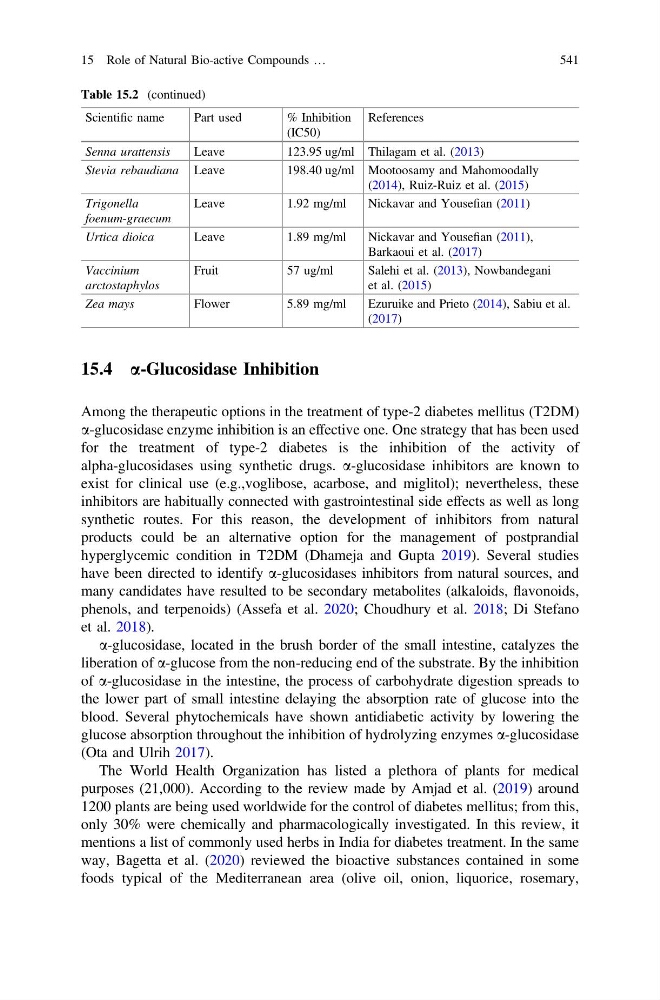
Table 15.2 (continued)
Scientific name
Part used
% Inhibition
(IC50)
References
Senna urattensis
Leave
123.95 ug/ml Thilagam et al. (2013)
Stevia rebaudiana Leave
198.40 ug/ml Mootoosamy and Mahomoodally
(2014), Ruiz-Ruiz et al. (2015)
Trigonella
foenum-graecum
Leave
1.92 mg/ml
Nickavar and Yousefian (2011)
Urtica dioica
Leave
1.89 mg/ml
Nickavar and Yousefian (2011),
Barkaoui et al. (2017)
Vaccinium
arctostaphylos
Fruit
57 ug/ml
Salehi et al. (2013), Nowbandegani
et al. (2015)
Zea mays
Flower
5.89 mg/ml
Ezuruike and Prieto (2014), Sabiu et al.
(2017)
15 Role of Natural Bio-active Compounds …
541
Among the therapeutic options in the treatment of type-2 diabetes mellitus (T2DM)
a-glucosidase enzyme inhibition is an effective one. One strategy that has been used
for the treatment of type-2 diabetes is the inhibition of the activity of
alpha-glucosidases using synthetic drugs. a-glucosidase inhibitors are known to
exist for clinical use (e.g.,voglibose, acarbose, and miglitol); nevertheless, these
inhibitors are habitually connected with gastrointestinal side effects as well as long
synthetic routes. For this reason, the development of inhibitors from natural
products could be an alternative option for the management of postprandial
hyperglycemic condition in T2DM (Dhameja and Gupta 2019). Several studies
have been directed to identify a-glucosidases inhibitors from natural sources, and
many candidates have resulted to be secondary metabolites (alkaloids, flavonoids,
phenols, and terpenoids) (Assefa et al. 2020; Choudhury et al. 2018; Di Stefano
et al. 2018).
a-glucosidase, located in the brush border of the small intestine, catalyzes the
liberation of a-glucose from the non-reducing end of the substrate. By the inhibition
of a-glucosidase in the intestine, the process of carbohydrate digestion spreads to
the lower part of small intestine delaying the absorption rate of glucose into the
blood. Several phytochemicals have shown antidiabetic activity by lowering the
glucose absorption throughout the inhibition of hydrolyzing enzymes a-glucosidase
(Ota and Ulrih 2017).
The World Health Organization has listed a plethora of plants for medical
purposes (21,000). According to the review made by Amjad et al. (2019) around
1200 plants are being used worldwide for the control of diabetes mellitus; from this,
only 30% were chemically and pharmacologically investigated. In this review, it
mentions a list of commonly used herbs in India for diabetes treatment. In the same
way, Bagetta et al. (2020) reviewed the bioactive substances contained in some
foods typical of the Mediterranean area (olive oil, onion, liquorice, rosemary,
Table 15.2 (continued)
Scientific name
Part used
% Inhibition
(IC50)
References
Senna urattensis
Leave
123.95 ug/ml Thilagam et al. (2013)
Stevia rebaudiana Leave
198.40 ug/ml Mootoosamy and Mahomoodally
(2014), Ruiz-Ruiz et al. (2015)
Trigonella
foenum-graecum
Leave
1.92 mg/ml
Nickavar and Yousefian (2011)
Urtica dioica
Leave
1.89 mg/ml
Nickavar and Yousefian (2011),
Barkaoui et al. (2017)
Vaccinium
arctostaphylos
Fruit
57 ug/ml
Salehi et al. (2013), Nowbandegani
et al. (2015)
Zea mays
Flower
5.89 mg/ml
Ezuruike and Prieto (2014), Sabiu et al.
(2017)
15 Role of Natural Bio-active Compounds …
541