

anti-protozoal (Entamoeba histolytica) and antiplasmodial (P. falciparum) activities
(Wright et al. 1992). Emetine hydrochloride and chloroquine diphosphate were
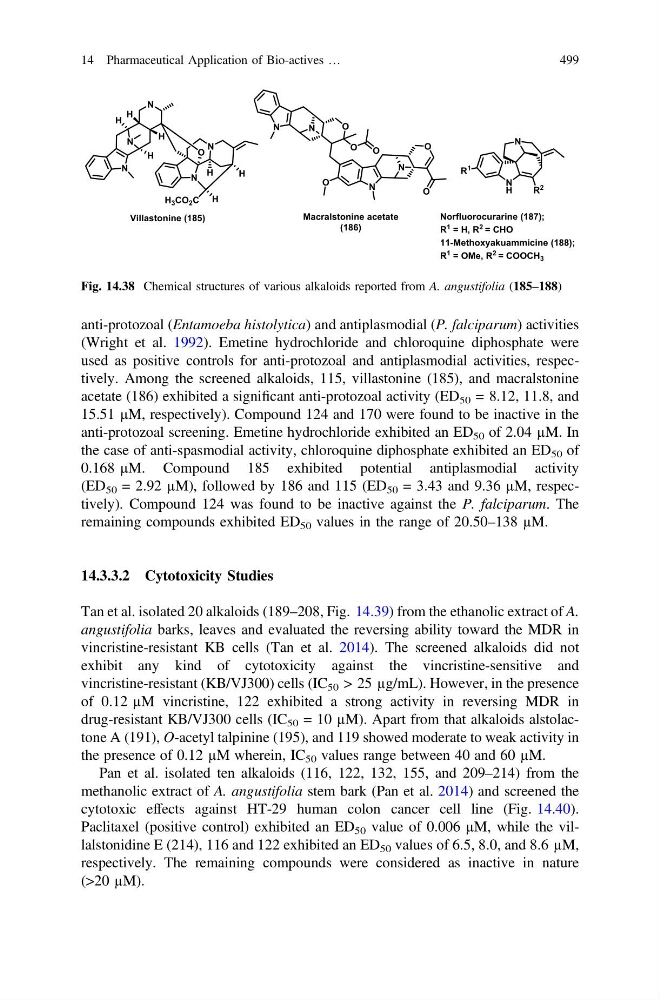
used as positive controls for anti-protozoal and antiplasmodial activities, respectively. Among the screened alkaloids, 115, villastonine (185), and macralstonine
acetate (186) exhibited a significant anti-protozoal activity (ED 50 = 8.12, 11.8, and
15.51 µM, respectively). Compound 124 and 170 were found to be inactive in the
anti-protozoal screening. Emetine hydrochloride exhibited an ED 50 of 2.04 µM. In
the case of anti-spasmodial activity, chloroquine diphosphate exhibited an ED 50 of
0.168 µM. Compound 185 exhibited potential antiplasmodial activity
(ED 50 = 2.92 µM), followed by 186 and 115 (ED 50 = 3.43 and 9.36 µM, respectively). Compound 124 was found to be inactive against the P. falciparum. The
remaining compounds exhibited ED 50 values in the range of 20.50–138 µM.
14.3.3.2 Cytotoxicity Studies
Tan et al. isolated 20 alkaloids (189–208, Fig. 14.39) from the ethanolic extract of A.
angustifolia barks, leaves and evaluated the reversing ability toward the MDR in
vincristine-resistant KB cells (Tan et al. 2014). The screened alkaloids did not
exhibit any kind of cytotoxicity against the vincristine-sensitive and
vincristine-resistant (KB/VJ300) cells (IC 50 > 25 µg/mL). However, in the presence
of 0.12 µM vincristine, 122 exhibited a strong activity in reversing MDR in
drug-resistant KB/VJ300 cells (IC 50 = 10 µM). Apart from that alkaloids alstolactone A (191), O-acetyl talpinine (195), and 119 showed moderate to weak activity in
the presence of 0.12 µM wherein, IC 50 values range between 40 and 60 µM.
Pan et al. isolated ten alkaloids (116, 122, 132, 155, and 209–214) from the
methanolic extract of A. angustifolia stem bark (Pan et al. 2014) and screened the
cytotoxic effects against HT-29 human colon cancer cell line (Fig. 14.40).
Paclitaxel (positive control) exhibited an ED 50 value of 0.006 µM, while the villalstonidine E (214), 116 and 122 exhibited an ED 50 values of 6.5, 8.0, and 8.6 µM,
respectively. The remaining compounds were considered as inactive in nature
(>20 µM).
Villastonine (185)
Macralstonine acetate
(186)
O
N
N
O
O
O
N
N
O
Norfluorocurarine (187);
R
1 = H, R
2 = CHO
11-Methoxyakuammicine (188);
R
1 = OMe, R
2 = COOCH 3
N
N
H
R
2
O
N
N
N
N
H
H
H
H
N
H
H
H 3 CO 2 C
O
H
R
1
Fig. 14.38 Chemical structures of various alkaloids reported from A. angustifolia (185–188)
14 Pharmaceutical Application of Bio-actives …
499
(Wright et al. 1992). Emetine hydrochloride and chloroquine diphosphate were
used as positive controls for anti-protozoal and antiplasmodial activities, respectively. Among the screened alkaloids, 115, villastonine (185), and macralstonine
acetate (186) exhibited a significant anti-protozoal activity (ED 50 = 8.12, 11.8, and
15.51 µM, respectively). Compound 124 and 170 were found to be inactive in the
anti-protozoal screening. Emetine hydrochloride exhibited an ED 50 of 2.04 µM. In
the case of anti-spasmodial activity, chloroquine diphosphate exhibited an ED 50 of
0.168 µM. Compound 185 exhibited potential antiplasmodial activity
(ED 50 = 2.92 µM), followed by 186 and 115 (ED 50 = 3.43 and 9.36 µM, respectively). Compound 124 was found to be inactive against the P. falciparum. The
remaining compounds exhibited ED 50 values in the range of 20.50–138 µM.
14.3.3.2 Cytotoxicity Studies
Tan et al. isolated 20 alkaloids (189–208, Fig. 14.39) from the ethanolic extract of A.
angustifolia barks, leaves and evaluated the reversing ability toward the MDR in
vincristine-resistant KB cells (Tan et al. 2014). The screened alkaloids did not
exhibit any kind of cytotoxicity against the vincristine-sensitive and
vincristine-resistant (KB/VJ300) cells (IC 50 > 25 µg/mL). However, in the presence
of 0.12 µM vincristine, 122 exhibited a strong activity in reversing MDR in
drug-resistant KB/VJ300 cells (IC 50 = 10 µM). Apart from that alkaloids alstolactone A (191), O-acetyl talpinine (195), and 119 showed moderate to weak activity in
the presence of 0.12 µM wherein, IC 50 values range between 40 and 60 µM.
Pan et al. isolated ten alkaloids (116, 122, 132, 155, and 209–214) from the
methanolic extract of A. angustifolia stem bark (Pan et al. 2014) and screened the
cytotoxic effects against HT-29 human colon cancer cell line (Fig. 14.40).
Paclitaxel (positive control) exhibited an ED 50 value of 0.006 µM, while the villalstonidine E (214), 116 and 122 exhibited an ED 50 values of 6.5, 8.0, and 8.6 µM,
respectively. The remaining compounds were considered as inactive in nature
(>20 µM).
Villastonine (185)
Macralstonine acetate
(186)
O
N
N
O
O
O
N
N
O
Norfluorocurarine (187);
R
1 = H, R
2 = CHO
11-Methoxyakuammicine (188);
R
1 = OMe, R
2 = COOCH 3
N
N
H
R
2
O
N
N
N
N
H
H
H
H
N
H
H
H 3 CO 2 C
O
H
R
1
Fig. 14.38 Chemical structures of various alkaloids reported from A. angustifolia (185–188)
14 Pharmaceutical Application of Bio-actives …
499