

14.3.2.7 Antifungal and Antibacterial Effects
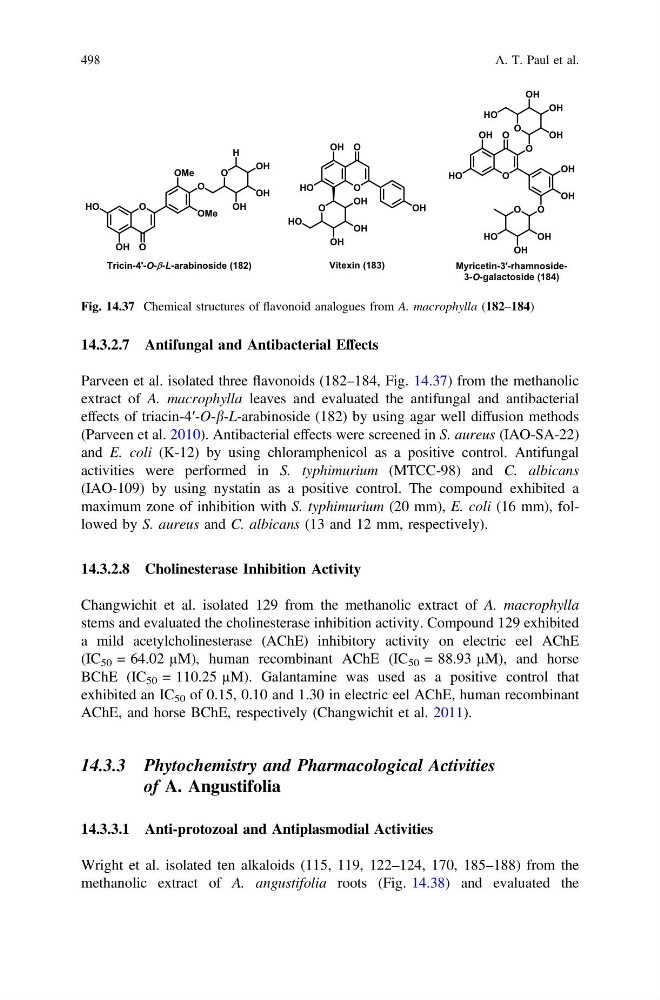
Parveen et al. isolated three flavonoids (182–184, Fig. 14.37) from the methanolic
extract of A. macrophylla leaves and evaluated the antifungal and antibacterial
effects of triacin-4′-O-b-L-arabinoside (182) by using agar well diffusion methods
(Parveen et al. 2010). Antibacterial effects were screened in S. aureus (IAO-SA-22)
and E. coli (K-12) by using chloramphenicol as a positive control. Antifungal
activities were performed in S. typhimurium (MTCC-98) and C. albicans
(IAO-109) by using nystatin as a positive control. The compound exhibited a
maximum zone of inhibition with S. typhimurium (20 mm), E. coli (16 mm), followed by S. aureus and C. albicans (13 and 12 mm, respectively).
14.3.2.8 Cholinesterase Inhibition Activity
Changwichit et al. isolated 129 from the methanolic extract of A. macrophylla
stems and evaluated the cholinesterase inhibition activity. Compound 129 exhibited
a mild acetylcholinesterase (AChE) inhibitory activity on electric eel AChE
(IC 50 = 64.02 µM), human recombinant AChE (IC 50 = 88.93 µM), and horse
BChE (IC 50 = 110.25 µM). Galantamine was used as a positive control that
exhibited an IC 50 of 0.15, 0.10 and 1.30 in electric eel AChE, human recombinant
AChE, and horse BChE, respectively (Changwichit et al. 2011).
14.3.3 Phytochemistry and Pharmacological Activities
of A. Angustifolia
14.3.3.1 Anti-protozoal and Antiplasmodial Activities
Wright et al. isolated ten alkaloids (115, 119, 122–124, 170, 185–188) from the
methanolic extract of A. angustifolia roots (Fig. 14.38) and evaluated the
Tricin-4'-O- -L-arabinoside (182)
Vitexin (183)
O
O
OH
HO
O
HO
OH
OH
OH
OH
Myricetin-3'-rhamnoside3-O-galactoside (184)
OH
OH
O
O
O
HO
OH
O
O
HO
OH
OH
OH
O
HO
OH
OH
O
O
OH
HO
OMe
OMe
O
O
H
OH
OH
OH
Fig. 14.37 Chemical structures of flavonoid analogues from A. macrophylla (182–184)
498
A. T. Paul et al.
Parveen et al. isolated three flavonoids (182–184, Fig. 14.37) from the methanolic
extract of A. macrophylla leaves and evaluated the antifungal and antibacterial
effects of triacin-4′-O-b-L-arabinoside (182) by using agar well diffusion methods
(Parveen et al. 2010). Antibacterial effects were screened in S. aureus (IAO-SA-22)
and E. coli (K-12) by using chloramphenicol as a positive control. Antifungal
activities were performed in S. typhimurium (MTCC-98) and C. albicans
(IAO-109) by using nystatin as a positive control. The compound exhibited a
maximum zone of inhibition with S. typhimurium (20 mm), E. coli (16 mm), followed by S. aureus and C. albicans (13 and 12 mm, respectively).
14.3.2.8 Cholinesterase Inhibition Activity
Changwichit et al. isolated 129 from the methanolic extract of A. macrophylla
stems and evaluated the cholinesterase inhibition activity. Compound 129 exhibited
a mild acetylcholinesterase (AChE) inhibitory activity on electric eel AChE
(IC 50 = 64.02 µM), human recombinant AChE (IC 50 = 88.93 µM), and horse
BChE (IC 50 = 110.25 µM). Galantamine was used as a positive control that
exhibited an IC 50 of 0.15, 0.10 and 1.30 in electric eel AChE, human recombinant
AChE, and horse BChE, respectively (Changwichit et al. 2011).
14.3.3 Phytochemistry and Pharmacological Activities
of A. Angustifolia
14.3.3.1 Anti-protozoal and Antiplasmodial Activities
Wright et al. isolated ten alkaloids (115, 119, 122–124, 170, 185–188) from the
methanolic extract of A. angustifolia roots (Fig. 14.38) and evaluated the
Tricin-4'-O- -L-arabinoside (182)
Vitexin (183)
O
O
OH
HO
O
HO
OH
OH
OH
OH
Myricetin-3'-rhamnoside3-O-galactoside (184)
OH
OH
O
O
O
HO
OH
O
O
HO
OH
OH
OH
O
HO
OH
OH
O
O
OH
HO
OMe
OMe
O
O
H
OH
OH
OH
Fig. 14.37 Chemical structures of flavonoid analogues from A. macrophylla (182–184)
498
A. T. Paul et al.