

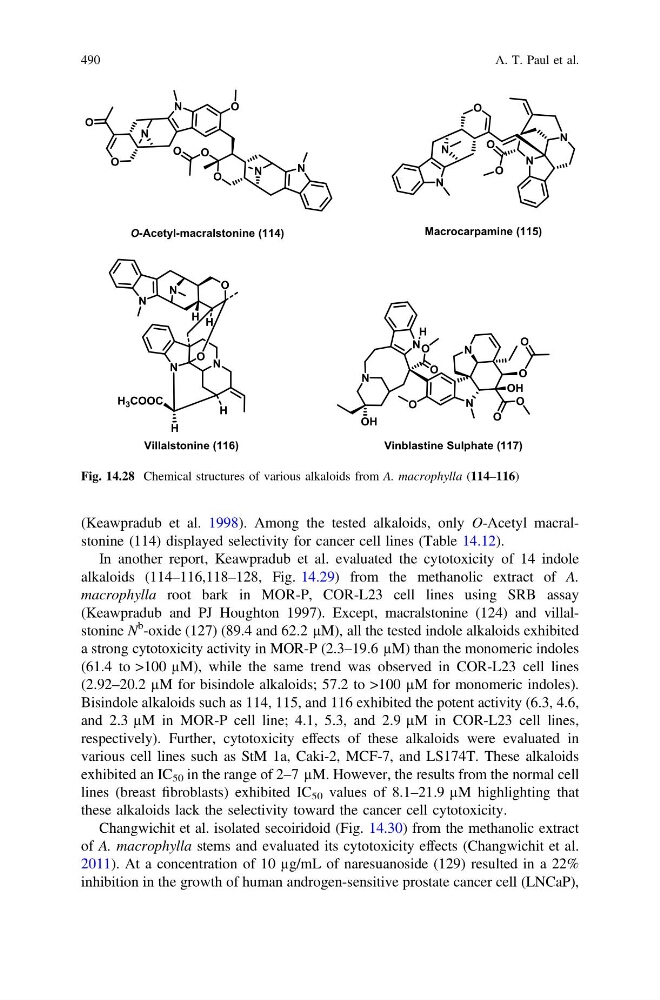
(Keawpradub et al. 1998). Among the tested alkaloids, only O-Acetyl macralstonine (114) displayed selectivity for cancer cell lines (Table 14.12).
In another report, Keawpradub et al. evaluated the cytotoxicity of 14 indole
alkaloids (114–116,118–128, Fig. 14.29) from the methanolic extract of A.
macrophylla root bark in MOR-P, COR-L23 cell lines using SRB assay
(Keawpradub and PJ Houghton 1997). Except, macralstonine (124) and villalstonine N
b -oxide (127) (89.4 and 62.2 µM), all the tested indole alkaloids exhibited
a strong cytotoxicity activity in MOR-P (2.3–19.6 µM) than the monomeric indoles
(61.4 to >100 µM), while the same trend was observed in COR-L23 cell lines
(2.92–20.2 µM for bisindole alkaloids; 57.2 to >100 µM for monomeric indoles).
Bisindole alkaloids such as 114, 115, and 116 exhibited the potent activity (6.3, 4.6,
and 2.3 µM in MOR-P cell line; 4.1, 5.3, and 2.9 µM in COR-L23 cell lines,
respectively). Further, cytotoxicity effects of these alkaloids were evaluated in
various cell lines such as StM 1a, Caki-2, MCF-7, and LS174T. These alkaloids
exhibited an IC 50 in the range of 2–7 µM. However, the results from the normal cell
lines (breast fibroblasts) exhibited IC 50 values of 8.1–21.9 µM highlighting that
these alkaloids lack the selectivity toward the cancer cell cytotoxicity.
Changwichit et al. isolated secoiridoid (Fig. 14.30) from the methanolic extract
of A. macrophylla stems and evaluated its cytotoxicity effects (Changwichit et al.
2011). At a concentration of 10 µg/mL of naresuanoside (129) resulted in a 22%
inhibition in the growth of human androgen-sensitive prostate cancer cell (LNCaP),
Macrocarpamine (115)
N
N
O
O
O
N
N
O
O
N
N
O
O
O
N
N
O
O-Acetyl-macralstonine (114)
N
N
N
N
O
O
OH
O
O
O
O
O
OH
H
Vinblastine Sulphate (117)
N
O
N
N
N
O
H
H
H 3 COOC
H
H
Villalstonine (116)
Fig. 14.28 Chemical structures of various alkaloids from A. macrophylla (114–116)
490
A. T. Paul et al.
In another report, Keawpradub et al. evaluated the cytotoxicity of 14 indole
alkaloids (114–116,118–128, Fig. 14.29) from the methanolic extract of A.
macrophylla root bark in MOR-P, COR-L23 cell lines using SRB assay
(Keawpradub and PJ Houghton 1997). Except, macralstonine (124) and villalstonine N
b -oxide (127) (89.4 and 62.2 µM), all the tested indole alkaloids exhibited
a strong cytotoxicity activity in MOR-P (2.3–19.6 µM) than the monomeric indoles
(61.4 to >100 µM), while the same trend was observed in COR-L23 cell lines
(2.92–20.2 µM for bisindole alkaloids; 57.2 to >100 µM for monomeric indoles).
Bisindole alkaloids such as 114, 115, and 116 exhibited the potent activity (6.3, 4.6,
and 2.3 µM in MOR-P cell line; 4.1, 5.3, and 2.9 µM in COR-L23 cell lines,
respectively). Further, cytotoxicity effects of these alkaloids were evaluated in
various cell lines such as StM 1a, Caki-2, MCF-7, and LS174T. These alkaloids
exhibited an IC 50 in the range of 2–7 µM. However, the results from the normal cell
lines (breast fibroblasts) exhibited IC 50 values of 8.1–21.9 µM highlighting that
these alkaloids lack the selectivity toward the cancer cell cytotoxicity.
Changwichit et al. isolated secoiridoid (Fig. 14.30) from the methanolic extract
of A. macrophylla stems and evaluated its cytotoxicity effects (Changwichit et al.
2011). At a concentration of 10 µg/mL of naresuanoside (129) resulted in a 22%
inhibition in the growth of human androgen-sensitive prostate cancer cell (LNCaP),
Macrocarpamine (115)
N
N
O
O
O
N
N
O
O
N
N
O
O
O
N
N
O
O-Acetyl-macralstonine (114)
N
N
N
N
O
O
OH
O
O
O
O
O
OH
H
Vinblastine Sulphate (117)
N
O
N
N
N
O
H
H
H 3 COOC
H
H
Villalstonine (116)
Fig. 14.28 Chemical structures of various alkaloids from A. macrophylla (114–116)
490
A. T. Paul et al.