

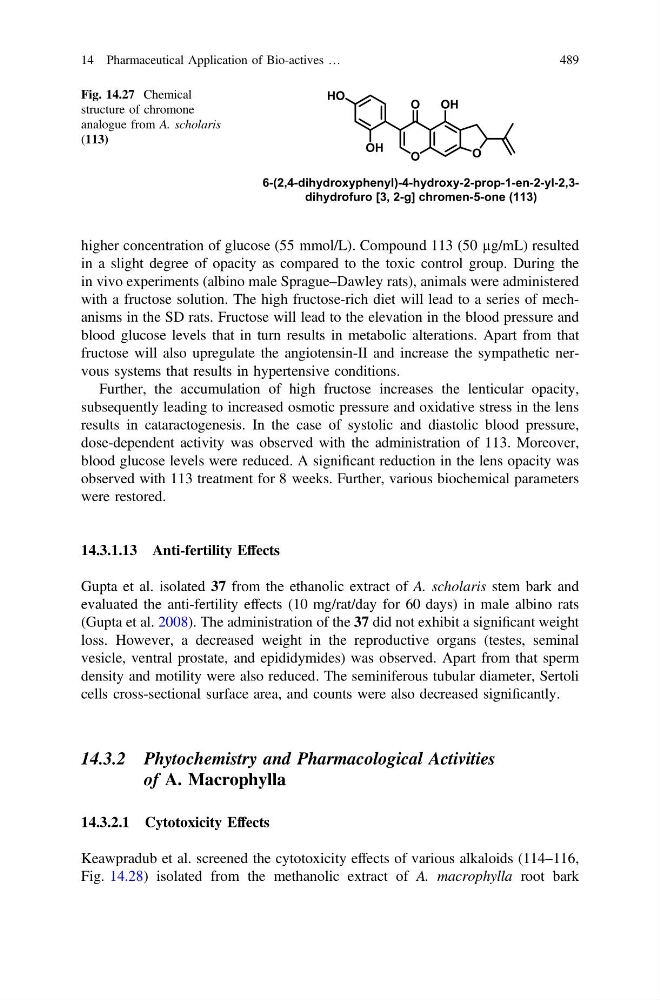
higher concentration of glucose (55 mmol/L). Compound 113 (50 µg/mL) resulted
in a slight degree of opacity as compared to the toxic control group. During the
in vivo experiments (albino male Sprague–Dawley rats), animals were administered
with a fructose solution. The high fructose-rich diet will lead to a series of mechanisms in the SD rats. Fructose will lead to the elevation in the blood pressure and
blood glucose levels that in turn results in metabolic alterations. Apart from that
fructose will also upregulate the angiotensin-II and increase the sympathetic nervous systems that results in hypertensive conditions.
Further, the accumulation of high fructose increases the lenticular opacity,
subsequently leading to increased osmotic pressure and oxidative stress in the lens
results in cataractogenesis. In the case of systolic and diastolic blood pressure,
dose-dependent activity was observed with the administration of 113. Moreover,
blood glucose levels were reduced. A significant reduction in the lens opacity was
observed with 113 treatment for 8 weeks. Further, various biochemical parameters
were restored.
14.3.1.13 Anti-fertility Effects
Gupta et al. isolated 37 from the ethanolic extract of A. scholaris stem bark and
evaluated the anti-fertility effects (10 mg/rat/day for 60 days) in male albino rats
(Gupta et al. 2008). The administration of the 37 did not exhibit a significant weight
loss. However, a decreased weight in the reproductive organs (testes, seminal
vesicle, ventral prostate, and epididymides) was observed. Apart from that sperm
density and motility were also reduced. The seminiferous tubular diameter, Sertoli
cells cross-sectional surface area, and counts were also decreased significantly.
14.3.2 Phytochemistry and Pharmacological Activities
of A. Macrophylla
14.3.2.1 Cytotoxicity Effects
Keawpradub et al. screened the cytotoxicity effects of various alkaloids (114–116,
Fig. 14.28) isolated from the methanolic extract of A. macrophylla root bark
O
O
OH
HO
OH
O
6-(2,4-dihydroxyphenyl)-4-hydroxy-2-prop-1-en-2-yl-2,3dihydrofuro [3, 2-g] chromen-5-one (113)
Fig. 14.27 Chemical
structure of chromone
analogue from A. scholaris
(113)
14 Pharmaceutical Application of Bio-actives …
489
in a slight degree of opacity as compared to the toxic control group. During the
in vivo experiments (albino male Sprague–Dawley rats), animals were administered
with a fructose solution. The high fructose-rich diet will lead to a series of mechanisms in the SD rats. Fructose will lead to the elevation in the blood pressure and
blood glucose levels that in turn results in metabolic alterations. Apart from that
fructose will also upregulate the angiotensin-II and increase the sympathetic nervous systems that results in hypertensive conditions.
Further, the accumulation of high fructose increases the lenticular opacity,
subsequently leading to increased osmotic pressure and oxidative stress in the lens
results in cataractogenesis. In the case of systolic and diastolic blood pressure,
dose-dependent activity was observed with the administration of 113. Moreover,
blood glucose levels were reduced. A significant reduction in the lens opacity was
observed with 113 treatment for 8 weeks. Further, various biochemical parameters
were restored.
14.3.1.13 Anti-fertility Effects
Gupta et al. isolated 37 from the ethanolic extract of A. scholaris stem bark and
evaluated the anti-fertility effects (10 mg/rat/day for 60 days) in male albino rats
(Gupta et al. 2008). The administration of the 37 did not exhibit a significant weight
loss. However, a decreased weight in the reproductive organs (testes, seminal
vesicle, ventral prostate, and epididymides) was observed. Apart from that sperm
density and motility were also reduced. The seminiferous tubular diameter, Sertoli
cells cross-sectional surface area, and counts were also decreased significantly.
14.3.2 Phytochemistry and Pharmacological Activities
of A. Macrophylla
14.3.2.1 Cytotoxicity Effects
Keawpradub et al. screened the cytotoxicity effects of various alkaloids (114–116,
Fig. 14.28) isolated from the methanolic extract of A. macrophylla root bark
O
O
OH
HO
OH
O
6-(2,4-dihydroxyphenyl)-4-hydroxy-2-prop-1-en-2-yl-2,3dihydrofuro [3, 2-g] chromen-5-one (113)
Fig. 14.27 Chemical
structure of chromone
analogue from A. scholaris
(113)
14 Pharmaceutical Application of Bio-actives …
489