

14.3.1.10 Hypoglycemic Activities
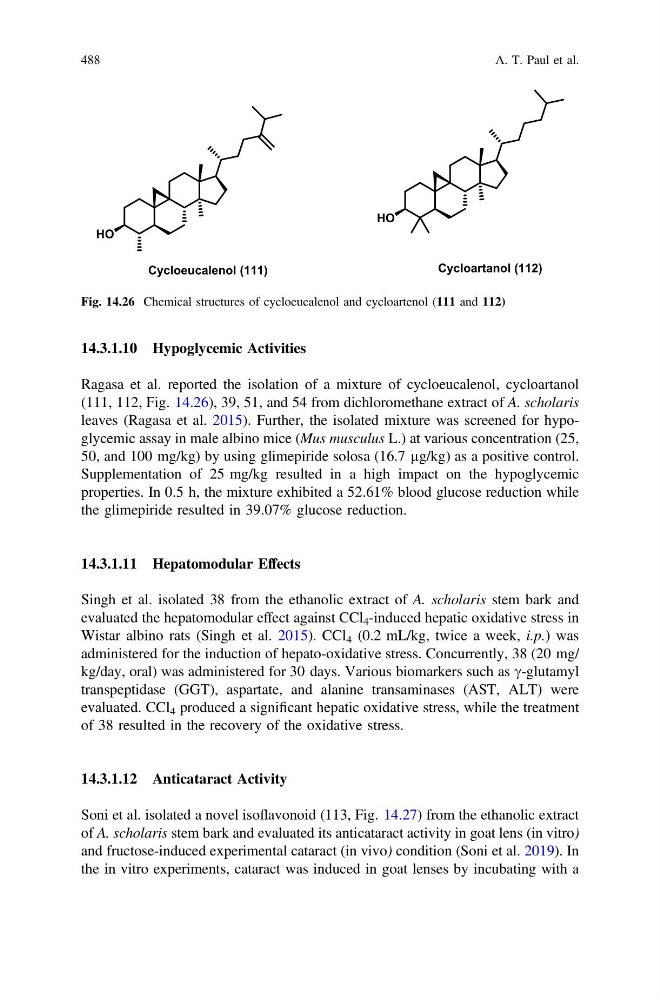
Ragasa et al. reported the isolation of a mixture of cycloeucalenol, cycloartanol
(111, 112, Fig. 14.26), 39, 51, and 54 from dichloromethane extract of A. scholaris
leaves (Ragasa et al. 2015). Further, the isolated mixture was screened for hypoglycemic assay in male albino mice (Mus musculus L.) at various concentration (25,
50, and 100 mg/kg) by using glimepiride solosa (16.7 µg/kg) as a positive control.
Supplementation of 25 mg/kg resulted in a high impact on the hypoglycemic
properties. In 0.5 h, the mixture exhibited a 52.61% blood glucose reduction while
the glimepiride resulted in 39.07% glucose reduction.
14.3.1.11 Hepatomodular Effects
Singh et al. isolated 38 from the ethanolic extract of A. scholaris stem bark and
evaluated the hepatomodular effect against CCl 4 -induced hepatic oxidative stress in
Wistar albino rats (Singh et al. 2015). CCl 4 (0.2 mL/kg, twice a week, i.p.) was
administered for the induction of hepato-oxidative stress. Concurrently, 38 (20 mg/
kg/day, oral) was administered for 30 days. Various biomarkers such as c-glutamyl
transpeptidase (GGT), aspartate, and alanine transaminases (AST, ALT) were
evaluated. CCl 4 produced a significant hepatic oxidative stress, while the treatment
of 38 resulted in the recovery of the oxidative stress.
14.3.1.12 Anticataract Activity
Soni et al. isolated a novel isoflavonoid (113, Fig. 14.27) from the ethanolic extract
of A. scholaris stem bark and evaluated its anticataract activity in goat lens (in vitro)
and fructose-induced experimental cataract (in vivo) condition (Soni et al. 2019). In
the in vitro experiments, cataract was induced in goat lenses by incubating with a
Cycloeucalenol (111)
HO
Cycloartanol (112)
HO
Fig. 14.26 Chemical structures of cycloeucalenol and cycloartenol (111 and 112)
488
A. T. Paul et al.
Ragasa et al. reported the isolation of a mixture of cycloeucalenol, cycloartanol
(111, 112, Fig. 14.26), 39, 51, and 54 from dichloromethane extract of A. scholaris
leaves (Ragasa et al. 2015). Further, the isolated mixture was screened for hypoglycemic assay in male albino mice (Mus musculus L.) at various concentration (25,
50, and 100 mg/kg) by using glimepiride solosa (16.7 µg/kg) as a positive control.
Supplementation of 25 mg/kg resulted in a high impact on the hypoglycemic
properties. In 0.5 h, the mixture exhibited a 52.61% blood glucose reduction while
the glimepiride resulted in 39.07% glucose reduction.
14.3.1.11 Hepatomodular Effects
Singh et al. isolated 38 from the ethanolic extract of A. scholaris stem bark and
evaluated the hepatomodular effect against CCl 4 -induced hepatic oxidative stress in
Wistar albino rats (Singh et al. 2015). CCl 4 (0.2 mL/kg, twice a week, i.p.) was
administered for the induction of hepato-oxidative stress. Concurrently, 38 (20 mg/
kg/day, oral) was administered for 30 days. Various biomarkers such as c-glutamyl
transpeptidase (GGT), aspartate, and alanine transaminases (AST, ALT) were
evaluated. CCl 4 produced a significant hepatic oxidative stress, while the treatment
of 38 resulted in the recovery of the oxidative stress.
14.3.1.12 Anticataract Activity
Soni et al. isolated a novel isoflavonoid (113, Fig. 14.27) from the ethanolic extract
of A. scholaris stem bark and evaluated its anticataract activity in goat lens (in vitro)
and fructose-induced experimental cataract (in vivo) condition (Soni et al. 2019). In
the in vitro experiments, cataract was induced in goat lenses by incubating with a
Cycloeucalenol (111)
HO
Cycloartanol (112)
HO
Fig. 14.26 Chemical structures of cycloeucalenol and cycloartenol (111 and 112)
488
A. T. Paul et al.