

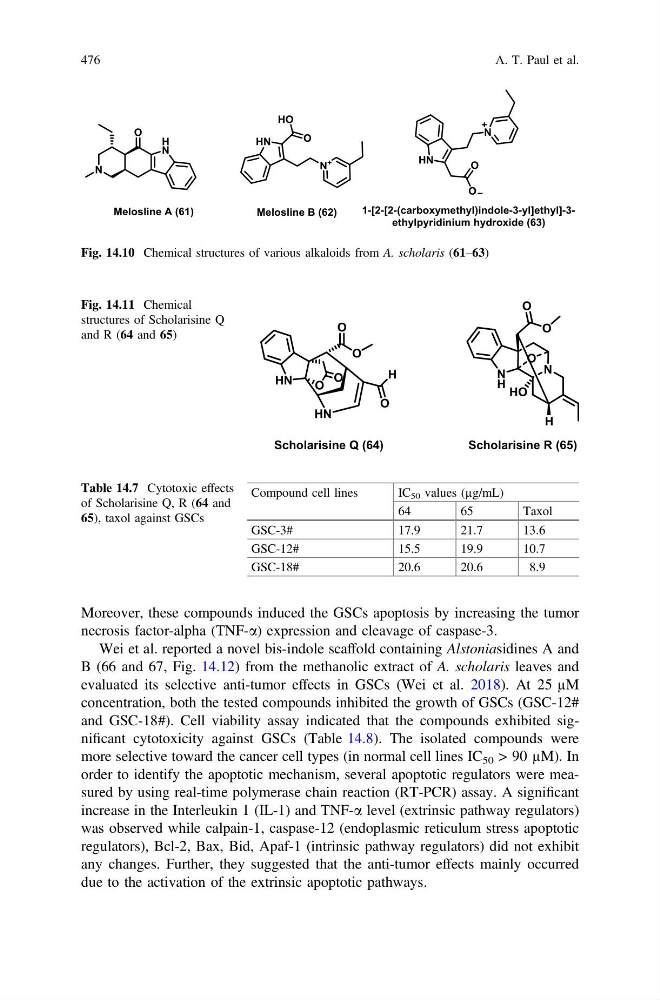
Moreover, these compounds induced the GSCs apoptosis by increasing the tumor
necrosis factor-alpha (TNF-a) expression and cleavage of caspase-3.
Wei et al. reported a novel bis-indole scaffold containing Alstoniasidines A and
B (66 and 67, Fig. 14.12) from the methanolic extract of A. scholaris leaves and
evaluated its selective anti-tumor effects in GSCs (Wei et al. 2018). At 25 µM
concentration, both the tested compounds inhibited the growth of GSCs (GSC-12#
and GSC-18#). Cell viability assay indicated that the compounds exhibited significant cytotoxicity against GSCs (Table 14.8). The isolated compounds were
more selective toward the cancer cell types (in normal cell lines IC 50 > 90 µM). In
order to identify the apoptotic mechanism, several apoptotic regulators were measured by using real-time polymerase chain reaction (RT-PCR) assay. A significant
increase in the Interleukin 1 (IL-1) and TNF-a level (extrinsic pathway regulators)
was observed while calpain-1, caspase-12 (endoplasmic reticulum stress apoptotic
regulators), Bcl-2, Bax, Bid, Apaf-1 (intrinsic pathway regulators) did not exhibit
any changes. Further, they suggested that the anti-tumor effects mainly occurred
due to the activation of the extrinsic apoptotic pathways.
Melosline A (61)
N
O
H
N
Melosline B (62)
N
+
HN
O
HO
1-[2-[2-(carboxymethyl)indole-3-yl]ethyl]-3ethylpyridinium hydroxide (63)
HN
N
O
O
Fig. 14.10 Chemical structures of various alkaloids from A. scholaris (61–63)
HN
O
O
HN
O
Scholarisine Q (64)
H
O
O
N
H
N
O
O
O
H
HO
Scholarisine R (65)
Fig. 14.11 Chemical
structures of Scholarisine Q
and R (64 and 65)
Table 14.7 Cytotoxic effects
of Scholarisine Q, R (64 and
65), taxol against GSCs
Compound cell lines
IC 50 values (µg/mL)
64
65
Taxol
GSC-3#
17.9
21.7
13.6
GSC-12#
15.5
19.9
10.7
GSC-18#
20.6
20.6
8.9
476
A. T. Paul et al.
necrosis factor-alpha (TNF-a) expression and cleavage of caspase-3.
Wei et al. reported a novel bis-indole scaffold containing Alstoniasidines A and
B (66 and 67, Fig. 14.12) from the methanolic extract of A. scholaris leaves and
evaluated its selective anti-tumor effects in GSCs (Wei et al. 2018). At 25 µM
concentration, both the tested compounds inhibited the growth of GSCs (GSC-12#
and GSC-18#). Cell viability assay indicated that the compounds exhibited significant cytotoxicity against GSCs (Table 14.8). The isolated compounds were
more selective toward the cancer cell types (in normal cell lines IC 50 > 90 µM). In
order to identify the apoptotic mechanism, several apoptotic regulators were measured by using real-time polymerase chain reaction (RT-PCR) assay. A significant
increase in the Interleukin 1 (IL-1) and TNF-a level (extrinsic pathway regulators)
was observed while calpain-1, caspase-12 (endoplasmic reticulum stress apoptotic
regulators), Bcl-2, Bax, Bid, Apaf-1 (intrinsic pathway regulators) did not exhibit
any changes. Further, they suggested that the anti-tumor effects mainly occurred
due to the activation of the extrinsic apoptotic pathways.
Melosline A (61)
N
O
H
N
Melosline B (62)
N
+
HN
O
HO
1-[2-[2-(carboxymethyl)indole-3-yl]ethyl]-3ethylpyridinium hydroxide (63)
HN
N
O
O
Fig. 14.10 Chemical structures of various alkaloids from A. scholaris (61–63)
HN
O
O
HN
O
Scholarisine Q (64)
H
O
O
N
H
N
O
O
O
H
HO
Scholarisine R (65)
Fig. 14.11 Chemical
structures of Scholarisine Q
and R (64 and 65)
Table 14.7 Cytotoxic effects
of Scholarisine Q, R (64 and
65), taxol against GSCs
Compound cell lines
IC 50 values (µg/mL)
64
65
Taxol
GSC-3#
17.9
21.7
13.6
GSC-12#
15.5
19.9
10.7
GSC-18#
20.6
20.6
8.9
476
A. T. Paul et al.