

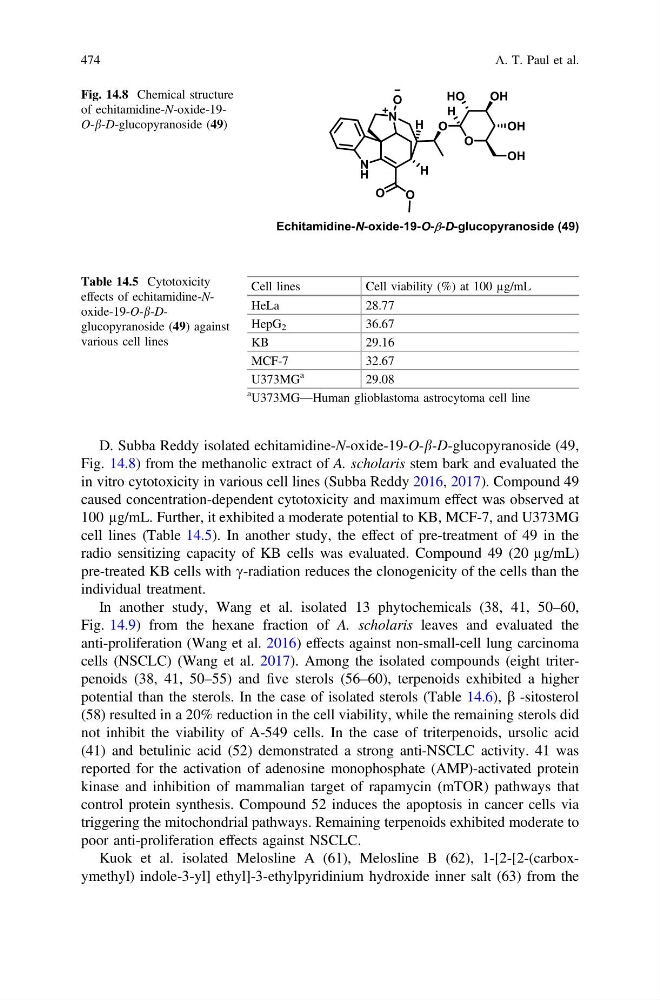
D. Subba Reddy isolated echitamidine-N-oxide-19-O-b-D-glucopyranoside (49,
Fig. 14.8) from the methanolic extract of A. scholaris stem bark and evaluated the
in vitro cytotoxicity in various cell lines (Subba Reddy 2016, 2017). Compound 49
caused concentration-dependent cytotoxicity and maximum effect was observed at
100 µg/mL. Further, it exhibited a moderate potential to KB, MCF-7, and U373MG
cell lines (Table 14.5). In another study, the effect of pre-treatment of 49 in the
radio sensitizing capacity of KB cells was evaluated. Compound 49 (20 µg/mL)
pre-treated KB cells with c-radiation reduces the clonogenicity of the cells than the
individual treatment.
In another study, Wang et al. isolated 13 phytochemicals (38, 41, 50–60,
Fig. 14.9) from the hexane fraction of A. scholaris leaves and evaluated the
anti-proliferation (Wang et al. 2016) effects against non-small-cell lung carcinoma
cells (NSCLC) (Wang et al. 2017). Among the isolated compounds (eight triterpenoids (38, 41, 50–55) and five sterols (56–60), terpenoids exhibited a higher
potential than the sterols. In the case of isolated sterols (Table 14.6), b -sitosterol
(58) resulted in a 20% reduction in the cell viability, while the remaining sterols did
not inhibit the viability of A-549 cells. In the case of triterpenoids, ursolic acid
(41) and betulinic acid (52) demonstrated a strong anti-NSCLC activity. 41 was
reported for the activation of adenosine monophosphate (AMP)-activated protein
kinase and inhibition of mammalian target of rapamycin (mTOR) pathways that
control protein synthesis. Compound 52 induces the apoptosis in cancer cells via
triggering the mitochondrial pathways. Remaining terpenoids exhibited moderate to
poor anti-proliferation effects against NSCLC.
Kuok et al. isolated Melosline A (61), Melosline B (62), 1-[2-[2-(carboxymethyl) indole-3-yl] ethyl]-3-ethylpyridinium hydroxide inner salt (63) from the
N
N
H
O
O
O
H
H
O
O
OH
OH
OH
HO
H
Echitamidine-N-oxide-19-O- -D-glucopyranoside (49)
Fig. 14.8 Chemical structure
of echitamidine-N-oxide-19O-b-D-glucopyranoside (49)
Table 14.5 Cytotoxicity
oxide-19-O-b-Dglucopyranoside (49) against
various cell lines
Cell lines
Cell viability (%) at 100 µg/mL
HeLa
28.77
HepG 2
36.67
KB
29.16
MCF-7
32.67
U373MG
a
29.08
a U373MG—Human glioblastoma astrocytoma cell line
474
A. T. Paul et al.
Fig. 14.8) from the methanolic extract of A. scholaris stem bark and evaluated the
in vitro cytotoxicity in various cell lines (Subba Reddy 2016, 2017). Compound 49
caused concentration-dependent cytotoxicity and maximum effect was observed at
100 µg/mL. Further, it exhibited a moderate potential to KB, MCF-7, and U373MG
cell lines (Table 14.5). In another study, the effect of pre-treatment of 49 in the
radio sensitizing capacity of KB cells was evaluated. Compound 49 (20 µg/mL)
pre-treated KB cells with c-radiation reduces the clonogenicity of the cells than the
individual treatment.
In another study, Wang et al. isolated 13 phytochemicals (38, 41, 50–60,
Fig. 14.9) from the hexane fraction of A. scholaris leaves and evaluated the
anti-proliferation (Wang et al. 2016) effects against non-small-cell lung carcinoma
cells (NSCLC) (Wang et al. 2017). Among the isolated compounds (eight triterpenoids (38, 41, 50–55) and five sterols (56–60), terpenoids exhibited a higher
potential than the sterols. In the case of isolated sterols (Table 14.6), b -sitosterol
(58) resulted in a 20% reduction in the cell viability, while the remaining sterols did
not inhibit the viability of A-549 cells. In the case of triterpenoids, ursolic acid
(41) and betulinic acid (52) demonstrated a strong anti-NSCLC activity. 41 was
reported for the activation of adenosine monophosphate (AMP)-activated protein
kinase and inhibition of mammalian target of rapamycin (mTOR) pathways that
control protein synthesis. Compound 52 induces the apoptosis in cancer cells via
triggering the mitochondrial pathways. Remaining terpenoids exhibited moderate to
poor anti-proliferation effects against NSCLC.
Kuok et al. isolated Melosline A (61), Melosline B (62), 1-[2-[2-(carboxymethyl) indole-3-yl] ethyl]-3-ethylpyridinium hydroxide inner salt (63) from the
N
N
H
O
O
O
H
H
O
O
OH
OH
OH
HO
H
Echitamidine-N-oxide-19-O- -D-glucopyranoside (49)
Fig. 14.8 Chemical structure
of echitamidine-N-oxide-19O-b-D-glucopyranoside (49)
Table 14.5 Cytotoxicity
oxide-19-O-b-Dglucopyranoside (49) against
various cell lines
Cell lines
Cell viability (%) at 100 µg/mL
HeLa
28.77
HepG 2
36.67
KB
29.16
MCF-7
32.67
U373MG
a
29.08
a U373MG—Human glioblastoma astrocytoma cell line
474
A. T. Paul et al.