

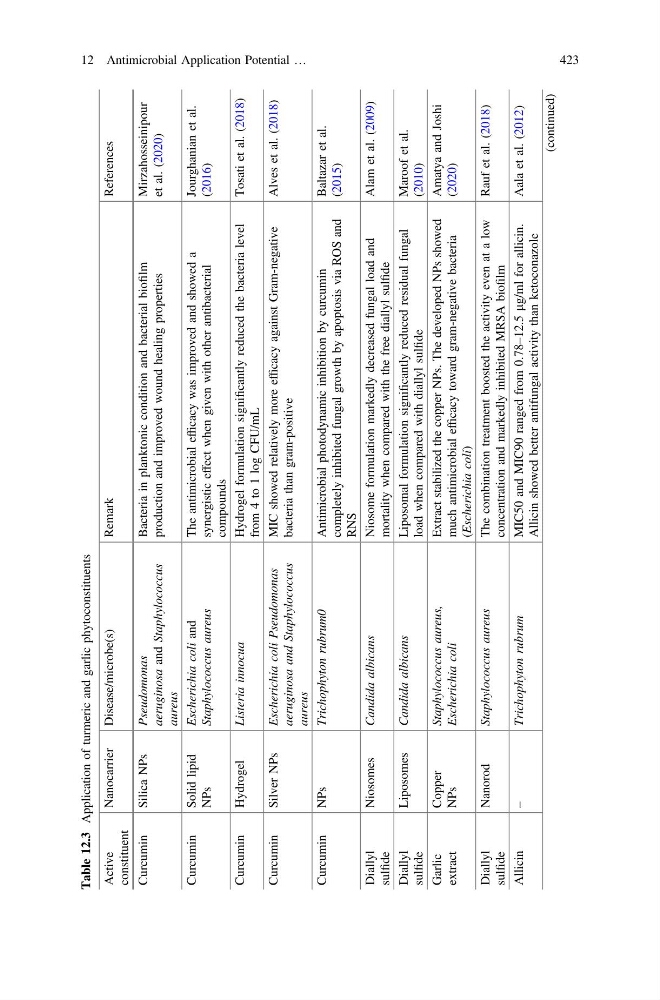
Table 12.3
Application of turmeric and garlic phytoconstituents
Active
constituent
Nanocarrier
Disease/microbe(s)
Remark
References
Curcumin
Silica NPs
Pseudomonas
aeruginosa
and Staphylococcus
aureus
Bacteria in planktonic condition and bacterial biofilm
production and improved wound healing properties
Mirzahosseinipour
et al. (2020)
Curcumin
Solid lipid
NPs
Escherichia coli
and
Staphylococcus aureus
The antimicrobial efficacy was improved and showed a
synergistic effect when given with other antibacterial
compounds
Jourghanian et al.
(2016)
Curcumin
Hydrogel
Listeria innocua
Hydrogel formulation significantly reduced the bacteria level
from 4 to 1 log CFU/mL
Tosati et al. (2018)
Curcumin
Silver NPs
Escherichia coli Pseudomonas
aeruginosa and Staphylococcus
aureus
MIC showed relatively more efficacy against Gram-negative
bacteria than gram-positive
Alves et al. (2018)
Curcumin
NPs
Trichophyton rubrum0
Antimicrobial photodynamic inhibition by curcumin
completely inhibited fungal growth by apoptosis via ROS and
RNS
Baltazar et al.
(2015)
Diallyl
sulfide
Niosomes
Candida albicans
Niosome formulation markedly decreased fungal load and
mortality when compared with the free diallyl sulfide
Alam et al. (2009)
Diallyl
sulfide
Liposomes
Candida albicans
Liposomal formulation significantly reduced residual fungal
load when compared with diallyl sulfide
Maroof et al.
(2010)
Garlic
extract
Copper
NPs
Staphylococcus aureus,
Escherichia coli
Extract stabilized the copper NPs. The developed NPs showed
much antimicrobial efficacy toward gram-negative bacteria
(Escherichia coli)
Amatya and Joshi
(2020)
Diallyl
sulfide
Nanorod
Staphylococcus aureus
The combination treatment boosted the activity even at a low
concentration and markedly inhibited MRSA biofilm
Rauf et al. (2018)
Allicin
–
Trichophyton rubrum
MIC50 and MIC90 ranged from 0.78–12.5
lg/ml for allicin.
Allicin showed better antifungal activity than ketoconazole
Aala et al. (2012)
(continued)
12 Antimicrobial Application Potential …
423
Application of turmeric and garlic phytoconstituents
Active
constituent
Nanocarrier
Disease/microbe(s)
Remark
References
Curcumin
Silica NPs
Pseudomonas
aeruginosa
and Staphylococcus
aureus
Bacteria in planktonic condition and bacterial biofilm
production and improved wound healing properties
Mirzahosseinipour
et al. (2020)
Curcumin
Solid lipid
NPs
Escherichia coli
and
Staphylococcus aureus
The antimicrobial efficacy was improved and showed a
synergistic effect when given with other antibacterial
compounds
Jourghanian et al.
(2016)
Curcumin
Hydrogel
Listeria innocua
Hydrogel formulation significantly reduced the bacteria level
from 4 to 1 log CFU/mL
Tosati et al. (2018)
Curcumin
Silver NPs
Escherichia coli Pseudomonas
aeruginosa and Staphylococcus
aureus
MIC showed relatively more efficacy against Gram-negative
bacteria than gram-positive
Alves et al. (2018)
Curcumin
NPs
Trichophyton rubrum0
Antimicrobial photodynamic inhibition by curcumin
completely inhibited fungal growth by apoptosis via ROS and
RNS
Baltazar et al.
(2015)
Diallyl
sulfide
Niosomes
Candida albicans
Niosome formulation markedly decreased fungal load and
mortality when compared with the free diallyl sulfide
Alam et al. (2009)
Diallyl
sulfide
Liposomes
Candida albicans
Liposomal formulation significantly reduced residual fungal
load when compared with diallyl sulfide
Maroof et al.
(2010)
Garlic
extract
Copper
NPs
Staphylococcus aureus,
Escherichia coli
Extract stabilized the copper NPs. The developed NPs showed
much antimicrobial efficacy toward gram-negative bacteria
(Escherichia coli)
Amatya and Joshi
(2020)
Diallyl
sulfide
Nanorod
Staphylococcus aureus
The combination treatment boosted the activity even at a low
concentration and markedly inhibited MRSA biofilm
Rauf et al. (2018)
Allicin
–
Trichophyton rubrum
MIC50 and MIC90 ranged from 0.78–12.5
lg/ml for allicin.
Allicin showed better antifungal activity than ketoconazole
Aala et al. (2012)
(continued)
12 Antimicrobial Application Potential …
423