

ultrasound treatment after 48 h. Maximum phenylalanine ammonia-lyase activity
was also observed after 48 h of storage with (1–4) min of ultrasound treatment.
These data confirmed the importance of abiotic elicitors on secondary metabolite
accumulation in tomato plant (Lu et al. 2020).
1.4.1.14 Effect of Abiotic Elicitors on Metabolite Accumulation
of Trifolium resupinatum
Twaij et al. experimentally proved the importance of abiotic elicitors and precursors
on the accumulation of secondary metabolites in Trifolium resupinatum. The
experiment was started with culture propagation of T. resupinatum shoot in MS
medium containing BA (2.0 mg/L), IAA (0.5 mg/L), sucrose and phytage at pH 7.0
until calli was full grown. Then the calli further transferred into the MS medium
with sucrose, NAA and kinetin as growth regulators. Then the grown explants were
divided into four categories such as shade grown plant, somatic embryos, light
induced and dark induced followed by treated with MJ, salicylic acid and glutathione with concentration range (0, 10, 20, 40, 80 and 160) µM for a period of (0–
4) weeks. Then total phenolic content, total flavonoid and antioxidative efficiency
using DPPH radical scavenging and ferric reducing antioxidant potential assay
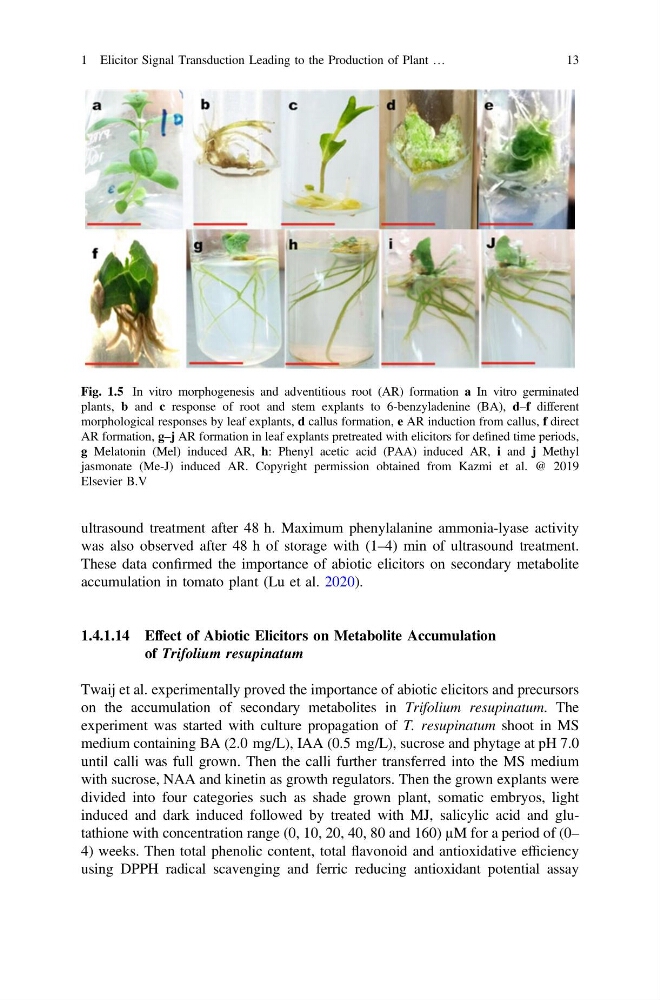
Fig. 1.5 In vitro morphogenesis and adventitious root (AR) formation a In vitro germinated
plants, b and c response of root and stem explants to 6-benzyladenine (BA), d–f different
morphological responses by leaf explants, d callus formation, e AR induction from callus, f direct
AR formation, g–j AR formation in leaf explants pretreated with elicitors for defined time periods,
g Melatonin (Mel) induced AR, h: Phenyl acetic acid (PAA) induced AR, i and j Methyl
jasmonate (Me-J) induced AR. Copyright permission obtained from Kazmi et al. @ 2019
Elsevier B.V
1 Elicitor Signal Transduction Leading to the Production of Plant …
13
was also observed after 48 h of storage with (1–4) min of ultrasound treatment.
These data confirmed the importance of abiotic elicitors on secondary metabolite
accumulation in tomato plant (Lu et al. 2020).
1.4.1.14 Effect of Abiotic Elicitors on Metabolite Accumulation
of Trifolium resupinatum
Twaij et al. experimentally proved the importance of abiotic elicitors and precursors
on the accumulation of secondary metabolites in Trifolium resupinatum. The
experiment was started with culture propagation of T. resupinatum shoot in MS
medium containing BA (2.0 mg/L), IAA (0.5 mg/L), sucrose and phytage at pH 7.0
until calli was full grown. Then the calli further transferred into the MS medium
with sucrose, NAA and kinetin as growth regulators. Then the grown explants were
divided into four categories such as shade grown plant, somatic embryos, light
induced and dark induced followed by treated with MJ, salicylic acid and glutathione with concentration range (0, 10, 20, 40, 80 and 160) µM for a period of (0–
4) weeks. Then total phenolic content, total flavonoid and antioxidative efficiency
using DPPH radical scavenging and ferric reducing antioxidant potential assay
Fig. 1.5 In vitro morphogenesis and adventitious root (AR) formation a In vitro germinated
plants, b and c response of root and stem explants to 6-benzyladenine (BA), d–f different
morphological responses by leaf explants, d callus formation, e AR induction from callus, f direct
AR formation, g–j AR formation in leaf explants pretreated with elicitors for defined time periods,
g Melatonin (Mel) induced AR, h: Phenyl acetic acid (PAA) induced AR, i and j Methyl
jasmonate (Me-J) induced AR. Copyright permission obtained from Kazmi et al. @ 2019
Elsevier B.V
1 Elicitor Signal Transduction Leading to the Production of Plant …
13