

10.9 Conclusion
As the plant can be considered as a storehouse of the various kinds of secondary
metabolites and the production of secondary substances of plant origin fully
depends upon the selectivity of the species of a family, i.e., the plants belonging to a
particular family provide most specific types phytoconstituents. A huge number of
different classes of plants and various types of phytoconstituents are found
worldwide but only very few of them are identified, extracted, isolated, elucidated
for the chemical structure, and evaluated for their pharmacological activity.
To overcome this, the knowledge regarding various fields of science such as
Botany, Organic Chemistry, Biochemistry, Analytical Chemistry, and
Pharmacology is needed. A plant extract contains several phytoconstituents
showing various biological activities due to complexity of the secondary metabolites in which a component may synergic or counteract the activity, and therefore,
specific research or study for gathering more information of the phytoconstituents
to develop a new drug or a new combination of drugs having less toxic and more
potent is highly essential. Since the chapter summarized the description and
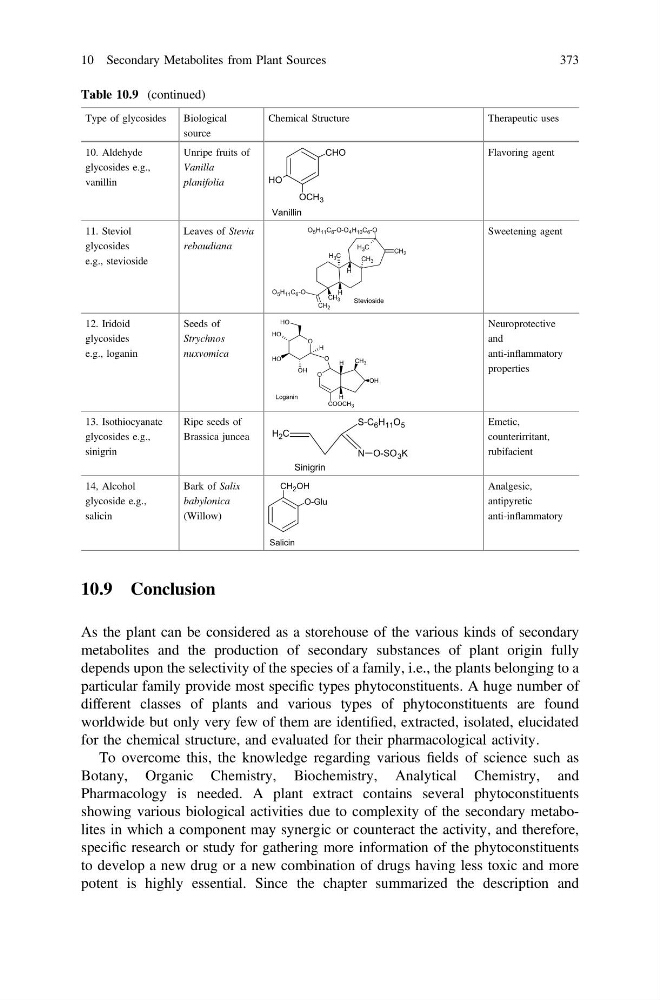
Table 10.9 (continued)
Type of glycosides
Biological
source
Chemical Structure
Therapeutic uses
10. Aldehyde
glycosides e.g.,
vanillin
Unripe fruits of
Vanilla
planifolia
CHO
O
H
OCH 3
Vanillin
Flavoring agent
11. Steviol
glycosides
e.g., stevioside
Leaves of Stevia
rebaudiana
CH 3
C
H 3
C
H 3
H
H
CH 3
O 5 H 11 C 6 -O
CH 2
O 5 H 11 C 6 -O-O 4 H 10 C 6 -O
CH 2
Stevioside
Sweetening agent
12. Iridoid
glycosides
e.g., loganin
Seeds of
Strychnos
nuxvomica
O
O
O
OH
CH 3
COOCH 3
OH
O
H
O
H
O
H
H
H
H
Loganin
Neuroprotective
and
anti-inflammatory
properties
13. Isothiocyanate
glycosides e.g.,
sinigrin
Ripe seeds of
Brassica juncea
C
H 2
S-C 6 H 11 O 5
N O-SO 3 K
Sinigrin
Emetic,
counterirritant,
rubifacient
14, Alcohol
glycoside e.g.,
salicin
Bark of Salix
babylonica
(Willow)
O-Glu
CH 2 OH
Salicin
Analgesic,
antipyretic
anti-inflammatory
10 Secondary Metabolites from Plant Sources
373
As the plant can be considered as a storehouse of the various kinds of secondary
metabolites and the production of secondary substances of plant origin fully
depends upon the selectivity of the species of a family, i.e., the plants belonging to a
particular family provide most specific types phytoconstituents. A huge number of
different classes of plants and various types of phytoconstituents are found
worldwide but only very few of them are identified, extracted, isolated, elucidated
for the chemical structure, and evaluated for their pharmacological activity.
To overcome this, the knowledge regarding various fields of science such as
Botany, Organic Chemistry, Biochemistry, Analytical Chemistry, and
Pharmacology is needed. A plant extract contains several phytoconstituents
showing various biological activities due to complexity of the secondary metabolites in which a component may synergic or counteract the activity, and therefore,
specific research or study for gathering more information of the phytoconstituents
to develop a new drug or a new combination of drugs having less toxic and more
potent is highly essential. Since the chapter summarized the description and
Table 10.9 (continued)
Type of glycosides
Biological
source
Chemical Structure
Therapeutic uses
10. Aldehyde
glycosides e.g.,
vanillin
Unripe fruits of
Vanilla
planifolia
CHO
O
H
OCH 3
Vanillin
Flavoring agent
11. Steviol
glycosides
e.g., stevioside
Leaves of Stevia
rebaudiana
CH 3
C
H 3
C
H 3
H
H
CH 3
O 5 H 11 C 6 -O
CH 2
O 5 H 11 C 6 -O-O 4 H 10 C 6 -O
CH 2
Stevioside
Sweetening agent
12. Iridoid
glycosides
e.g., loganin
Seeds of
Strychnos
nuxvomica
O
O
O
OH
CH 3
COOCH 3
OH
O
H
O
H
O
H
H
H
H
Loganin
Neuroprotective
and
anti-inflammatory
properties
13. Isothiocyanate
glycosides e.g.,
sinigrin
Ripe seeds of
Brassica juncea
C
H 2
S-C 6 H 11 O 5
N O-SO 3 K
Sinigrin
Emetic,
counterirritant,
rubifacient
14, Alcohol
glycoside e.g.,
salicin
Bark of Salix
babylonica
(Willow)
O-Glu
CH 2 OH
Salicin
Analgesic,
antipyretic
anti-inflammatory
10 Secondary Metabolites from Plant Sources
373