

1.4.1.6 Effects of Abiotic Elicitor on Steviosides Production in Stevia
rebaudiana Bertoni Calli
Mejia-Espejel et al. was experimentally proved the effects of abiotic elicitor (salicylic acid, MJ, citric acid, ascorbic acid) with different light (red, blue and white)
and temperature environment on the production of steviosides (diterpene glycoside)
present in Stevia rebaudiana. The experiment was started with the reaction between
3 gm of calii (grown in Murashige and Skoog (MS) medium containing
2,4-dichlorophenoxyacetic acid, BA, citric acid and ascorbic acid) and different
elicitors such as salicylic acid (10 and 100 mM), MJ (10 and 100 mM), antioxidants, growth regulator, different light (white light, red light, blue light and a
combination of red light and blue light) and temperature (25 °C and 28 °C) as
physical abiotic elicitor. The outcomes revealed that maximum stevioside was
obtained at a combination of white light, 28 °C, 100 mM of salicylic acid and
10 mM of MJ. These data strictly adhere with the importance of abiotic elicitor on
the production of steviosides (Mejia-Espejel et al. 2018).
1.4.1.7 Effect of Light as Abiotic Elicitor on the Secondary Metabolite
Growth in Stevia rebaudiana
Ahmad et al. was experimentally proved the effect of light of the production of
secondary metabolites (total phenolic and flavonoid content) and antioxidative
properties of the Stevia rebaudiana plant. The experiment was started with the
development of callus from the leaves of the plant in MS medium contained with
2,4-dichlorophenoxyacetic acid, BA; then the callus was exposed to different light
medium such as green light, yellow light, blue light, red light and white fluorescent
light environments at a 25 °C temperature flowed by antioxidative property
assessment using DPPH antioxidant method. The outcomes revealed that maximum
fresh callus weight was observed in white light with greater growth kinetic. Total
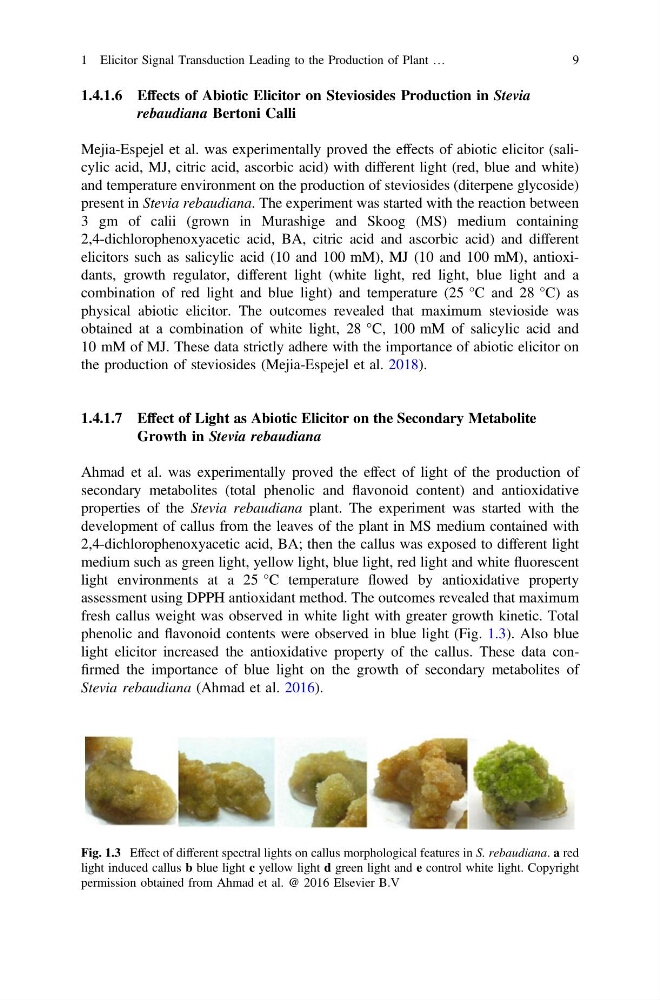
phenolic and flavonoid contents were observed in blue light (Fig. 1.3). Also blue
light elicitor increased the antioxidative property of the callus. These data confirmed the importance of blue light on the growth of secondary metabolites of
Stevia rebaudiana (Ahmad et al. 2016).
Fig. 1.3 Effect of different spectral lights on callus morphological features in S. rebaudiana. a red
light induced callus b blue light c yellow light d green light and e control white light. Copyright
permission obtained from Ahmad et al. @ 2016 Elsevier B.V
1 Elicitor Signal Transduction Leading to the Production of Plant …
9
rebaudiana Bertoni Calli
Mejia-Espejel et al. was experimentally proved the effects of abiotic elicitor (salicylic acid, MJ, citric acid, ascorbic acid) with different light (red, blue and white)
and temperature environment on the production of steviosides (diterpene glycoside)
present in Stevia rebaudiana. The experiment was started with the reaction between
3 gm of calii (grown in Murashige and Skoog (MS) medium containing
2,4-dichlorophenoxyacetic acid, BA, citric acid and ascorbic acid) and different
elicitors such as salicylic acid (10 and 100 mM), MJ (10 and 100 mM), antioxidants, growth regulator, different light (white light, red light, blue light and a
combination of red light and blue light) and temperature (25 °C and 28 °C) as
physical abiotic elicitor. The outcomes revealed that maximum stevioside was
obtained at a combination of white light, 28 °C, 100 mM of salicylic acid and
10 mM of MJ. These data strictly adhere with the importance of abiotic elicitor on
the production of steviosides (Mejia-Espejel et al. 2018).
1.4.1.7 Effect of Light as Abiotic Elicitor on the Secondary Metabolite
Growth in Stevia rebaudiana
Ahmad et al. was experimentally proved the effect of light of the production of
secondary metabolites (total phenolic and flavonoid content) and antioxidative
properties of the Stevia rebaudiana plant. The experiment was started with the
development of callus from the leaves of the plant in MS medium contained with
2,4-dichlorophenoxyacetic acid, BA; then the callus was exposed to different light
medium such as green light, yellow light, blue light, red light and white fluorescent
light environments at a 25 °C temperature flowed by antioxidative property
assessment using DPPH antioxidant method. The outcomes revealed that maximum
fresh callus weight was observed in white light with greater growth kinetic. Total
phenolic and flavonoid contents were observed in blue light (Fig. 1.3). Also blue
light elicitor increased the antioxidative property of the callus. These data confirmed the importance of blue light on the growth of secondary metabolites of
Stevia rebaudiana (Ahmad et al. 2016).
Fig. 1.3 Effect of different spectral lights on callus morphological features in S. rebaudiana. a red
light induced callus b blue light c yellow light d green light and e control white light. Copyright
permission obtained from Ahmad et al. @ 2016 Elsevier B.V
1 Elicitor Signal Transduction Leading to the Production of Plant …
9