

prolonged metformin HCl release in vitro and significant antidiabetic activity in
alloxan induced diabetic rats, in vivo. Das et al. (2014) developed alginate-based
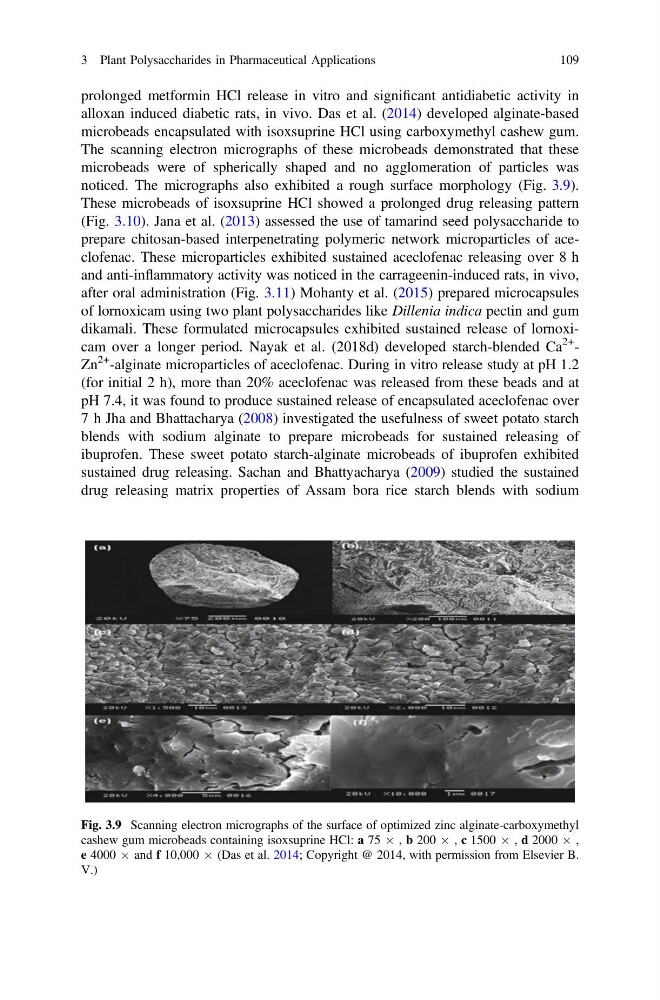
microbeads encapsulated with isoxsuprine HCl using carboxymethyl cashew gum.
The scanning electron micrographs of these microbeads demonstrated that these
microbeads were of spherically shaped and no agglomeration of particles was
noticed. The micrographs also exhibited a rough surface morphology (Fig. 3.9).
These microbeads of isoxsuprine HCl showed a prolonged drug releasing pattern
(Fig. 3.10). Jana et al. (2013) assessed the use of tamarind seed polysaccharide to
prepare chitosan-based interpenetrating polymeric network microparticles of aceclofenac. These microparticles exhibited sustained aceclofenac releasing over 8 h
and anti-inflammatory activity was noticed in the carrageenin-induced rats, in vivo,
after oral administration (Fig. 3.11) Mohanty et al. (2015) prepared microcapsules
of lornoxicam using two plant polysaccharides like Dillenia indica pectin and gum
dikamali. These formulated microcapsules exhibited sustained release of lornoxicam over a longer period. Nayak et al. (2018d) developed starch-blended Ca
2+ -
Zn
2+ -alginate microparticles of aceclofenac. During in vitro release study at pH 1.2
(for initial 2 h), more than 20% aceclofenac was released from these beads and at
pH 7.4, it was found to produce sustained release of encapsulated aceclofenac over
7 h Jha and Bhattacharya (2008) investigated the usefulness of sweet potato starch
blends with sodium alginate to prepare microbeads for sustained releasing of
ibuprofen. These sweet potato starch-alginate microbeads of ibuprofen exhibited
sustained drug releasing. Sachan and Bhattyacharya (2009) studied the sustained
drug releasing matrix properties of Assam bora rice starch blends with sodium
Fig. 3.9 Scanning electron micrographs of the surface of optimized zinc alginate-carboxymethyl
cashew gum microbeads containing isoxsuprine HCl: a 75 Â , b 200 Â , c 1500 Â , d 2000 Â ,
e 4000 Â and f 10,000 Â (Das et al. 2014; Copyright @ 2014, with permission from Elsevier B.
V.)
3 Plant Polysaccharides in Pharmaceutical Applications
109
alloxan induced diabetic rats, in vivo. Das et al. (2014) developed alginate-based
microbeads encapsulated with isoxsuprine HCl using carboxymethyl cashew gum.
The scanning electron micrographs of these microbeads demonstrated that these
microbeads were of spherically shaped and no agglomeration of particles was
noticed. The micrographs also exhibited a rough surface morphology (Fig. 3.9).
These microbeads of isoxsuprine HCl showed a prolonged drug releasing pattern
(Fig. 3.10). Jana et al. (2013) assessed the use of tamarind seed polysaccharide to
prepare chitosan-based interpenetrating polymeric network microparticles of aceclofenac. These microparticles exhibited sustained aceclofenac releasing over 8 h
and anti-inflammatory activity was noticed in the carrageenin-induced rats, in vivo,
after oral administration (Fig. 3.11) Mohanty et al. (2015) prepared microcapsules
of lornoxicam using two plant polysaccharides like Dillenia indica pectin and gum
dikamali. These formulated microcapsules exhibited sustained release of lornoxicam over a longer period. Nayak et al. (2018d) developed starch-blended Ca
2+ -
Zn
2+ -alginate microparticles of aceclofenac. During in vitro release study at pH 1.2
(for initial 2 h), more than 20% aceclofenac was released from these beads and at
pH 7.4, it was found to produce sustained release of encapsulated aceclofenac over
7 h Jha and Bhattacharya (2008) investigated the usefulness of sweet potato starch
blends with sodium alginate to prepare microbeads for sustained releasing of
ibuprofen. These sweet potato starch-alginate microbeads of ibuprofen exhibited
sustained drug releasing. Sachan and Bhattyacharya (2009) studied the sustained
drug releasing matrix properties of Assam bora rice starch blends with sodium
Fig. 3.9 Scanning electron micrographs of the surface of optimized zinc alginate-carboxymethyl
cashew gum microbeads containing isoxsuprine HCl: a 75 Â , b 200 Â , c 1500 Â , d 2000 Â ,
e 4000 Â and f 10,000 Â (Das et al. 2014; Copyright @ 2014, with permission from Elsevier B.
V.)
3 Plant Polysaccharides in Pharmaceutical Applications
109