

3.3.4 Capsules
Plant polysaccharides are also investigated in the formulations of capsules, where
these are used to prepare capsule shells, diluents and capsule matrices. Misale et al.
(2008) studied sago starch in the preparation capsule shell as because of its film
forming ability. The results of the study indicated that sago starch made capsule
shells were moderately comparable to that of gelatin made capsule shells. The
in vitro drug releasing rate using sago starch capsule shells exhibited a slower and
sustained drug releasing as compared to that of gelatin capsule shells.
3.3.5 Beads
Recent years, many plant polysaccharides have been used to formulate polymeric
beads loaded with a variety of drugs and the uses of plant polysaccharides to
formulate beads is mainly due to the matrix forming and release retarding properties
(Nayak and Hasnain 2019k). Most of these polymeric beads made up of plant
polysaccharides are intended for oral administrations. Sometimes, mucoadhesive
plant polymers are being used to formulate bioadhesive beads, which have been
proved useful by facilitating better drug delivery (Nayak and Pal 2016, 2017a, b;
Pal and Nayak 2017). In a work, Bera et al. (2015a) developed interpenetrating
polymer network beads of ziprasidone HCl employing two plant polysaccharides,
namely pectin and sterculia gum via the simultaneous ionotropic crosslinking by
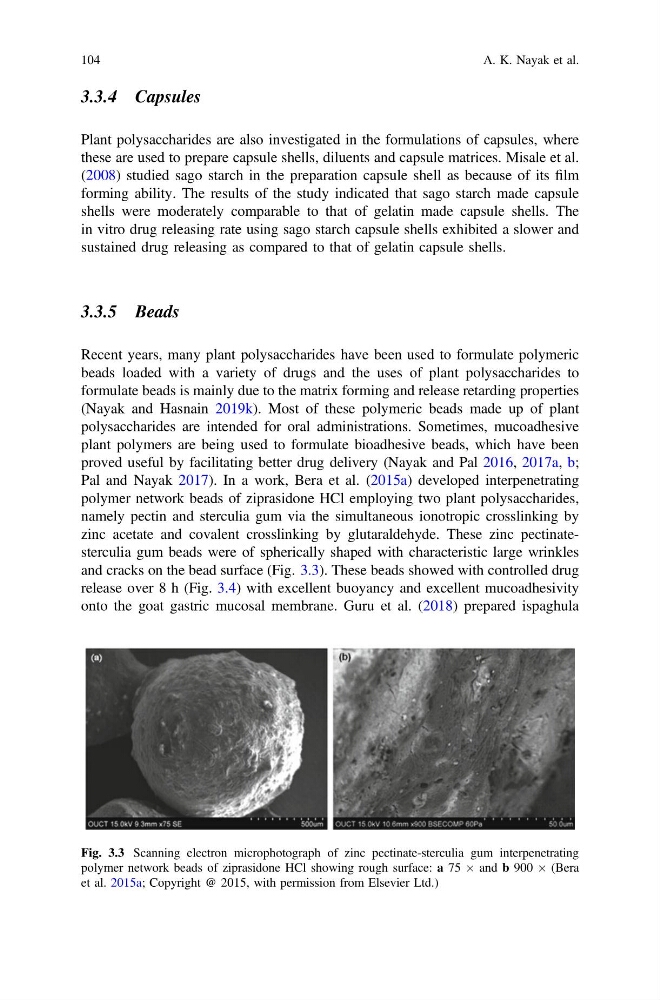
zinc acetate and covalent crosslinking by glutaraldehyde. These zinc pectinatesterculia gum beads were of spherically shaped with characteristic large wrinkles
and cracks on the bead surface (Fig. 3.3). These beads showed with controlled drug
release over 8 h (Fig. 3.4) with excellent buoyancy and excellent mucoadhesivity
onto the goat gastric mucosal membrane. Guru et al. (2018) prepared ispaghula
Fig. 3.3 Scanning electron microphotograph of zinc pectinate-sterculia gum interpenetrating
polymer network beads of ziprasidone HCl showing rough surface: a 75 Â and b 900 Â (Bera
et al. 2015a; Copyright @ 2015, with permission from Elsevier Ltd.)
104
A. K. Nayak et al.
Plant polysaccharides are also investigated in the formulations of capsules, where
these are used to prepare capsule shells, diluents and capsule matrices. Misale et al.
(2008) studied sago starch in the preparation capsule shell as because of its film
forming ability. The results of the study indicated that sago starch made capsule
shells were moderately comparable to that of gelatin made capsule shells. The
in vitro drug releasing rate using sago starch capsule shells exhibited a slower and
sustained drug releasing as compared to that of gelatin capsule shells.
3.3.5 Beads
Recent years, many plant polysaccharides have been used to formulate polymeric
beads loaded with a variety of drugs and the uses of plant polysaccharides to
formulate beads is mainly due to the matrix forming and release retarding properties
(Nayak and Hasnain 2019k). Most of these polymeric beads made up of plant
polysaccharides are intended for oral administrations. Sometimes, mucoadhesive
plant polymers are being used to formulate bioadhesive beads, which have been
proved useful by facilitating better drug delivery (Nayak and Pal 2016, 2017a, b;
Pal and Nayak 2017). In a work, Bera et al. (2015a) developed interpenetrating
polymer network beads of ziprasidone HCl employing two plant polysaccharides,
namely pectin and sterculia gum via the simultaneous ionotropic crosslinking by
zinc acetate and covalent crosslinking by glutaraldehyde. These zinc pectinatesterculia gum beads were of spherically shaped with characteristic large wrinkles
and cracks on the bead surface (Fig. 3.3). These beads showed with controlled drug
release over 8 h (Fig. 3.4) with excellent buoyancy and excellent mucoadhesivity
onto the goat gastric mucosal membrane. Guru et al. (2018) prepared ispaghula
Fig. 3.3 Scanning electron microphotograph of zinc pectinate-sterculia gum interpenetrating
polymer network beads of ziprasidone HCl showing rough surface: a 75 Â and b 900 Â (Bera
et al. 2015a; Copyright @ 2015, with permission from Elsevier Ltd.)
104
A. K. Nayak et al.