

Production of SHG Zinc From 100% Recycled Materials
79
Table 1 Typical compositions for EAF dust, Kiln Feed, WOX and IRM
EAF Dust
Kiln Feed
WOX
IRM
%Zn
10–37
15–23
60–68
0.5–2.4
%Pb
0.3–2.4
0.3–0.8
1.0–2.4
0–0.06
%Fe
14–37
17–25
1.2–5
37–49
V4 Ratio a
1.5–10
2.0–4.0
–
1.6–3.2
%Cl0.5–3.2
0.8–1.4
3.5–5.3
–
%C
1–4
16–22
0.2–2
1–6
a V4 Ratio = (%CaO + %MgO)/(%Al 2 O 3 + %SiO 2 )
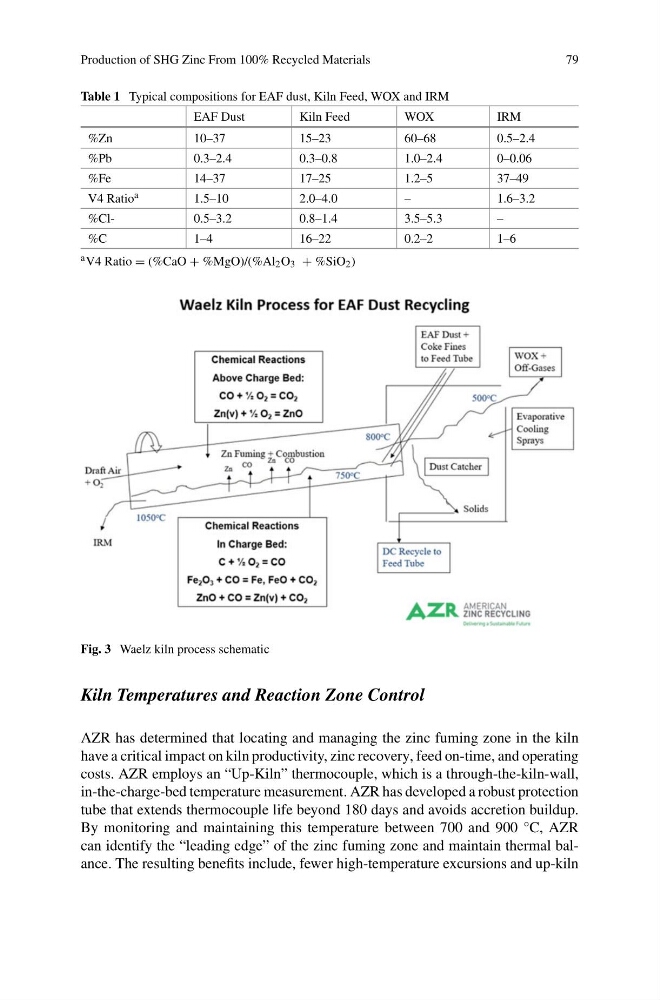
Fig. 3 Waelz kiln process schematic
Kiln Temperatures and Reaction Zone Control
AZR has determined that locating and managing the zinc fuming zone in the kiln
have a critical impact on kiln productivity, zinc recovery, feed on-time, and operating
costs. AZR employs an “Up-Kiln” thermocouple, which is a through-the-kiln-wall,
in-the-charge-bed temperature measurement. AZR has developed a robust protection
tube that extends thermocouple life beyond 180 days and avoids accretion buildup.
By monitoring and maintaining this temperature between 700 and 900 °C, AZR
can identify the “leading edge” of the zinc fuming zone and maintain thermal balance. The resulting benefits include, fewer high-temperature excursions and up-kiln
79
Table 1 Typical compositions for EAF dust, Kiln Feed, WOX and IRM
EAF Dust
Kiln Feed
WOX
IRM
%Zn
10–37
15–23
60–68
0.5–2.4
%Pb
0.3–2.4
0.3–0.8
1.0–2.4
0–0.06
%Fe
14–37
17–25
1.2–5
37–49
V4 Ratio a
1.5–10
2.0–4.0
–
1.6–3.2
%Cl0.5–3.2
0.8–1.4
3.5–5.3
–
%C
1–4
16–22
0.2–2
1–6
a V4 Ratio = (%CaO + %MgO)/(%Al 2 O 3 + %SiO 2 )
Fig. 3 Waelz kiln process schematic
Kiln Temperatures and Reaction Zone Control
AZR has determined that locating and managing the zinc fuming zone in the kiln
have a critical impact on kiln productivity, zinc recovery, feed on-time, and operating
costs. AZR employs an “Up-Kiln” thermocouple, which is a through-the-kiln-wall,
in-the-charge-bed temperature measurement. AZR has developed a robust protection
tube that extends thermocouple life beyond 180 days and avoids accretion buildup.
By monitoring and maintaining this temperature between 700 and 900 °C, AZR
can identify the “leading edge” of the zinc fuming zone and maintain thermal balance. The resulting benefits include, fewer high-temperature excursions and up-kiln