

78
J. F. Pusateri et al.
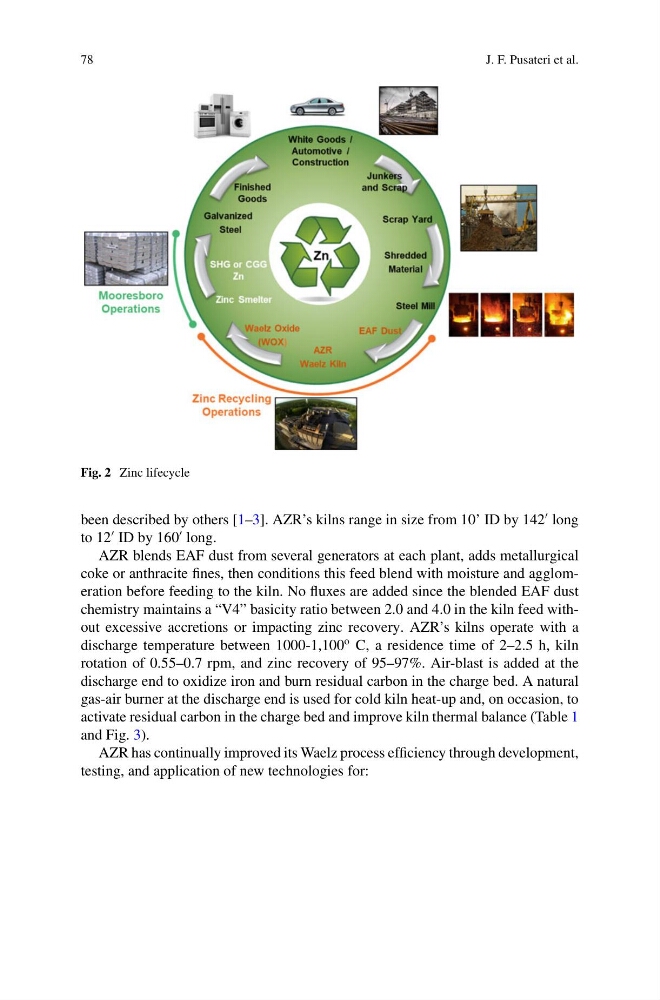
Fig. 2 Zinc lifecycle
been described by others [1–3]. AZR’s kilns range in size from 10’ ID by 142
long
to 12
ID by 160
long.
AZR blends EAF dust from several generators at each plant, adds metallurgical
coke or anthracite fines, then conditions this feed blend with moisture and agglomeration before feeding to the kiln. No fluxes are added since the blended EAF dust
chemistry maintains a “V4” basicity ratio between 2.0 and 4.0 in the kiln feed without excessive accretions or impacting zinc recovery. AZR’s kilns operate with a
discharge temperature between 1000-1,100
o C, a residence time of 2–2.5 h, kiln
rotation of 0.55–0.7 rpm, and zinc recovery of 95–97%. Air-blast is added at the
discharge end to oxidize iron and burn residual carbon in the charge bed. A natural
gas-air burner at the discharge end is used for cold kiln heat-up and, on occasion, to
activate residual carbon in the charge bed and improve kiln thermal balance (Table 1
and Fig. 3).
AZR has continually improved its Waelz process efficiency through development,
testing, and application of new technologies for:
J. F. Pusateri et al.
Fig. 2 Zinc lifecycle
been described by others [1–3]. AZR’s kilns range in size from 10’ ID by 142
long
to 12
ID by 160
long.
AZR blends EAF dust from several generators at each plant, adds metallurgical
coke or anthracite fines, then conditions this feed blend with moisture and agglomeration before feeding to the kiln. No fluxes are added since the blended EAF dust
chemistry maintains a “V4” basicity ratio between 2.0 and 4.0 in the kiln feed without excessive accretions or impacting zinc recovery. AZR’s kilns operate with a
discharge temperature between 1000-1,100
o C, a residence time of 2–2.5 h, kiln
rotation of 0.55–0.7 rpm, and zinc recovery of 95–97%. Air-blast is added at the
discharge end to oxidize iron and burn residual carbon in the charge bed. A natural
gas-air burner at the discharge end is used for cold kiln heat-up and, on occasion, to
activate residual carbon in the charge bed and improve kiln thermal balance (Table 1
and Fig. 3).
AZR has continually improved its Waelz process efficiency through development,
testing, and application of new technologies for: