

A New Route for Treating Neutral Leaching Residue
831
Table 1 Composition of the
dried underflow from Tres
Marias neutral leaching
process
Specie
Percentage (%)
ZnO
10.01
ZnSO 4
23.41
PbSO 4
4.33
ZnFe 2 O 4
29.44
MgSO 4
2.13
CaSO 4
18.28
SiO 4
6.40
H 2 O
6.00
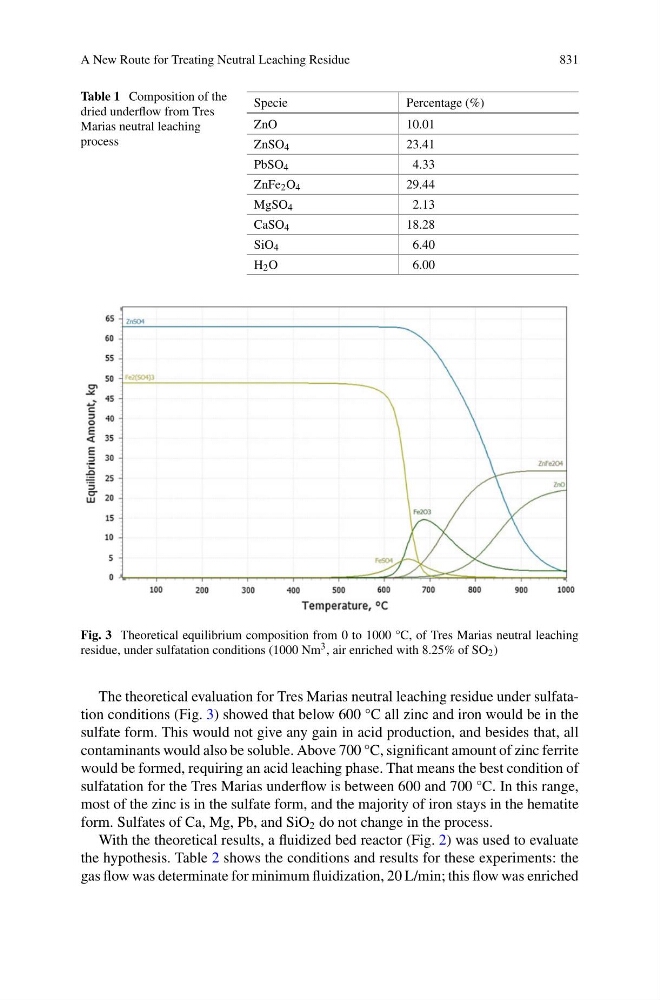
Fig. 3 Theoretical equilibrium composition from 0 to 1000 °C, of Tres Marias neutral leaching
residue, under sulfatation conditions (1000 Nm 3 , air enriched with 8.25% of SO 2 )
The theoretical evaluation for Tres Marias neutral leaching residue under sulfatation conditions (Fig. 3) showed that below 600 °C all zinc and iron would be in the
sulfate form. This would not give any gain in acid production, and besides that, all
contaminants would also be soluble. Above 700 °C, significant amount of zinc ferrite
would be formed, requiring an acid leaching phase. That means the best condition of
sulfatation for the Tres Marias underflow is between 600 and 700 °C. In this range,
most of the zinc is in the sulfate form, and the majority of iron stays in the hematite
form. Sulfates of Ca, Mg, Pb, and SiO 2 do not change in the process.
With the theoretical results, a fluidized bed reactor (Fig. 2) was used to evaluate
the hypothesis. Table 2 shows the conditions and results for these experiments: the
gas flow was determinate for minimum fluidization, 20 L/min; this flow was enriched