

830
C. C. S. de Oliveira et al.
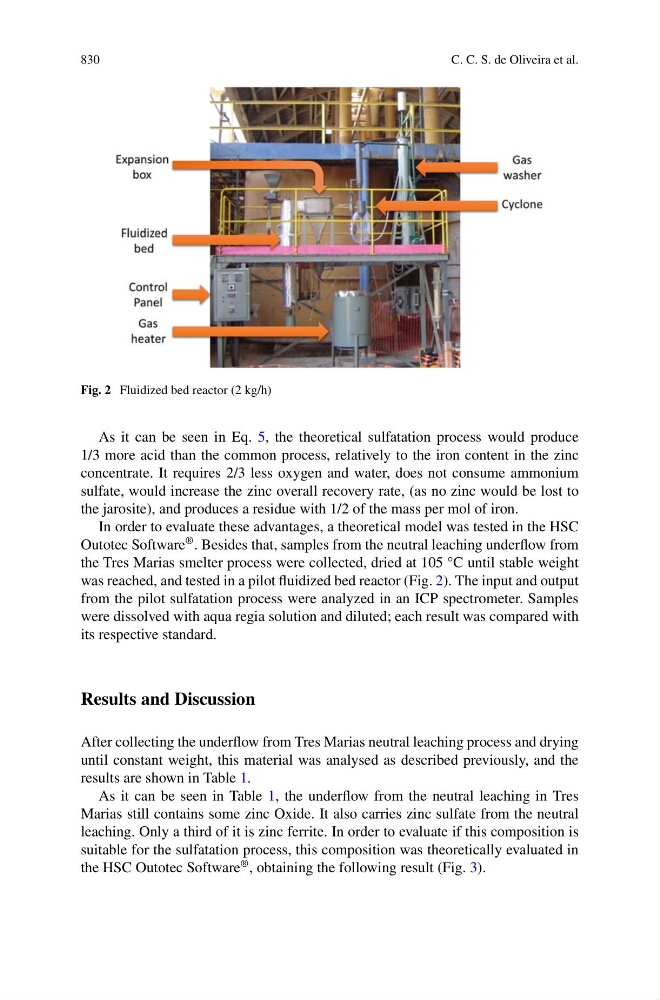
Fig. 2 Fluidized bed reactor (2 kg/h)
As it can be seen in Eq. 5, the theoretical sulfatation process would produce
1/3 more acid than the common process, relatively to the iron content in the zinc
concentrate. It requires 2/3 less oxygen and water, does not consume ammonium
sulfate, would increase the zinc overall recovery rate, (as no zinc would be lost to
the jarosite), and produces a residue with 1/2 of the mass per mol of iron.
In order to evaluate these advantages, a theoretical model was tested in the HSC
Outotec Software
® . Besides that, samples from the neutral leaching underflow from
the Tres Marias smelter process were collected, dried at 105 °C until stable weight
was reached, and tested in a pilot fluidized bed reactor (Fig. 2). The input and output
from the pilot sulfatation process were analyzed in an ICP spectrometer. Samples
were dissolved with aqua regia solution and diluted; each result was compared with
its respective standard.
Results and Discussion
After collecting the underflow from Tres Marias neutral leaching process and drying
until constant weight, this material was analysed as described previously, and the
results are shown in Table 1.
As it can be seen in Table 1, the underflow from the neutral leaching in Tres
Marias still contains some zinc Oxide. It also carries zinc sulfate from the neutral
leaching. Only a third of it is zinc ferrite. In order to evaluate if this composition is
suitable for the sulfatation process, this composition was theoretically evaluated in
the HSC Outotec Software
® , obtaining the following result (Fig. 3).