

770
A. Fraser and J.-M. Deschênes
-50
-40
-30
-20
-10
0
10
20
30
40
50
0
1000
2000
3000
4000
Heigh (μm)
Position (μm)
Base
White
Black
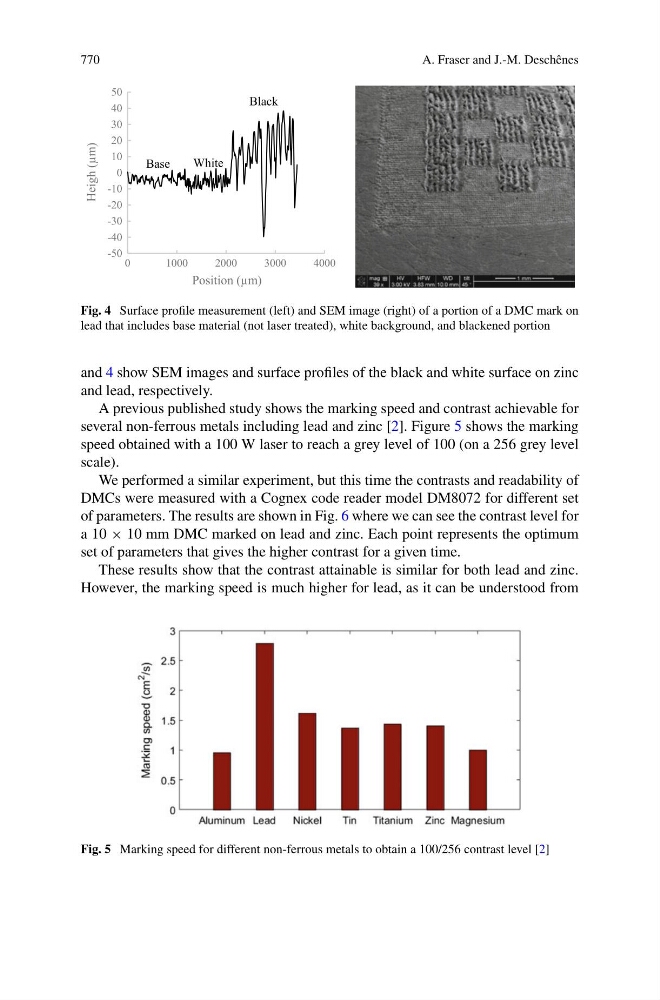
Fig. 4 Surface profile measurement (left) and SEM image (right) of a portion of a DMC mark on
lead that includes base material (not laser treated), white background, and blackened portion
and 4 show SEM images and surface profiles of the black and white surface on zinc
and lead, respectively.
A previous published study shows the marking speed and contrast achievable for
several non-ferrous metals including lead and zinc [2]. Figure 5 shows the marking
speed obtained with a 100 W laser to reach a grey level of 100 (on a 256 grey level
scale).
We performed a similar experiment, but this time the contrasts and readability of
DMCs were measured with a Cognex code reader model DM8072 for different set
of parameters. The results are shown in Fig. 6 where we can see the contrast level for
a 10 × 10 mm DMC marked on lead and zinc. Each point represents the optimum
set of parameters that gives the higher contrast for a given time.
These results show that the contrast attainable is similar for both lead and zinc.
However, the marking speed is much higher for lead, as it can be understood from
Fig. 5 Marking speed for different non-ferrous metals to obtain a 100/256 contrast level [2]