

702
J. Dahlstrom et al.
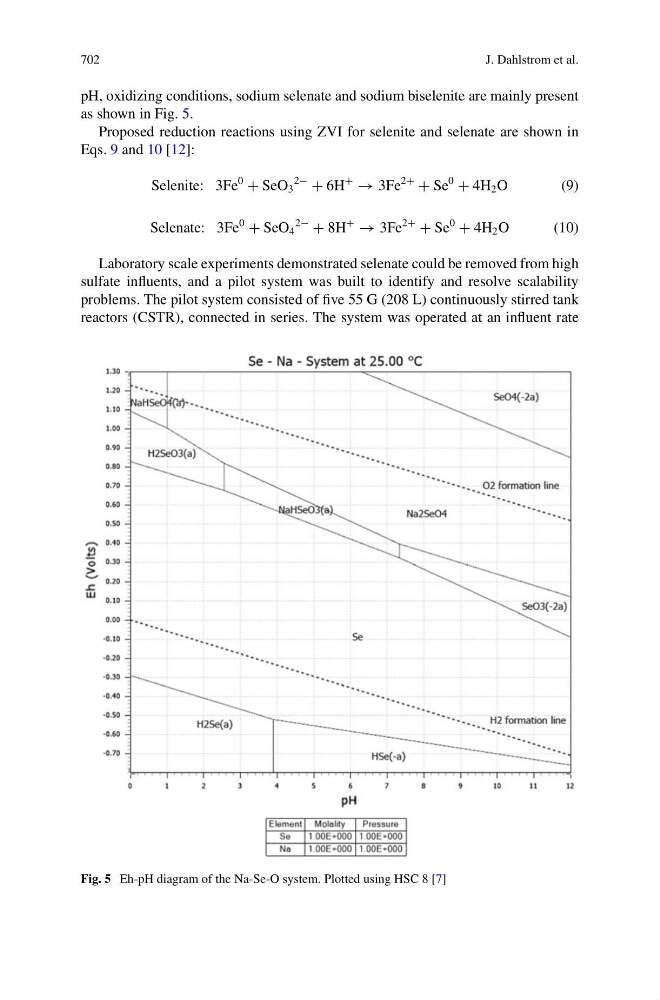
pH, oxidizing conditions, sodium selenate and sodium biselenite are mainly present
as shown in Fig. 5.
Proposed reduction reactions using ZVI for selenite and selenate are shown in
Eqs. 9 and 10 [12]:
Selenite: 3Fe
0
+ SeO 3
2−
+ 6H
+
→ 3Fe
2+
+ Se
0
+ 4H 2 O
( 9 )
Selenate: 3Fe
0
+ SeO 4
2−
+ 8H
+
→ 3Fe
2+
+ Se
0
+ 4H 2 O
(10)
Laboratory scale experiments demonstrated selenate could be removed from high
sulfate influents, and a pilot system was built to identify and resolve scalability
problems. The pilot system consisted of five 55 G (208 L) continuously stirred tank
reactors (CSTR), connected in series. The system was operated at an influent rate
Fig. 5 Eh-pH diagram of the Na-Se-O system. Plotted using HSC 8 [7]