

Review of Waste Water Treatment Technologies …
701
metals lead to large sludge volumes that can be problematic to dispose of [3]. In most
cases, the sludge is dried to form gypsum, and either landfilled or valorized where
possible.
Selenium Removal in Conventional Secondary Lead Iron
Co-precipitation Systems
Of the metals discussed previously, all can be removed to a high degree with the
exception of selenium. Although selenium has four potential valence states, secondary lead smelters are primarily concerned with the soluble species, selenite (4+)
and selenate (6+) [7]. Selenium is a grain refiner in lead acid batteries and through
various upstream separation and smelting processes, will eventually end up in the
facilities waste water, with concentrations ranging from 1 mg Se/L [1] to 10 mg Se/L
[8], with 40–60% of this being selenate [7].
Selenium can be removed via adsorption onto iron oxides and is regarded as the
best demonstrated available technology by the USEPA for industrial waste waters
[9]. Unfortunately, the mechanisms necessary to adsorb selenate onto the iron surface
are impeded by similar reactions with sulfates [7]. Because of the high sulfate concentrations seen at secondary lead facilities, the removal of selenium from treatment
waters is greatly limited by the selenate concentration.
Zero Valent Iron (ZVI) Reduction of Selenate
Gopher Resource, who currently utilize an iron co-precipitation system, began
exploring alternative methods for selenate removal that would function under high
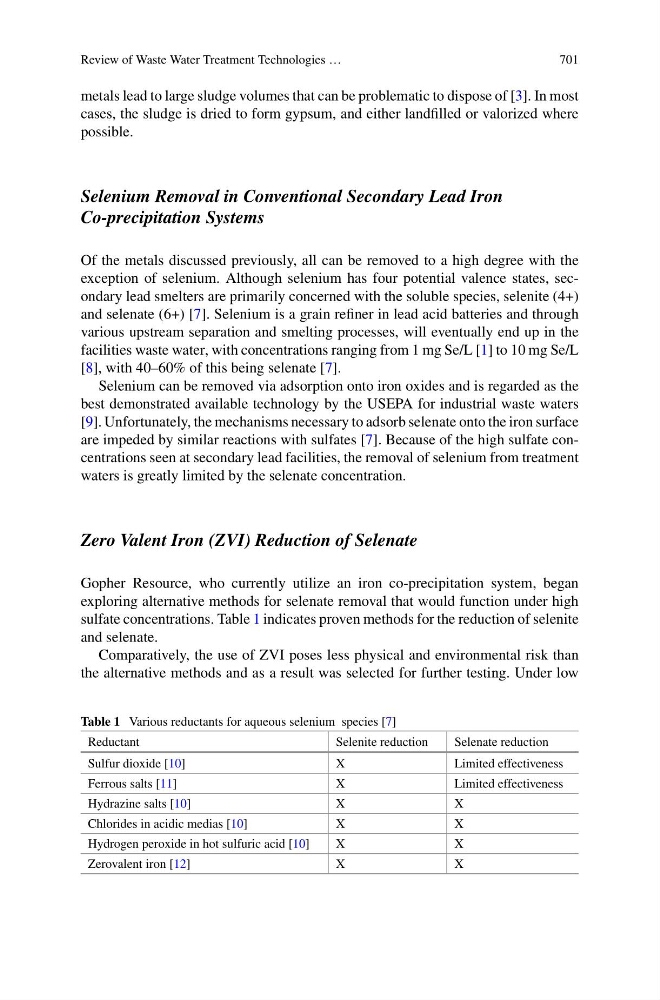
sulfate concentrations. Table 1 indicates proven methods for the reduction of selenite
and selenate.
Comparatively, the use of ZVI poses less physical and environmental risk than
the alternative methods and as a result was selected for further testing. Under low
Table 1 Various reductants for aqueous selenium species [7]
Reductant
Selenite reduction
Selenate reduction
Sulfur dioxide [10]
X
Limited effectiveness
Ferrous salts [11]
X
Limited effectiveness
Hydrazine salts [10]
X
X
Chlorides in acidic medias [10]
X
X
Hydrogen peroxide in hot sulfuric acid [10]
X
X
Zerovalent iron [12]
X
X