

700
J. Dahlstrom et al.
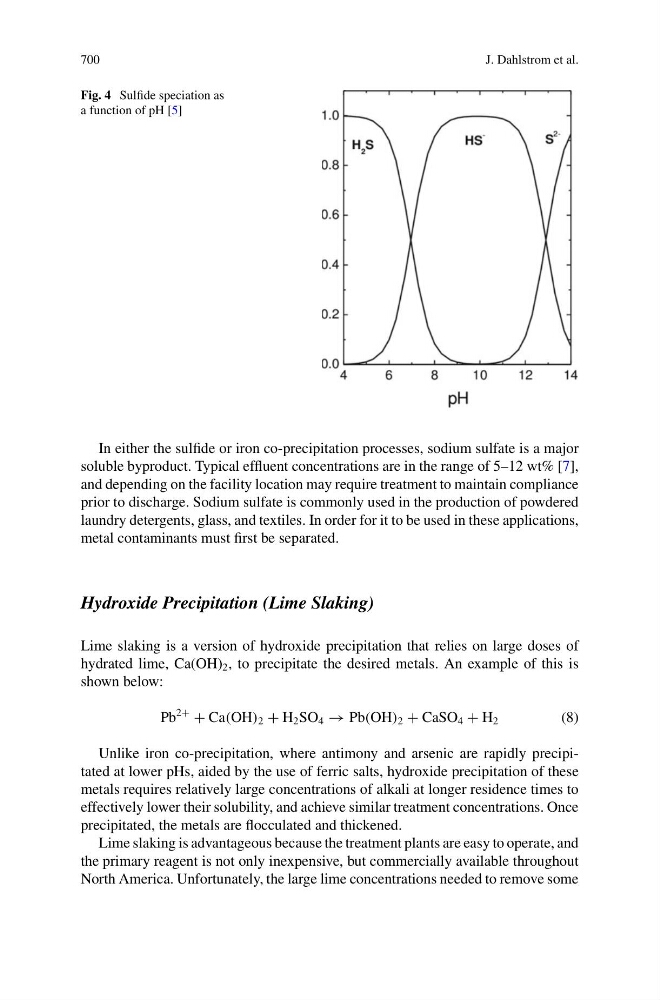
Fig. 4 Sulfide speciation as
a function of pH [5]
In either the sulfide or iron co-precipitation processes, sodium sulfate is a major
soluble byproduct. Typical effluent concentrations are in the range of 5–12 wt% [7],
and depending on the facility location may require treatment to maintain compliance
prior to discharge. Sodium sulfate is commonly used in the production of powdered
laundry detergents, glass, and textiles. In order for it to be used in these applications,
metal contaminants must first be separated.
Hydroxide Precipitation (Lime Slaking)
Lime slaking is a version of hydroxide precipitation that relies on large doses of
hydrated lime, Ca(OH) 2 , to precipitate the desired metals. An example of this is
shown below:
Pb
2+
+ Ca(OH) 2 + H 2 SO 4 → Pb(OH) 2 + CaSO 4 + H 2
(8)
Unlike iron co-precipitation, where antimony and arsenic are rapidly precipitated at lower pHs, aided by the use of ferric salts, hydroxide precipitation of these
metals requires relatively large concentrations of alkali at longer residence times to
effectively lower their solubility, and achieve similar treatment concentrations. Once
precipitated, the metals are flocculated and thickened.
Lime slaking is advantageous because the treatment plants are easy to operate, and
the primary reagent is not only inexpensive, but commercially available throughout
North America. Unfortunately, the large lime concentrations needed to remove some