

Review of Waste Water Treatment Technologies …
699
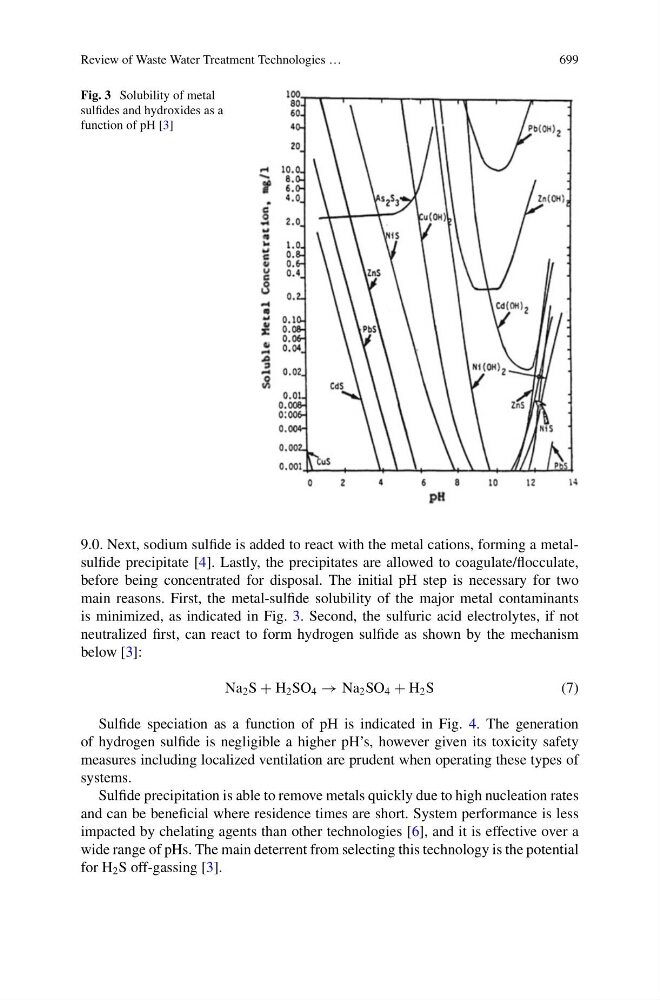
Fig. 3 Solubility of metal
sulfides and hydroxides as a
function of pH [3]
9.0. Next, sodium sulfide is added to react with the metal cations, forming a metalsulfide precipitate [4]. Lastly, the precipitates are allowed to coagulate/flocculate,
before being concentrated for disposal. The initial pH step is necessary for two
main reasons. First, the metal-sulfide solubility of the major metal contaminants
is minimized, as indicated in Fig. 3. Second, the sulfuric acid electrolytes, if not
neutralized first, can react to form hydrogen sulfide as shown by the mechanism
below [3]:
Na 2 S + H 2 SO 4 → Na 2 SO 4 + H 2 S
( 7 )
Sulfide speciation as a function of pH is indicated in Fig. 4. The generation
of hydrogen sulfide is negligible a higher pH’s, however given its toxicity safety
measures including localized ventilation are prudent when operating these types of
systems.
Sulfide precipitation is able to remove metals quickly due to high nucleation rates
and can be beneficial where residence times are short. System performance is less
impacted by chelating agents than other technologies [6], and it is effective over a
wide range of pHs. The main deterrent from selecting this technology is the potential
for H 2 S off-gassing [3].