

644
W. Zhang et al.
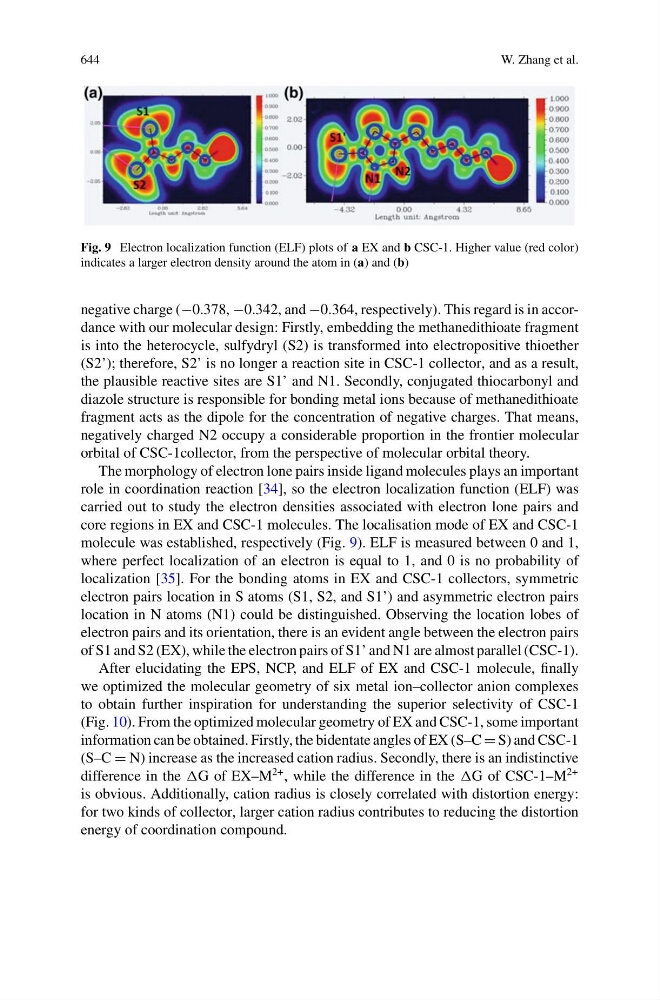
Fig. 9 Electron localization function (ELF) plots of a EX and b CSC-1. Higher value (red color)
indicates a larger electron density around the atom in (a) and (b)
negative charge (−0.378, −0.342, and −0.364, respectively). This regard is in accordance with our molecular design: Firstly, embedding the methanedithioate fragment
is into the heterocycle, sulfydryl (S2) is transformed into electropositive thioether
(S2’); therefore, S2’ is no longer a reaction site in CSC-1 collector, and as a result,
the plausible reactive sites are S1’ and N1. Secondly, conjugated thiocarbonyl and
diazole structure is responsible for bonding metal ions because of methanedithioate
fragment acts as the dipole for the concentration of negative charges. That means,
negatively charged N2 occupy a considerable proportion in the frontier molecular
orbital of CSC-1collector, from the perspective of molecular orbital theory.
The morphology of electron lone pairs inside ligand molecules plays an important
role in coordination reaction [34], so the electron localization function (ELF) was
carried out to study the electron densities associated with electron lone pairs and
core regions in EX and CSC-1 molecules. The localisation mode of EX and CSC-1
molecule was established, respectively (Fig. 9). ELF is measured between 0 and 1,
where perfect localization of an electron is equal to 1, and 0 is no probability of
localization [35]. For the bonding atoms in EX and CSC-1 collectors, symmetric
electron pairs location in S atoms (S1, S2, and S1’) and asymmetric electron pairs
location in N atoms (N1) could be distinguished. Observing the location lobes of
electron pairs and its orientation, there is an evident angle between the electron pairs
of S1 and S2 (EX), while the electron pairs of S1’ and N1 are almost parallel (CSC-1).
After elucidating the EPS, NCP, and ELF of EX and CSC-1 molecule, finally
we optimized the molecular geometry of six metal ion–collector anion complexes
to obtain further inspiration for understanding the superior selectivity of CSC-1
(Fig. 10). From the optimized molecular geometry of EX and CSC-1, some important
information can be obtained. Firstly, the bidentate angles of EX (S–C = S) and CSC-1
(S–C = N) increase as the increased cation radius. Secondly, there is an indistinctive
difference in the G of EX–M
2+ , while the difference in the G of CSC-1–M
2+
is obvious. Additionally, cation radius is closely correlated with distortion energy:
for two kinds of collector, larger cation radius contributes to reducing the distortion
energy of coordination compound.
W. Zhang et al.
Fig. 9 Electron localization function (ELF) plots of a EX and b CSC-1. Higher value (red color)
indicates a larger electron density around the atom in (a) and (b)
negative charge (−0.378, −0.342, and −0.364, respectively). This regard is in accordance with our molecular design: Firstly, embedding the methanedithioate fragment
is into the heterocycle, sulfydryl (S2) is transformed into electropositive thioether
(S2’); therefore, S2’ is no longer a reaction site in CSC-1 collector, and as a result,
the plausible reactive sites are S1’ and N1. Secondly, conjugated thiocarbonyl and
diazole structure is responsible for bonding metal ions because of methanedithioate
fragment acts as the dipole for the concentration of negative charges. That means,
negatively charged N2 occupy a considerable proportion in the frontier molecular
orbital of CSC-1collector, from the perspective of molecular orbital theory.
The morphology of electron lone pairs inside ligand molecules plays an important
role in coordination reaction [34], so the electron localization function (ELF) was
carried out to study the electron densities associated with electron lone pairs and
core regions in EX and CSC-1 molecules. The localisation mode of EX and CSC-1
molecule was established, respectively (Fig. 9). ELF is measured between 0 and 1,
where perfect localization of an electron is equal to 1, and 0 is no probability of
localization [35]. For the bonding atoms in EX and CSC-1 collectors, symmetric
electron pairs location in S atoms (S1, S2, and S1’) and asymmetric electron pairs
location in N atoms (N1) could be distinguished. Observing the location lobes of
electron pairs and its orientation, there is an evident angle between the electron pairs
of S1 and S2 (EX), while the electron pairs of S1’ and N1 are almost parallel (CSC-1).
After elucidating the EPS, NCP, and ELF of EX and CSC-1 molecule, finally
we optimized the molecular geometry of six metal ion–collector anion complexes
to obtain further inspiration for understanding the superior selectivity of CSC-1
(Fig. 10). From the optimized molecular geometry of EX and CSC-1, some important
information can be obtained. Firstly, the bidentate angles of EX (S–C = S) and CSC-1
(S–C = N) increase as the increased cation radius. Secondly, there is an indistinctive
difference in the G of EX–M
2+ , while the difference in the G of CSC-1–M
2+
is obvious. Additionally, cation radius is closely correlated with distortion energy:
for two kinds of collector, larger cation radius contributes to reducing the distortion
energy of coordination compound.