

A Novel Collector 5–(Butylthio)–1,3,4–Thiadiazole–2–Thiol …
643
Table 2 Zeta potential variations (mV) of pyrite, sphalerite, and galena in the presence of ethyl
xanthate (EX)/CSC-1 (1 × 10 −5 mol/L) at pH 8
Pyrite
Sphalerite
Galena
Ethyl xanthate (EX)
−8.5
−8.0
−12.0
CSC-1
−2.1
−18.3
−19.3
zeta potentials of sphalerite and galena significantly drop by 18.3 mV and 19.3 mV,
respectively, while that of pyrite trivially decrease by 2.1 mV.
DFT Calculations
Selective collecting ability of CSC-1 collector has been proven by flotation tests, contact angle measurements, and zeta potential measurements. In order to understand the
mechanism of the selectivity of CSC-1 collector, DFT calculations were carried out.
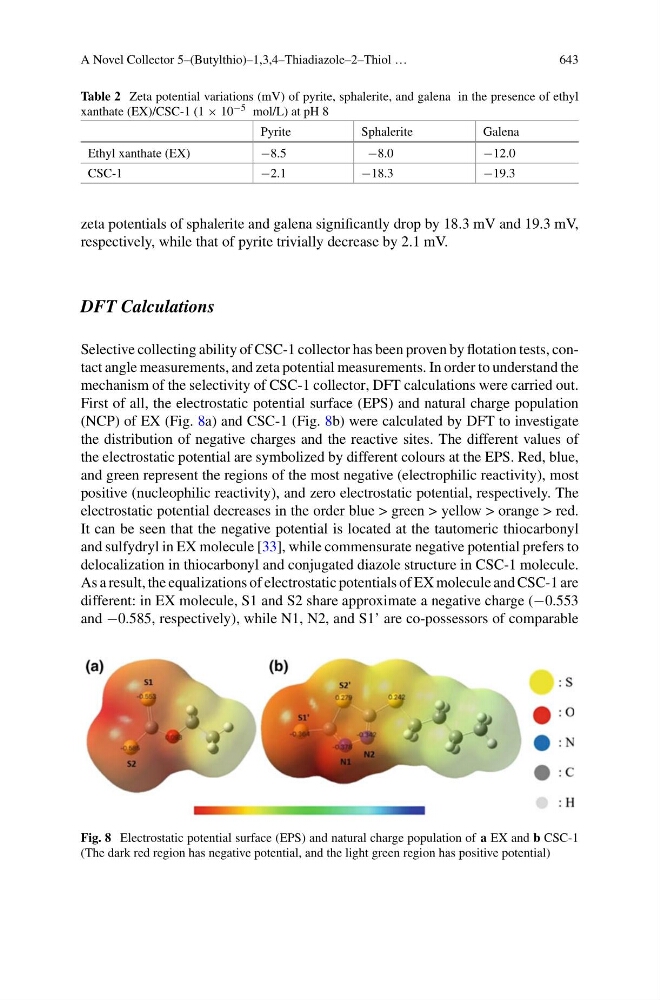
First of all, the electrostatic potential surface (EPS) and natural charge population
(NCP) of EX (Fig. 8a) and CSC-1 (Fig. 8b) were calculated by DFT to investigate
the distribution of negative charges and the reactive sites. The different values of
the electrostatic potential are symbolized by different colours at the EPS. Red, blue,
and green represent the regions of the most negative (electrophilic reactivity), most
positive (nucleophilic reactivity), and zero electrostatic potential, respectively. The
electrostatic potential decreases in the order blue > green > yellow > orange > red.
It can be seen that the negative potential is located at the tautomeric thiocarbonyl
and sulfydryl in EX molecule [33], while commensurate negative potential prefers to
delocalization in thiocarbonyl and conjugated diazole structure in CSC-1 molecule.
As a result, the equalizations of electrostatic potentials of EX molecule and CSC-1 are
different: in EX molecule, S1 and S2 share approximate a negative charge (−0.553
and −0.585, respectively), while N1, N2, and S1’ are co-possessors of comparable
Fig. 8 Electrostatic potential surface (EPS) and natural charge population of a EX and b CSC-1
(The dark red region has negative potential, and the light green region has positive potential)
643
Table 2 Zeta potential variations (mV) of pyrite, sphalerite, and galena in the presence of ethyl
xanthate (EX)/CSC-1 (1 × 10 −5 mol/L) at pH 8
Pyrite
Sphalerite
Galena
Ethyl xanthate (EX)
−8.5
−8.0
−12.0
CSC-1
−2.1
−18.3
−19.3
zeta potentials of sphalerite and galena significantly drop by 18.3 mV and 19.3 mV,
respectively, while that of pyrite trivially decrease by 2.1 mV.
DFT Calculations
Selective collecting ability of CSC-1 collector has been proven by flotation tests, contact angle measurements, and zeta potential measurements. In order to understand the
mechanism of the selectivity of CSC-1 collector, DFT calculations were carried out.
First of all, the electrostatic potential surface (EPS) and natural charge population
(NCP) of EX (Fig. 8a) and CSC-1 (Fig. 8b) were calculated by DFT to investigate
the distribution of negative charges and the reactive sites. The different values of
the electrostatic potential are symbolized by different colours at the EPS. Red, blue,
and green represent the regions of the most negative (electrophilic reactivity), most
positive (nucleophilic reactivity), and zero electrostatic potential, respectively. The
electrostatic potential decreases in the order blue > green > yellow > orange > red.
It can be seen that the negative potential is located at the tautomeric thiocarbonyl
and sulfydryl in EX molecule [33], while commensurate negative potential prefers to
delocalization in thiocarbonyl and conjugated diazole structure in CSC-1 molecule.
As a result, the equalizations of electrostatic potentials of EX molecule and CSC-1 are
different: in EX molecule, S1 and S2 share approximate a negative charge (−0.553
and −0.585, respectively), while N1, N2, and S1’ are co-possessors of comparable
Fig. 8 Electrostatic potential surface (EPS) and natural charge population of a EX and b CSC-1
(The dark red region has negative potential, and the light green region has positive potential)