

642
W. Zhang et al.
Zeta Potential Measurement
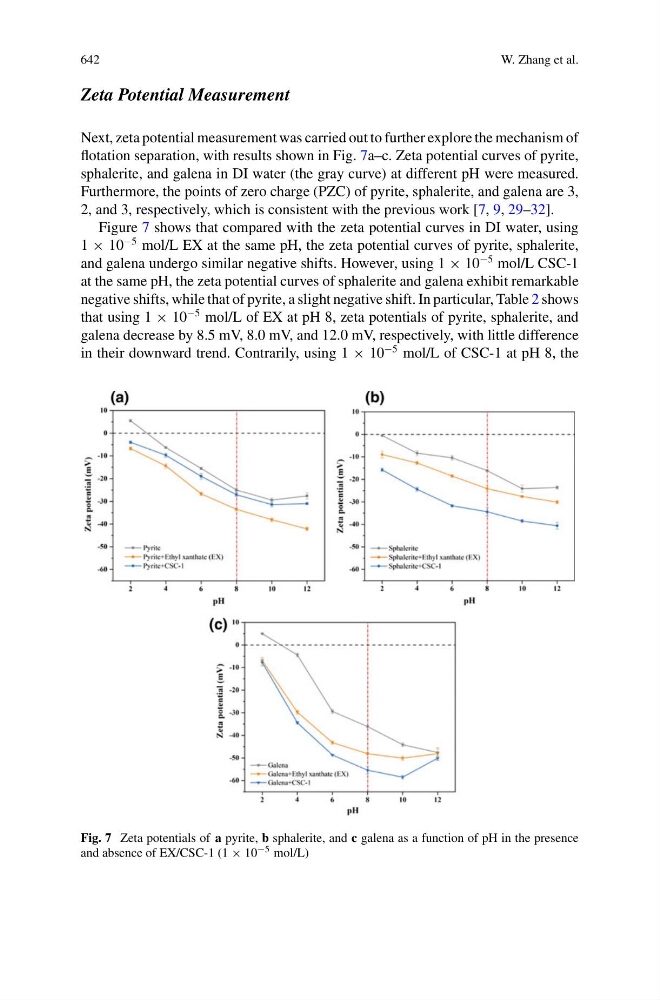
Next, zeta potential measurement was carried out to further explore the mechanism of
flotation separation, with results shown in Fig. 7a–c. Zeta potential curves of pyrite,
sphalerite, and galena in DI water (the gray curve) at different pH were measured.
Furthermore, the points of zero charge (PZC) of pyrite, sphalerite, and galena are 3,
2, and 3, respectively, which is consistent with the previous work [7, 9, 29–32].
Figure 7 shows that compared with the zeta potential curves in DI water, using
1 × 10
−5 mol/L EX at the same pH, the zeta potential curves of pyrite, sphalerite,
and galena undergo similar negative shifts. However, using 1 × 10
−5 mol/L CSC-1
at the same pH, the zeta potential curves of sphalerite and galena exhibit remarkable
negative shifts, while that of pyrite, a slight negative shift. In particular, Table 2 shows
that using 1 × 10
−5 mol/L of EX at pH 8, zeta potentials of pyrite, sphalerite, and
galena decrease by 8.5 mV, 8.0 mV, and 12.0 mV, respectively, with little difference
in their downward trend. Contrarily, using 1 × 10
−5 mol/L of CSC-1 at pH 8, the
Fig. 7 Zeta potentials of a pyrite, b sphalerite, and c galena as a function of pH in the presence
and absence of EX/CSC-1 (1 × 10 −5 mol/L)
W. Zhang et al.
Zeta Potential Measurement
Next, zeta potential measurement was carried out to further explore the mechanism of
flotation separation, with results shown in Fig. 7a–c. Zeta potential curves of pyrite,
sphalerite, and galena in DI water (the gray curve) at different pH were measured.
Furthermore, the points of zero charge (PZC) of pyrite, sphalerite, and galena are 3,
2, and 3, respectively, which is consistent with the previous work [7, 9, 29–32].
Figure 7 shows that compared with the zeta potential curves in DI water, using
1 × 10
−5 mol/L EX at the same pH, the zeta potential curves of pyrite, sphalerite,
and galena undergo similar negative shifts. However, using 1 × 10
−5 mol/L CSC-1
at the same pH, the zeta potential curves of sphalerite and galena exhibit remarkable
negative shifts, while that of pyrite, a slight negative shift. In particular, Table 2 shows
that using 1 × 10
−5 mol/L of EX at pH 8, zeta potentials of pyrite, sphalerite, and
galena decrease by 8.5 mV, 8.0 mV, and 12.0 mV, respectively, with little difference
in their downward trend. Contrarily, using 1 × 10
−5 mol/L of CSC-1 at pH 8, the
Fig. 7 Zeta potentials of a pyrite, b sphalerite, and c galena as a function of pH in the presence
and absence of EX/CSC-1 (1 × 10 −5 mol/L)