

A Novel Collector 5–(Butylthio)–1,3,4–Thiadiazole–2–Thiol …
641
ascendancy for the grades and recoveries of flotation concentrates than that of Zn
and Pb, when EX is the collector. Furthermore, the results of actual ore flotation tests
(Fig. 5b) indicate the satisfactory flotation recovery (85.6%), and moderate flotation
grade (20.5%) of Pb are obtained by CSC-1 collector, while other metal recoveries
are inferior with poor metal grades.
Contact Angle Measurement
In this study, the flotation results obtained are investigated by using the contact angle
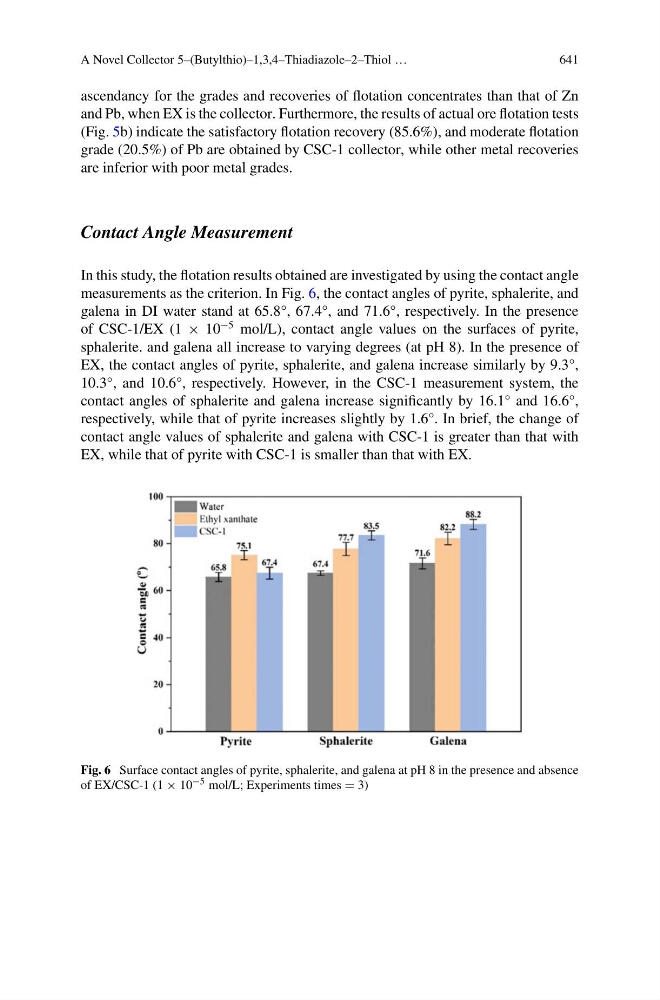
measurements as the criterion. In Fig. 6, the contact angles of pyrite, sphalerite, and
galena in DI water stand at 65.8°, 67.4°, and 71.6°, respectively. In the presence
of CSC-1/EX (1 × 10
−5 mol/L), contact angle values on the surfaces of pyrite,
sphalerite. and galena all increase to varying degrees (at pH 8). In the presence of
EX, the contact angles of pyrite, sphalerite, and galena increase similarly by 9.3°,
10.3°, and 10.6°, respectively. However, in the CSC-1 measurement system, the
contact angles of sphalerite and galena increase significantly by 16.1° and 16.6°,
respectively, while that of pyrite increases slightly by 1.6°. In brief, the change of
contact angle values of sphalerite and galena with CSC-1 is greater than that with
EX, while that of pyrite with CSC-1 is smaller than that with EX.
Fig. 6 Surface contact angles of pyrite, sphalerite, and galena at pH 8 in the presence and absence
of EX/CSC-1 (1 × 10 −5 mol/L; Experiments times = 3)
641
ascendancy for the grades and recoveries of flotation concentrates than that of Zn
and Pb, when EX is the collector. Furthermore, the results of actual ore flotation tests
(Fig. 5b) indicate the satisfactory flotation recovery (85.6%), and moderate flotation
grade (20.5%) of Pb are obtained by CSC-1 collector, while other metal recoveries
are inferior with poor metal grades.
Contact Angle Measurement
In this study, the flotation results obtained are investigated by using the contact angle
measurements as the criterion. In Fig. 6, the contact angles of pyrite, sphalerite, and
galena in DI water stand at 65.8°, 67.4°, and 71.6°, respectively. In the presence
of CSC-1/EX (1 × 10
−5 mol/L), contact angle values on the surfaces of pyrite,
sphalerite. and galena all increase to varying degrees (at pH 8). In the presence of
EX, the contact angles of pyrite, sphalerite, and galena increase similarly by 9.3°,
10.3°, and 10.6°, respectively. However, in the CSC-1 measurement system, the
contact angles of sphalerite and galena increase significantly by 16.1° and 16.6°,
respectively, while that of pyrite increases slightly by 1.6°. In brief, the change of
contact angle values of sphalerite and galena with CSC-1 is greater than that with
EX, while that of pyrite with CSC-1 is smaller than that with EX.
Fig. 6 Surface contact angles of pyrite, sphalerite, and galena at pH 8 in the presence and absence
of EX/CSC-1 (1 × 10 −5 mol/L; Experiments times = 3)