

A New Innovative Method of Flotation Separation for High Sulfur …
629
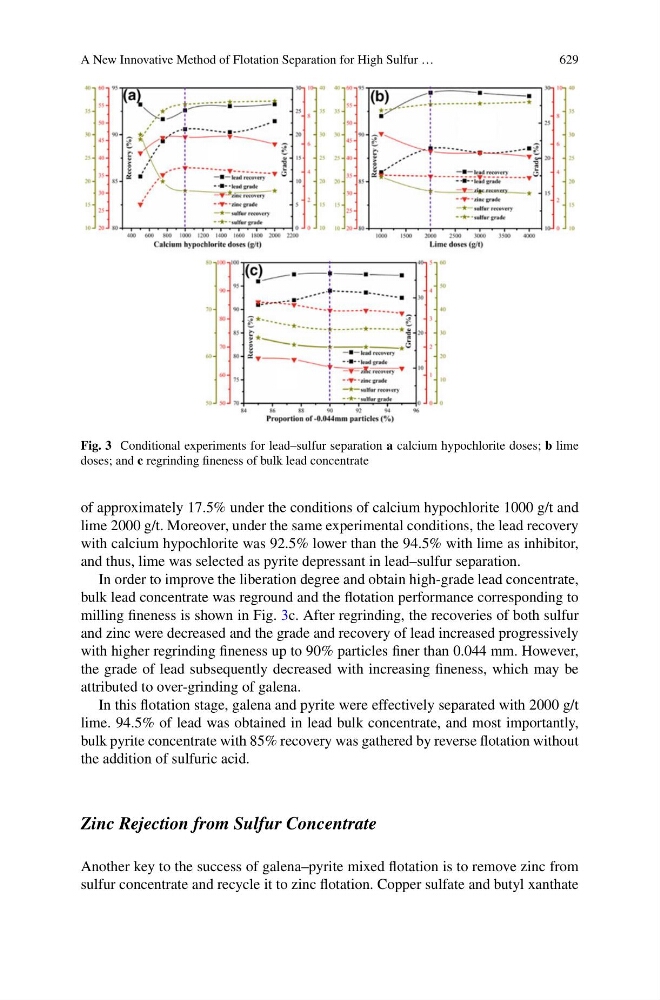
Fig. 3 Conditional experiments for lead–sulfur separation a calcium hypochlorite doses; b lime
doses; and c regrinding fineness of bulk lead concentrate
of approximately 17.5% under the conditions of calcium hypochlorite 1000 g/t and
lime 2000 g/t. Moreover, under the same experimental conditions, the lead recovery
with calcium hypochlorite was 92.5% lower than the 94.5% with lime as inhibitor,
and thus, lime was selected as pyrite depressant in lead–sulfur separation.
In order to improve the liberation degree and obtain high-grade lead concentrate,
bulk lead concentrate was reground and the flotation performance corresponding to
milling fineness is shown in Fig. 3c. After regrinding, the recoveries of both sulfur
and zinc were decreased and the grade and recovery of lead increased progressively
with higher regrinding fineness up to 90% particles finer than 0.044 mm. However,
the grade of lead subsequently decreased with increasing fineness, which may be
attributed to over-grinding of galena.
In this flotation stage, galena and pyrite were effectively separated with 2000 g/t
lime. 94.5% of lead was obtained in lead bulk concentrate, and most importantly,
bulk pyrite concentrate with 85% recovery was gathered by reverse flotation without
the addition of sulfuric acid.
Zinc Rejection from Sulfur Concentrate
Another key to the success of galena–pyrite mixed flotation is to remove zinc from
sulfur concentrate and recycle it to zinc flotation. Copper sulfate and butyl xanthate
629
Fig. 3 Conditional experiments for lead–sulfur separation a calcium hypochlorite doses; b lime
doses; and c regrinding fineness of bulk lead concentrate
of approximately 17.5% under the conditions of calcium hypochlorite 1000 g/t and
lime 2000 g/t. Moreover, under the same experimental conditions, the lead recovery
with calcium hypochlorite was 92.5% lower than the 94.5% with lime as inhibitor,
and thus, lime was selected as pyrite depressant in lead–sulfur separation.
In order to improve the liberation degree and obtain high-grade lead concentrate,
bulk lead concentrate was reground and the flotation performance corresponding to
milling fineness is shown in Fig. 3c. After regrinding, the recoveries of both sulfur
and zinc were decreased and the grade and recovery of lead increased progressively
with higher regrinding fineness up to 90% particles finer than 0.044 mm. However,
the grade of lead subsequently decreased with increasing fineness, which may be
attributed to over-grinding of galena.
In this flotation stage, galena and pyrite were effectively separated with 2000 g/t
lime. 94.5% of lead was obtained in lead bulk concentrate, and most importantly,
bulk pyrite concentrate with 85% recovery was gathered by reverse flotation without
the addition of sulfuric acid.
Zinc Rejection from Sulfur Concentrate
Another key to the success of galena–pyrite mixed flotation is to remove zinc from
sulfur concentrate and recycle it to zinc flotation. Copper sulfate and butyl xanthate