

630
C. Wang et al.
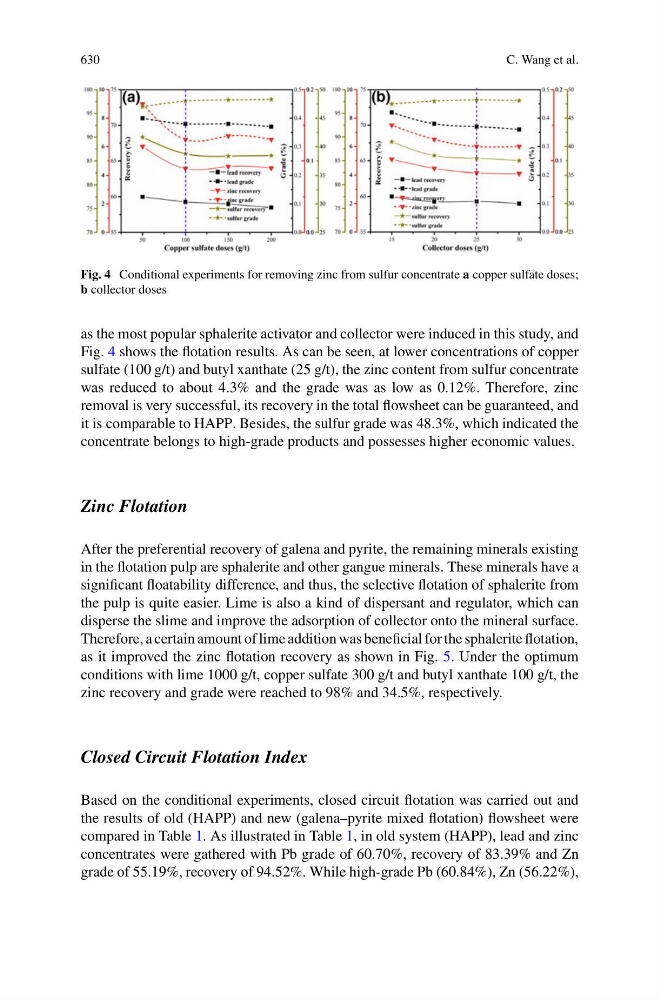
Fig. 4 Conditional experiments for removing zinc from sulfur concentrate a copper sulfate doses;
b collector doses
as the most popular sphalerite activator and collector were induced in this study, and
Fig. 4 shows the flotation results. As can be seen, at lower concentrations of copper
sulfate (100 g/t) and butyl xanthate (25 g/t), the zinc content from sulfur concentrate
was reduced to about 4.3% and the grade was as low as 0.12%. Therefore, zinc
removal is very successful, its recovery in the total flowsheet can be guaranteed, and
it is comparable to HAPP. Besides, the sulfur grade was 48.3%, which indicated the
concentrate belongs to high-grade products and possesses higher economic values.
Zinc Flotation
After the preferential recovery of galena and pyrite, the remaining minerals existing
in the flotation pulp are sphalerite and other gangue minerals. These minerals have a
significant floatability difference, and thus, the selective flotation of sphalerite from
the pulp is quite easier. Lime is also a kind of dispersant and regulator, which can
disperse the slime and improve the adsorption of collector onto the mineral surface.
Therefore, a certain amount of lime addition was beneficial for the sphalerite flotation,
as it improved the zinc flotation recovery as shown in Fig. 5. Under the optimum
conditions with lime 1000 g/t, copper sulfate 300 g/t and butyl xanthate 100 g/t, the
zinc recovery and grade were reached to 98% and 34.5%, respectively.
Closed Circuit Flotation Index
Based on the conditional experiments, closed circuit flotation was carried out and
the results of old (HAPP) and new (galena–pyrite mixed flotation) flowsheet were
compared in Table 1. As illustrated in Table 1, in old system (HAPP), lead and zinc
concentrates were gathered with Pb grade of 60.70%, recovery of 83.39% and Zn
grade of 55.19%, recovery of 94.52%. While high-grade Pb (60.84%), Zn (56.22%),
C. Wang et al.
Fig. 4 Conditional experiments for removing zinc from sulfur concentrate a copper sulfate doses;
b collector doses
as the most popular sphalerite activator and collector were induced in this study, and
Fig. 4 shows the flotation results. As can be seen, at lower concentrations of copper
sulfate (100 g/t) and butyl xanthate (25 g/t), the zinc content from sulfur concentrate
was reduced to about 4.3% and the grade was as low as 0.12%. Therefore, zinc
removal is very successful, its recovery in the total flowsheet can be guaranteed, and
it is comparable to HAPP. Besides, the sulfur grade was 48.3%, which indicated the
concentrate belongs to high-grade products and possesses higher economic values.
Zinc Flotation
After the preferential recovery of galena and pyrite, the remaining minerals existing
in the flotation pulp are sphalerite and other gangue minerals. These minerals have a
significant floatability difference, and thus, the selective flotation of sphalerite from
the pulp is quite easier. Lime is also a kind of dispersant and regulator, which can
disperse the slime and improve the adsorption of collector onto the mineral surface.
Therefore, a certain amount of lime addition was beneficial for the sphalerite flotation,
as it improved the zinc flotation recovery as shown in Fig. 5. Under the optimum
conditions with lime 1000 g/t, copper sulfate 300 g/t and butyl xanthate 100 g/t, the
zinc recovery and grade were reached to 98% and 34.5%, respectively.
Closed Circuit Flotation Index
Based on the conditional experiments, closed circuit flotation was carried out and
the results of old (HAPP) and new (galena–pyrite mixed flotation) flowsheet were
compared in Table 1. As illustrated in Table 1, in old system (HAPP), lead and zinc
concentrates were gathered with Pb grade of 60.70%, recovery of 83.39% and Zn
grade of 55.19%, recovery of 94.52%. While high-grade Pb (60.84%), Zn (56.22%),