

610
D. Fonseca et al.
magnesia-chromite specimens showed the highest wear in tests 1, 2, and 5, probably
due to the higher amount of CaO and SiO 2 in these slags. In addition, DBP presented
the highest resistance among the direct-bonded bricks in tests 1 and 5, most likely
due to its higher Cr 2 O 3 content.
Brick A showed lower wear resistance to slags with relatively high Na content
(tests 3 and 4 and 6) and higher resistance in tests 1, 2, and 5 compared to the directbonded bricks. This suggests that sodium plays an important role in the corrosion
mechanism of non-basic bricks under these test conditions.
Apart from A and DB, the specimens showed the lowest overall wear during
test 6, probably because this slag had the highest viscosity. The optical microscopy
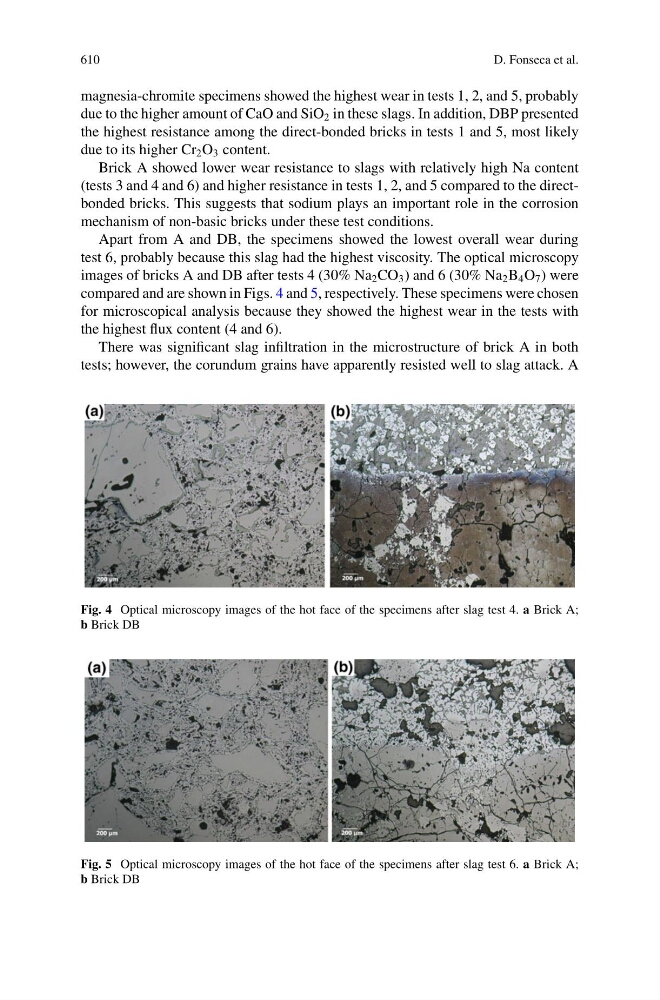
images of bricks A and DB after tests 4 (30% Na 2 CO 3 ) and 6 (30% Na 2 B 4 O 7 ) were
compared and are shown in Figs. 4 and 5, respectively. These specimens were chosen
for microscopical analysis because they showed the highest wear in the tests with
the highest flux content (4 and 6).
There was significant slag infiltration in the microstructure of brick A in both
tests; however, the corundum grains have apparently resisted well to slag attack. A
Fig. 4 Optical microscopy images of the hot face of the specimens after slag test 4. a Brick A;
b Brick DB
Fig. 5 Optical microscopy images of the hot face of the specimens after slag test 6. a Brick A;
b Brick DB
D. Fonseca et al.
magnesia-chromite specimens showed the highest wear in tests 1, 2, and 5, probably
due to the higher amount of CaO and SiO 2 in these slags. In addition, DBP presented
the highest resistance among the direct-bonded bricks in tests 1 and 5, most likely
due to its higher Cr 2 O 3 content.
Brick A showed lower wear resistance to slags with relatively high Na content
(tests 3 and 4 and 6) and higher resistance in tests 1, 2, and 5 compared to the directbonded bricks. This suggests that sodium plays an important role in the corrosion
mechanism of non-basic bricks under these test conditions.
Apart from A and DB, the specimens showed the lowest overall wear during
test 6, probably because this slag had the highest viscosity. The optical microscopy
images of bricks A and DB after tests 4 (30% Na 2 CO 3 ) and 6 (30% Na 2 B 4 O 7 ) were
compared and are shown in Figs. 4 and 5, respectively. These specimens were chosen
for microscopical analysis because they showed the highest wear in the tests with
the highest flux content (4 and 6).
There was significant slag infiltration in the microstructure of brick A in both
tests; however, the corundum grains have apparently resisted well to slag attack. A
Fig. 4 Optical microscopy images of the hot face of the specimens after slag test 4. a Brick A;
b Brick DB
Fig. 5 Optical microscopy images of the hot face of the specimens after slag test 6. a Brick A;
b Brick DB