

Refractory Corrosion Comparison Through …
611
Slag
Refractory
Reaction zone
Refractory
1
2
1
3
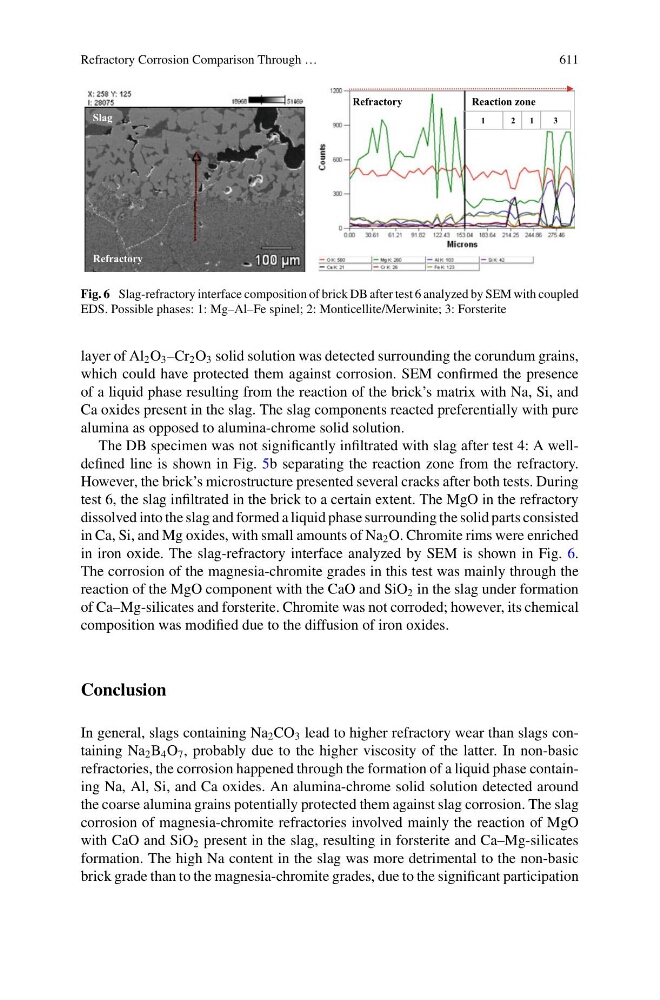
Fig. 6 Slag-refractory interface composition of brick DB after test 6 analyzed by SEM with coupled
EDS. Possible phases: 1: Mg–Al–Fe spinel; 2: Monticellite/Merwinite; 3: Forsterite
layer of Al 2 O 3 –Cr 2 O 3 solid solution was detected surrounding the corundum grains,
which could have protected them against corrosion. SEM confirmed the presence
of a liquid phase resulting from the reaction of the brick’s matrix with Na, Si, and
Ca oxides present in the slag. The slag components reacted preferentially with pure
alumina as opposed to alumina-chrome solid solution.
The DB specimen was not significantly infiltrated with slag after test 4: A welldefined line is shown in Fig. 5b separating the reaction zone from the refractory.
However, the brick’s microstructure presented several cracks after both tests. During
test 6, the slag infiltrated in the brick to a certain extent. The MgO in the refractory
dissolved into the slag and formed a liquid phase surrounding the solid parts consisted
in Ca, Si, and Mg oxides, with small amounts of Na 2 O. Chromite rims were enriched
in iron oxide. The slag-refractory interface analyzed by SEM is shown in Fig. 6.
The corrosion of the magnesia-chromite grades in this test was mainly through the
reaction of the MgO component with the CaO and SiO 2 in the slag under formation
of Ca–Mg-silicates and forsterite. Chromite was not corroded; however, its chemical
composition was modified due to the diffusion of iron oxides.
Conclusion
In general, slags containing Na 2 CO 3 lead to higher refractory wear than slags containing Na 2 B 4 O 7 , probably due to the higher viscosity of the latter. In non-basic
refractories, the corrosion happened through the formation of a liquid phase containing Na, Al, Si, and Ca oxides. An alumina-chrome solid solution detected around
the coarse alumina grains potentially protected them against slag corrosion. The slag
corrosion of magnesia-chromite refractories involved mainly the reaction of MgO
with CaO and SiO 2 present in the slag, resulting in forsterite and Ca–Mg-silicates
formation. The high Na content in the slag was more detrimental to the non-basic
brick grade than to the magnesia-chromite grades, due to the significant participation
611
Slag
Refractory
Reaction zone
Refractory
1
2
1
3
Fig. 6 Slag-refractory interface composition of brick DB after test 6 analyzed by SEM with coupled
EDS. Possible phases: 1: Mg–Al–Fe spinel; 2: Monticellite/Merwinite; 3: Forsterite
layer of Al 2 O 3 –Cr 2 O 3 solid solution was detected surrounding the corundum grains,
which could have protected them against corrosion. SEM confirmed the presence
of a liquid phase resulting from the reaction of the brick’s matrix with Na, Si, and
Ca oxides present in the slag. The slag components reacted preferentially with pure
alumina as opposed to alumina-chrome solid solution.
The DB specimen was not significantly infiltrated with slag after test 4: A welldefined line is shown in Fig. 5b separating the reaction zone from the refractory.
However, the brick’s microstructure presented several cracks after both tests. During
test 6, the slag infiltrated in the brick to a certain extent. The MgO in the refractory
dissolved into the slag and formed a liquid phase surrounding the solid parts consisted
in Ca, Si, and Mg oxides, with small amounts of Na 2 O. Chromite rims were enriched
in iron oxide. The slag-refractory interface analyzed by SEM is shown in Fig. 6.
The corrosion of the magnesia-chromite grades in this test was mainly through the
reaction of the MgO component with the CaO and SiO 2 in the slag under formation
of Ca–Mg-silicates and forsterite. Chromite was not corroded; however, its chemical
composition was modified due to the diffusion of iron oxides.
Conclusion
In general, slags containing Na 2 CO 3 lead to higher refractory wear than slags containing Na 2 B 4 O 7 , probably due to the higher viscosity of the latter. In non-basic
refractories, the corrosion happened through the formation of a liquid phase containing Na, Al, Si, and Ca oxides. An alumina-chrome solid solution detected around
the coarse alumina grains potentially protected them against slag corrosion. The slag
corrosion of magnesia-chromite refractories involved mainly the reaction of MgO
with CaO and SiO 2 present in the slag, resulting in forsterite and Ca–Mg-silicates
formation. The high Na content in the slag was more detrimental to the non-basic
brick grade than to the magnesia-chromite grades, due to the significant participation