

Refractory Solutions by Laboratory Tests and Fieldworks …
559
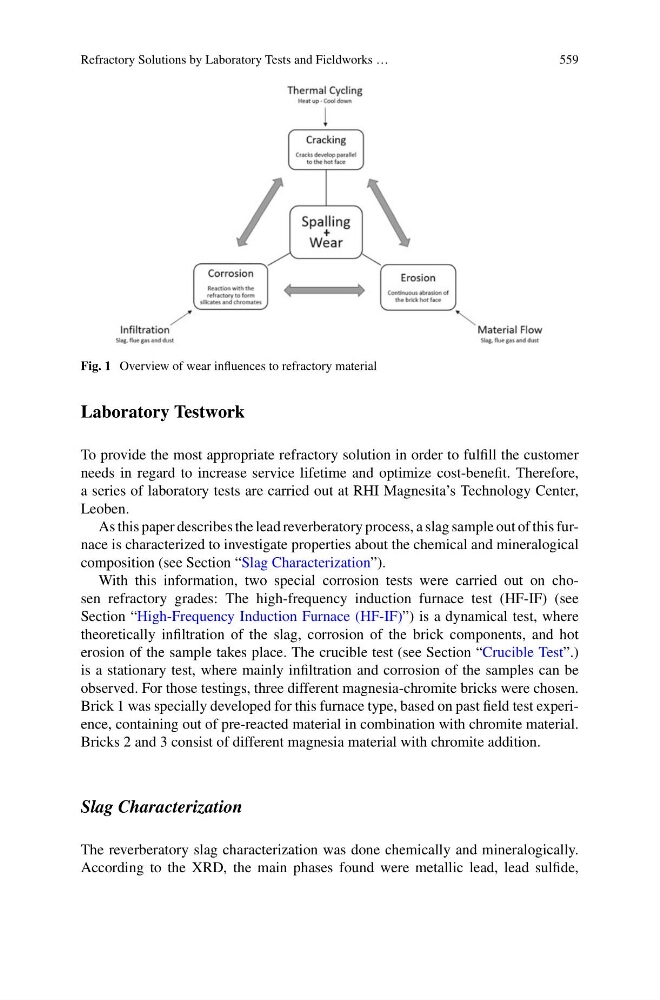
Fig. 1 Overview of wear influences to refractory material
Laboratory Testwork
To provide the most appropriate refractory solution in order to fulfill the customer
needs in regard to increase service lifetime and optimize cost-benefit. Therefore,
a series of laboratory tests are carried out at RHI Magnesita’s Technology Center,
Leoben.
As this paper describes the lead reverberatory process, a slag sample out of this furnace is characterized to investigate properties about the chemical and mineralogical
composition (see Section “Slag Characterization”).
With this information, two special corrosion tests were carried out on chosen refractory grades: The high-frequency induction furnace test (HF-IF) (see
Section “High-Frequency Induction Furnace (HF-IF)”) is a dynamical test, where
theoretically infiltration of the slag, corrosion of the brick components, and hot
erosion of the sample takes place. The crucible test (see Section “Crucible Test”.)
is a stationary test, where mainly infiltration and corrosion of the samples can be
observed. For those testings, three different magnesia-chromite bricks were chosen.
Brick 1 was specially developed for this furnace type, based on past field test experience, containing out of pre-reacted material in combination with chromite material.
Bricks 2 and 3 consist of different magnesia material with chromite addition.
Slag Characterization
The reverberatory slag characterization was done chemically and mineralogically.
According to the XRD, the main phases found were metallic lead, lead sulfide,
559
Fig. 1 Overview of wear influences to refractory material
Laboratory Testwork
To provide the most appropriate refractory solution in order to fulfill the customer
needs in regard to increase service lifetime and optimize cost-benefit. Therefore,
a series of laboratory tests are carried out at RHI Magnesita’s Technology Center,
Leoben.
As this paper describes the lead reverberatory process, a slag sample out of this furnace is characterized to investigate properties about the chemical and mineralogical
composition (see Section “Slag Characterization”).
With this information, two special corrosion tests were carried out on chosen refractory grades: The high-frequency induction furnace test (HF-IF) (see
Section “High-Frequency Induction Furnace (HF-IF)”) is a dynamical test, where
theoretically infiltration of the slag, corrosion of the brick components, and hot
erosion of the sample takes place. The crucible test (see Section “Crucible Test”.)
is a stationary test, where mainly infiltration and corrosion of the samples can be
observed. For those testings, three different magnesia-chromite bricks were chosen.
Brick 1 was specially developed for this furnace type, based on past field test experience, containing out of pre-reacted material in combination with chromite material.
Bricks 2 and 3 consist of different magnesia material with chromite addition.
Slag Characterization
The reverberatory slag characterization was done chemically and mineralogically.
According to the XRD, the main phases found were metallic lead, lead sulfide,