

560
K. Reinharter et al.
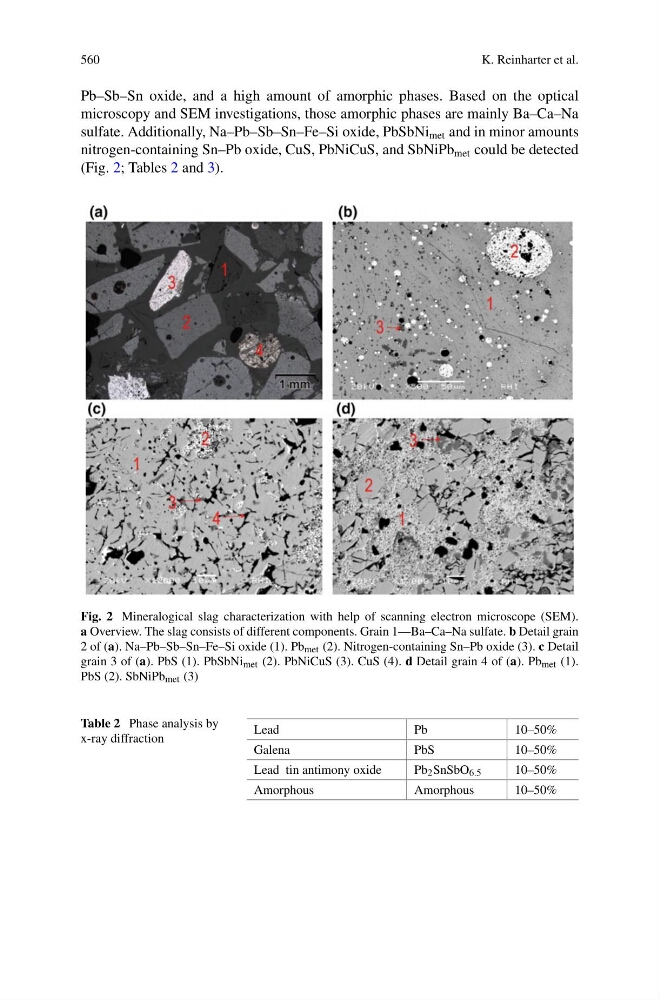
Pb–Sb–Sn oxide, and a high amount of amorphic phases. Based on the optical
microscopy and SEM investigations, those amorphic phases are mainly Ba–Ca–Na
sulfate. Additionally, Na–Pb–Sb–Sn–Fe–Si oxide, PbSbNi met and in minor amounts
nitrogen-containing Sn–Pb oxide, CuS, PbNiCuS, and SbNiPb met could be detected
(Fig. 2; Tables 2 and 3).
Fig. 2 Mineralogical slag characterization with help of scanning electron microscope (SEM).
a Overview. The slag consists of different components. Grain 1—Ba–Ca–Na sulfate. b Detail grain
2 of (a). Na–Pb–Sb–Sn–Fe–Si oxide (1). Pb met (2). Nitrogen-containing Sn–Pb oxide (3). c Detail
grain 3 of (a). PbS (1). PbSbNi met (2). PbNiCuS (3). CuS (4). d Detail grain 4 of (a). Pb met (1).
PbS (2). SbNiPb met (3)
Table 2 Phase analysis by
x-ray diffraction
Lead
Pb
10–50%
Galena
PbS
10–50%
Lead tin antimony oxide
Pb 2 SnSbO 6.5
10–50%
Amorphous
Amorphous
10–50%
K. Reinharter et al.
Pb–Sb–Sn oxide, and a high amount of amorphic phases. Based on the optical
microscopy and SEM investigations, those amorphic phases are mainly Ba–Ca–Na
sulfate. Additionally, Na–Pb–Sb–Sn–Fe–Si oxide, PbSbNi met and in minor amounts
nitrogen-containing Sn–Pb oxide, CuS, PbNiCuS, and SbNiPb met could be detected
(Fig. 2; Tables 2 and 3).
Fig. 2 Mineralogical slag characterization with help of scanning electron microscope (SEM).
a Overview. The slag consists of different components. Grain 1—Ba–Ca–Na sulfate. b Detail grain
2 of (a). Na–Pb–Sb–Sn–Fe–Si oxide (1). Pb met (2). Nitrogen-containing Sn–Pb oxide (3). c Detail
grain 3 of (a). PbS (1). PbSbNi met (2). PbNiCuS (3). CuS (4). d Detail grain 4 of (a). Pb met (1).
PbS (2). SbNiPb met (3)
Table 2 Phase analysis by
x-ray diffraction
Lead
Pb
10–50%
Galena
PbS
10–50%
Lead tin antimony oxide
Pb 2 SnSbO 6.5
10–50%
Amorphous
Amorphous
10–50%