

558
K. Reinharter et al.
or two-stage smelting, which mainly differs on implemented process flow sheet in
combination with used furnace types and technologies. For one-stage smelting, the
typical furnaces are reverberatory, blast, and rotary furnace. For two-stage processing, common furnace combinations are reverberatory + blast, rotary or electric arc
furnace, and bottom-blown oxygen furnace + blast furnace [2–6].
This paper deals with laboratory test and industrial field trials of customized
refractory materials for the reverberatory furnace process. Stationary reverb furnaces
have been historically used in North America for the production of secondary lead.
They are reliable, highly productive furnaces allowing for continuous smelting.
The main input of the reverberatory furnace is battery scrap combined with reductants such as metallurgical coke. The furnace is operated with a gas-air burner, and
under oxidizing atmosphere for oxidation of the carbonaceous materials, sulfur and
other alloying elements like Ca, Al, Sb, As, Sn, etc. contained in battery scrap [2]. In
fuel-fired furnaces, which are most common in the secondary lead industry, flames
extend from the end wall to the furnace hearth or from the roof to the bath. The role
of the refractory is paramount as part of the heat is also reverberated by radiation
from the roof and the side walls. Reverberatory furnaces produce a soft lead (99%
+ Pb) and slag which is very rich in lead (30–50% + PbO) and other metallics. This
slag needs to be further processed for optimal lead recovery as well as production of
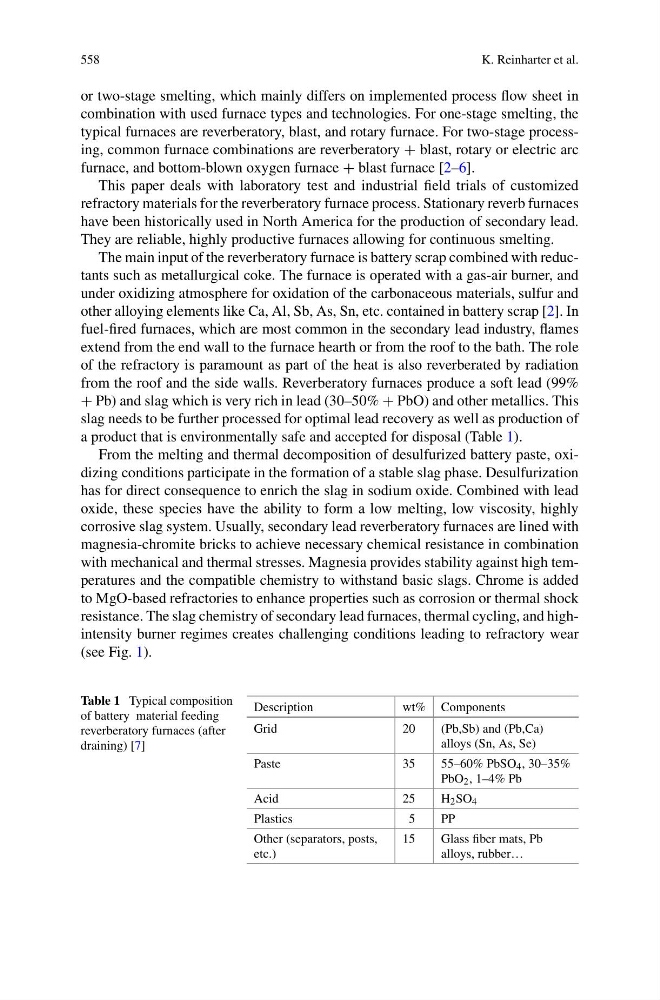
a product that is environmentally safe and accepted for disposal (Table 1).
From the melting and thermal decomposition of desulfurized battery paste, oxidizing conditions participate in the formation of a stable slag phase. Desulfurization
has for direct consequence to enrich the slag in sodium oxide. Combined with lead
oxide, these species have the ability to form a low melting, low viscosity, highly
corrosive slag system. Usually, secondary lead reverberatory furnaces are lined with
magnesia-chromite bricks to achieve necessary chemical resistance in combination
with mechanical and thermal stresses. Magnesia provides stability against high temperatures and the compatible chemistry to withstand basic slags. Chrome is added
to MgO-based refractories to enhance properties such as corrosion or thermal shock
resistance. The slag chemistry of secondary lead furnaces, thermal cycling, and highintensity burner regimes creates challenging conditions leading to refractory wear
(see Fig. 1).
Table 1 Typical composition
of battery material feeding
reverberatory furnaces (after
draining) [7]
Description
wt% Components
Grid
20
(Pb,Sb) and (Pb,Ca)
alloys (Sn, As, Se)
Paste
35
55–60% PbSO 4 , 30–35%
PbO 2 , 1–4% Pb
Acid
25
H 2 SO 4
Plastics
5
PP
Other (separators, posts,
etc.)
15
Glass fiber mats, Pb
alloys, rubber…
K. Reinharter et al.
or two-stage smelting, which mainly differs on implemented process flow sheet in
combination with used furnace types and technologies. For one-stage smelting, the
typical furnaces are reverberatory, blast, and rotary furnace. For two-stage processing, common furnace combinations are reverberatory + blast, rotary or electric arc
furnace, and bottom-blown oxygen furnace + blast furnace [2–6].
This paper deals with laboratory test and industrial field trials of customized
refractory materials for the reverberatory furnace process. Stationary reverb furnaces
have been historically used in North America for the production of secondary lead.
They are reliable, highly productive furnaces allowing for continuous smelting.
The main input of the reverberatory furnace is battery scrap combined with reductants such as metallurgical coke. The furnace is operated with a gas-air burner, and
under oxidizing atmosphere for oxidation of the carbonaceous materials, sulfur and
other alloying elements like Ca, Al, Sb, As, Sn, etc. contained in battery scrap [2]. In
fuel-fired furnaces, which are most common in the secondary lead industry, flames
extend from the end wall to the furnace hearth or from the roof to the bath. The role
of the refractory is paramount as part of the heat is also reverberated by radiation
from the roof and the side walls. Reverberatory furnaces produce a soft lead (99%
+ Pb) and slag which is very rich in lead (30–50% + PbO) and other metallics. This
slag needs to be further processed for optimal lead recovery as well as production of
a product that is environmentally safe and accepted for disposal (Table 1).
From the melting and thermal decomposition of desulfurized battery paste, oxidizing conditions participate in the formation of a stable slag phase. Desulfurization
has for direct consequence to enrich the slag in sodium oxide. Combined with lead
oxide, these species have the ability to form a low melting, low viscosity, highly
corrosive slag system. Usually, secondary lead reverberatory furnaces are lined with
magnesia-chromite bricks to achieve necessary chemical resistance in combination
with mechanical and thermal stresses. Magnesia provides stability against high temperatures and the compatible chemistry to withstand basic slags. Chrome is added
to MgO-based refractories to enhance properties such as corrosion or thermal shock
resistance. The slag chemistry of secondary lead furnaces, thermal cycling, and highintensity burner regimes creates challenging conditions leading to refractory wear
(see Fig. 1).
Table 1 Typical composition
of battery material feeding
reverberatory furnaces (after
draining) [7]
Description
wt% Components
Grid
20
(Pb,Sb) and (Pb,Ca)
alloys (Sn, As, Se)
Paste
35
55–60% PbSO 4 , 30–35%
PbO 2 , 1–4% Pb
Acid
25
H 2 SO 4
Plastics
5
PP
Other (separators, posts,
etc.)
15
Glass fiber mats, Pb
alloys, rubber…