

440
J. Antrekowitsch and G. Hanke
top blown rotary converters are the furnaces of choice, dependent, if a continuous or
batch process is preferred. In the case of homogeneous dumps, a continuous operating
rotary kiln would be favorable due to positive aspects for the off-gas treatment and
higher throughputs. In the case of inhomogeneous material, a batch process would
help to treat the material under more flexible and therefore optimized conditions.
The calcine is then charged, preferably in hot stage, into an electric furnace where
it is molten and reduced on a lead bath. Quartz and carbon carriers are added. The
metal bath collects most of the lead, copper as well as silver and gold, if present.
Zinc oxide is reduced, zinc evaporates and re-oxidizes in the off-gas. If indium is
also part of the jarosite, it most likely follows the zinc into the dust. A simplified
process scheme is shown in Fig. 2.
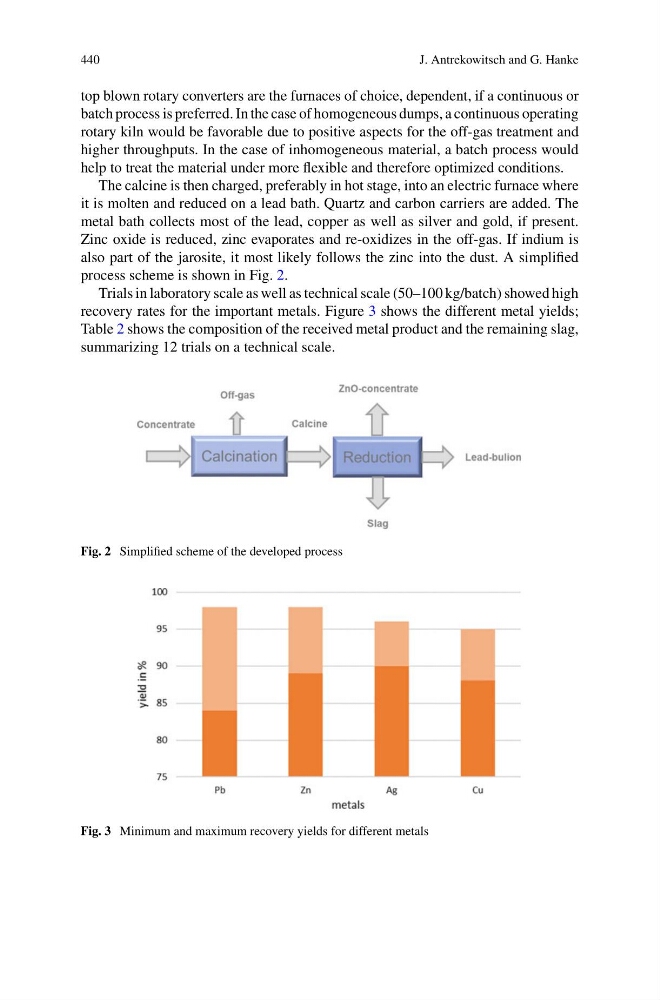
Trials in laboratory scale as well as technical scale (50–100 kg/batch) showed high
recovery rates for the important metals. Figure 3 shows the different metal yields;
Table 2 shows the composition of the received metal product and the remaining slag,
summarizing 12 trials on a technical scale.
Fig. 2 Simplified scheme of the developed process
Fig. 3 Minimum and maximum recovery yields for different metals
J. Antrekowitsch and G. Hanke
top blown rotary converters are the furnaces of choice, dependent, if a continuous or
batch process is preferred. In the case of homogeneous dumps, a continuous operating
rotary kiln would be favorable due to positive aspects for the off-gas treatment and
higher throughputs. In the case of inhomogeneous material, a batch process would
help to treat the material under more flexible and therefore optimized conditions.
The calcine is then charged, preferably in hot stage, into an electric furnace where
it is molten and reduced on a lead bath. Quartz and carbon carriers are added. The
metal bath collects most of the lead, copper as well as silver and gold, if present.
Zinc oxide is reduced, zinc evaporates and re-oxidizes in the off-gas. If indium is
also part of the jarosite, it most likely follows the zinc into the dust. A simplified
process scheme is shown in Fig. 2.
Trials in laboratory scale as well as technical scale (50–100 kg/batch) showed high
recovery rates for the important metals. Figure 3 shows the different metal yields;
Table 2 shows the composition of the received metal product and the remaining slag,
summarizing 12 trials on a technical scale.
Fig. 2 Simplified scheme of the developed process
Fig. 3 Minimum and maximum recovery yields for different metals