

244
S. Nagraj et al.
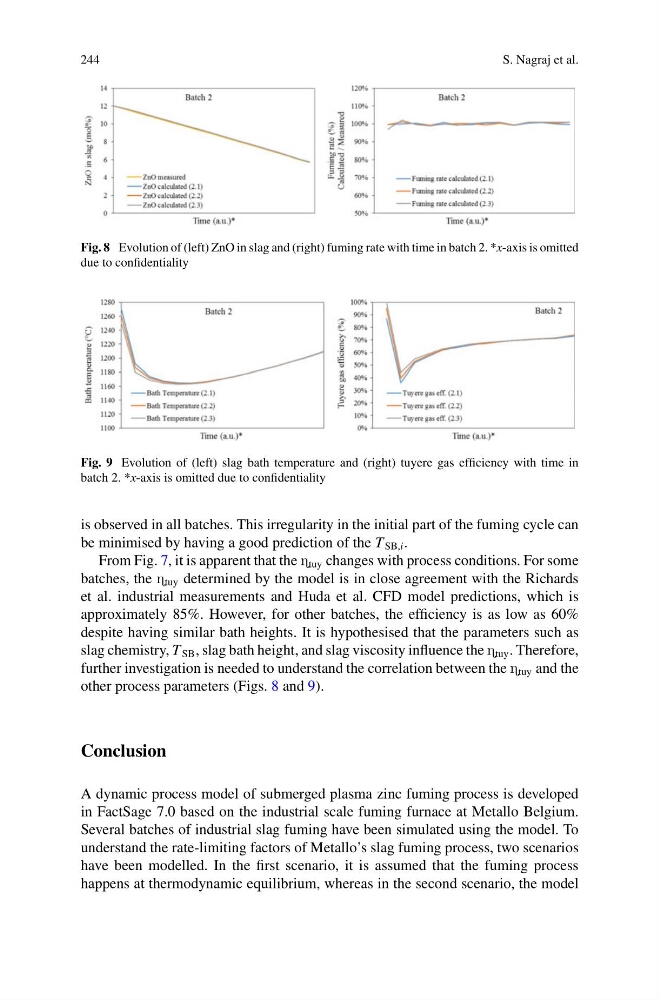
Fig. 8 Evolution of (left) ZnO in slag and (right) fuming rate with time in batch 2. *x-axis is omitted
due to confidentiality
Fig. 9 Evolution of (left) slag bath temperature and (right) tuyere gas efficiency with time in
batch 2. *x-axis is omitted due to confidentiality
is observed in all batches. This irregularity in the initial part of the fuming cycle can
be minimised by having a good prediction of the T SB,i .
From Fig. 7, it is apparent that the ï tuy changes with process conditions. For some
batches, the ï tuy determined by the model is in close agreement with the Richards
et al. industrial measurements and Huda et al. CFD model predictions, which is
approximately 85%. However, for other batches, the efficiency is as low as 60%
despite having similar bath heights. It is hypothesised that the parameters such as
slag chemistry, T SB , slag bath height, and slag viscosity influence the ï tuy . Therefore,
further investigation is needed to understand the correlation between the ï tuy and the
other process parameters (Figs. 8 and 9).
Conclusion
A dynamic process model of submerged plasma zinc fuming process is developed
in FactSage 7.0 based on the industrial scale fuming furnace at Metallo Belgium.
Several batches of industrial slag fuming have been simulated using the model. To
understand the rate-limiting factors of Metallo’s slag fuming process, two scenarios
have been modelled. In the first scenario, it is assumed that the fuming process
happens at thermodynamic equilibrium, whereas in the second scenario, the model
S. Nagraj et al.
Fig. 8 Evolution of (left) ZnO in slag and (right) fuming rate with time in batch 2. *x-axis is omitted
due to confidentiality
Fig. 9 Evolution of (left) slag bath temperature and (right) tuyere gas efficiency with time in
batch 2. *x-axis is omitted due to confidentiality
is observed in all batches. This irregularity in the initial part of the fuming cycle can
be minimised by having a good prediction of the T SB,i .
From Fig. 7, it is apparent that the ï tuy changes with process conditions. For some
batches, the ï tuy determined by the model is in close agreement with the Richards
et al. industrial measurements and Huda et al. CFD model predictions, which is
approximately 85%. However, for other batches, the efficiency is as low as 60%
despite having similar bath heights. It is hypothesised that the parameters such as
slag chemistry, T SB , slag bath height, and slag viscosity influence the ï tuy . Therefore,
further investigation is needed to understand the correlation between the ï tuy and the
other process parameters (Figs. 8 and 9).
Conclusion
A dynamic process model of submerged plasma zinc fuming process is developed
in FactSage 7.0 based on the industrial scale fuming furnace at Metallo Belgium.
Several batches of industrial slag fuming have been simulated using the model. To
understand the rate-limiting factors of Metallo’s slag fuming process, two scenarios
have been modelled. In the first scenario, it is assumed that the fuming process
happens at thermodynamic equilibrium, whereas in the second scenario, the model